

A Creature Whose Very Existence Testifies to a Designer
New York (VINNEWS/Rabbi Yair Hoffman) Every creature in the natural world is a mofes, a living testimony to the chochmah of the Borei Olam. But some creatures testify louder than others. Some, when examined honestly, simply cannot be explained by any process of slow, gradual, unguided change. They demand a Designer. The secretary bird — Sagittarius serpentarius — is one of these.
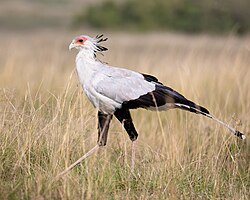
Walking the open savannas of sub-Saharan Africa on absurdly long legs, crowned with a spray of dark quill-like feathers that look like the goose quills a scribe once tucked behind his ear, this bird does something no other raptor on earth does. It hunts venomous snakes — cobras, mambas, vipers — by kicking them to death. And not with ordinary kicks. With kicks so fast, so forceful, and so neurologically demanding that they strain the very limits of what biology can do.
A Predator Built for a Task
The open grasslands where the secretary bird lives offer no cover. There are no trees from which to ambush prey, no thick canopy to dive through. Rodents, lizards, and snakes move through the tall grass, briefly exposed and then hidden again. The classic raptor strategy — spot, dive, seize with talons – does not work here.
So the secretary bird walks. It strides through the grass, flushing out prey. And when a snake rears up to strike, the bird strikes first.
Its legs are long enough to keep its body just beyond the snake’s lunging range. Its foot comes down on the snake’s head — the one target that reliably neutralizes the threat — with devastating force. Miss by an inch, and a fanged mouth full of neurotoxic venom finds a leg. Strike correctly, and dinner is served.
This is a precision weapon system no different than the new Lockheed Martin Precision Strike Missile (PrSM) just used against Iran.
The Numbers That Should Stop Us Cold
A 2016 study published in Current Biology put the secretary bird’s kick under the microscope. Researchers trained a male bird named Madeleine at the Hawk Conservancy Trust in England to strike at a rubber snake fitted with instruments, and the results were extraordinary.
The average peak force of a kick: roughly five times the bird’s body weight — about 195 newtons from an animal weighing less than four kilograms. The duration of contact with the target: approximately 15 milliseconds. That is not a typo. Fifteen one-thousandths of a second.
To appreciate what this means, consider that the adult human nervous system takes between 200 and 300 milliseconds to process tactile information and issue a corrective motor response. The secretary bird’s entire strike — impact, force delivery, withdrawal — is complete in less than one-twentieth the time it takes a person to even register that something has touched their skin.
The researchers drew the obvious conclusion: the bird cannot possibly be using real-time sensory feedback to guide the kick. There is no time. The entire motion must be planned, aimed, and committed to before it begins. The bird’s brain effectively fires a ballistic missile at a moving snake’s head — and hits.
Why This Speed Could Not Have Evolved Gradually
Here is where the story turns from remarkable to impossible — at least, impossible within the framework of slow, random, step-by-step change.
The standard evolutionary model taught holds that complex behaviors emerge incrementally. A mutation produces a slightly longer leg. That leg confers a tiny survival advantage. Over generations, longer legs accumulate. Somewhere along the way, the bird begins kicking prey. Kicks become stronger. Aim improves. And eventually, after countless generations, you arrive at the modern secretary bird.
But apply that logic honestly to what the 2016 study actually measured, and the whole edifice collapses.
Consider what the secretary bird’s kick requires, simultaneously, in order to function at all:
First, legs long enough to reach beyond a striking snake’s range. A slightly longer leg does not help. The leg must be long enough, specifically, to exceed the lunge distance of a cobra. Shorter legs put the bird in the kill zone.
Second, muscular and skeletal architecture capable of generating five times body weight in peak force. Bones must be reinforced at the same time as tendons must be tuned like springs. Joint geometry must permit the motion. A bird with the legs but not the musculature produces a weak slap, not a killing blow.
Third, a nervous system capable of pre-programmed ballistic targeting. The entire strike unfolds faster than feedback can travel from foot to brain and back. This means the visual system must predict where the snake’s head will be, compute the required trajectory, and fire the motor command — all before contact. A bird that kicks “mostly right” at a cobra dies.
Fourth, the behavioral instinct to kick the head specifically. A kick aimed at the body of a cobra leaves the head free to strike back. A kick aimed at the head must be hardwired, not learned, because learning requires surviving mistakes — and there are no surviving mistakes when the teacher is a mamba.
Fifth, scaled armored feet. An ordinary foot, unprotected, would be punctured on the first encounter. The secretary bird’s feet carry specialized scaling to absorb fang pressure.
Now ask the honest question: which came first?
Long legs alone provide no benefit — they only put the bird closer to snakes it cannot yet kill. Strong leg muscles without the neural targeting system produce only a clumsy stomp. Neural targeting without the musculoskeletal hardware produces a beautifully aimed kick that bounces off. Armored feet without any of the rest are just oddly thick feet on a bird that doesn’t hunt snakes. The instinct to aim at a cobra’s head, absent every other component, is a suicide program.
Each component is useless — actively lethal, in fact — without all the others already in place. This is what the philosopher of biology Michael Behe called irreducible complexity, but one does not need Behe to see it. One needs only honesty. A system that must be complete to function cannot be assembled one random mutation at a time, because the intermediate stages do not help the bird survive. They kill it.
And the speed itself — that fifteen-millisecond window — seals the case. Speed that exceeds the nervous system’s feedback loop is not something a bird can gradually “get better at.” Either the entire predictive-ballistic neural architecture is in place, or the bird is operating blind against a venomous snake. There is no slow improvement from sighted feedback-guided kicking to blind predictive kicking, because feedback-guided kicking at a snake is itself a death sentence at these timescales.
Yad Hashem — The Signature on the Work
The Rambam, in Hilchos Yesodei HaTorah (2:2), teaches that the path to ahavas Hashem and yiras Hashem runs directly through the contemplation of His creations: “When a person contemplates His wondrous and great works and creatures, and sees through them His wisdom which has no measure and no end — immediately he loves and praises and glorifies, and desires with a great desire to know the great Name.”
The Chovos HaLevavos devotes the entire Shaar HaBechinah to this avodah — the service of examining creation and drawing from it emunah in the Creator. The Rabbeinu Bachya writes there that every creature is a letter in a vast sefer, and that one who fails to read these letters has squandered the clearest proof of Hashem’s existence available to the human mind.
The secretary bird is such a letter.
Its long legs, its armored feet, its pre-programmed neural targeting, its hardwired instinct to strike the head of a venomous snake — each piece fits the others with the precision of a Master Engineer’s drafting. Remove any one piece and the animal cannot exist in its niche. Assemble all the pieces at once, in coordinated perfection, and you have a creature that walks the African grasslands as a living refutation of blind chance.
Secular biology calls this “convergent specialization” and moves on.
But the language papers over the problem rather than solving it. Naming a phenomenon is not explaining it. The question remains: how does a process that works by tiny, cumulative, random changes produce a system in which no intermediate stage is survivable? The honest answer is that it does not.
Such a system must be designed.
The Gemara in Chullin (127a) observes that Hashem filled His world with creatures of every kind to demonstrate His greatness, and that each one has something to teach. The secretary bird teaches something particular. It teaches that the chochmah of the Borei is not a vague, diffuse cleverness visible only in the large-scale beauty of the cosmos. It is a specific, engineered, mathematically quantifiable precision visible in the tendons of a bird’s leg and the timing circuits of its brain.
Yad Hashem is visible in the data.
What the Secretary Bird Asks of Us
When Dovid HaMelech stood before the creations of Hashem and sang “mah rabu maasecha,” he was explaining that the honest examination of a single creature is sufficient to drive a thinking human being to praise. The Malbim, commenting on this posuk, emphasizes the word “kulam” — all of them. Not merely the grand and obvious. Every one.
A bird kicks a cobra in the head at a speed faster than its own nervous system can consciously monitor. Every element of its anatomy, musculature, nervous system, and instinct is tuned to this single task, and every element is useless without the others. There is no gradual pathway from an ordinary bird to this one. There is only the design, complete, handed down from the Maker of birds and snakes and grasslands alike.
Mah rabu maasecha Hashem. Kulam b’chochmah asisa. How manifold are Your works, Hashem. All of them — including this strange, stalking, long-legged prophet of Your wisdom — in chochmah You made them all.
———
Rabbi Yair Hoffman can be reached at [email protected]