
 Matzav
Trump Says He ‘Will Not Be Rushed’ To End Iran War, Lashes Out At Pols Urging Him To Settle: ‘Helping The Other Side’
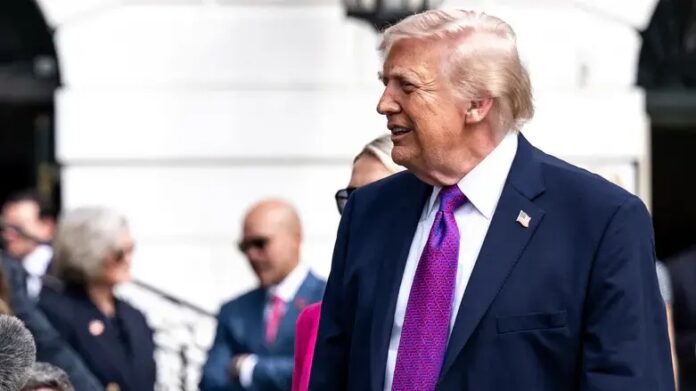
President Donald Trump said he will not speed up efforts to end the ongoing war with Iran, now in its 52nd day, sharply criticizing both Democrats and Republicans who are urging him to wrap up the conflict.
In a phone interview with The New York Post, Trump argued that calls for a swift agreement are undermining the United States at a critical moment in negotiations.
“How bad is it that when you are in the middle of negotiations and you have got the Iranians in a perfect position, including being militarily defeated, and you have Democrats and some Republicans asking to settle it now?” Trump said.
He expressed frustration that pressure is coming from within his own country while talks are still ongoing. “As a negotiator — and I am a great negotiator — how bad is it when you have people from your own country trying to reach a deal?” he fumed.
Trump said such efforts only strengthen Tehran’s hand. “They are helping the other side. The other side has nothing, they have no cards, but they are using this to delay. When [Senate Minority Leader Chuck] Schumer was in, he was in Afghanistan for so long.”
He emphasized that he intends to proceed on his own timeline. “I have only been in this for five weeks. I will not be rushed,” he said.
At the outset of the conflict, Trump had predicted it would conclude quickly. He said last week that Iran had privately signaled agreement to key U.S. demands, including ending its pursuit of nuclear weapons and giving up roughly 1,000 pounds of highly enriched uranium, even as public statements from Tehran remained less accommodating.
Following a first round of talks in Islamabad that failed to produce results, the administration moved to blockade Iranian ports. A second round of negotiations is expected to begin as soon as Monday.
Early in the conflict, Trump had estimated the war would last “four weeks or so.”
Under the War Powers Resolution of 1973, which the White House maintains is unconstitutional, the president is required to obtain congressional authorization for military engagements that extend beyond 60 days.
Some Republican lawmakers have begun urging Trump to bring the operation to a close, especially after recent developments that included U.S. Marines seizing an Iranian tanker that attempted to breach the blockade.
Sen. Josh Hawley (R-Mo.) said last week that the “clock is ticking” and that “I hope that we are arriving at an exit strategy here to bring this to a close to preserve our security interests and bring down the cost of gasoline.”
Senate Majority Leader John Thune (R-SD) also signaled interest in the administration’s next moves, saying, “I think our members are going to be very interested in what next steps are,” and noting that a forthcoming supplemental funding request “will be an important inflection point if and when the administration submits their request.”
Democrats in Congress have largely opposed Trump’s military campaign, known as Operation Epic Fury.
The War Powers Resolution allows for an additional 30-day period to wind down hostilities after the initial 60-day limit, though enforcement of the law has historically been inconsistent.
In past conflicts, federal courts have declined to intervene to halt military operations, including during legal challenges brought against then-President Barack Obama over U.S. involvement in the Libyan Civil War.
Courts have generally ruled that questions about the duration of military engagements fall within the political sphere, leaving Congress with tools such as funding decisions to check presidential authority.