
 Matzav
Berysz Aurbach, Among the Last Witnesses of the Warsaw Ghetto Uprising, Passes Away at 104
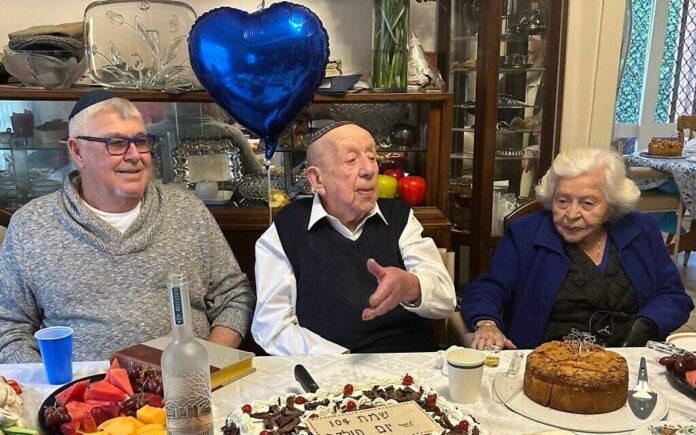
Berysz Aurbach, one of the last surviving Jews to have witnessed the Warsaw Ghetto Uprising, has passed away at the age of 104. A survivor of unimaginable hardship who carried the memories of the churban with remarkable clarity, Aurbach lived a life defined by resilience, faith, and an unwavering commitment to remembrance.
Born in Biala Podlaska, Poland, into a middle-class family with close ties to Ger, Aurbach’s early years were marked by both stability and loss. His mother passed away when he was just three months old. He grew up with three older brothers, a sister, and later a half-brother from his father’s second marriage. He often recalled, word-for-word, the tefillos and pesukim he had learned in his local cheder.
When World War II erupted, Aurbach was 19 years old. He was forced into the Warsaw Ghetto, where he worked in a factory amid widespread starvation, disease, and death. Tens of thousands perished in the ghetto, while hundreds of thousands were deported to extermination camps. As the Nazis prepared to crush the Jewish resistance during the uprising in April 1943, Aurbach’s life was saved through an extraordinary act of courage by his older brother, Mordechai.
Mordechai, who was involved in the underground resistance, secured false papers and a Polish police uniform for his brother, enabling Aurbach to escape the ghetto undetected just before the uprising began on Pesach of 1943. Reflecting on that period, Aurbach once said, “My elder brother Mordechai, together with other ghetto leaders, went to rich people in Warsaw to obtain money for arms. Rich people gave him and other leaders money after my brother convinced them to fund resistance in the ghetto.”
After his escape, Aurbach spent the remainder of the war in hiding, sheltered in safe houses run by the Polish underground. The horrors he left behind never faded. Most of his family did not survive. His brother Mordechai, who had helped orchestrate his rescue, was later betrayed by Polish informants and executed by the Gestapo. “I don’t know where he is buried,” Aurbach said, a pain he carried for the rest of his life.
Following the war, Aurbach discovered that only one sibling had survived—his sister Esther, who had emigrated before the war to what was then British Mandate Palestine. Seeking to rebuild, he immigrated to Australia, joining thousands of other survivors who settled there in the postwar years. He made his home in Melbourne, eventually settling in the suburb of Caulfield, where he would live for decades.
In Australia, Aurbach rebuilt his life with dignity and purpose. He married his wife, Tova a”h, and together they established a family. Though Tova passed away years ago, he is survived by his children, grandchildren, and extended family, who remained close to him and drew strength from his presence.
Aurbach became a respected member of the Melbourne Jewish community. He was a longtime member—and for many years, president—of the Caulfield Shul, where he was deeply connected to tefillah and communal life. Even in his later years, when his strength allowed, he would make his way to the shul.
His story did not remain private. Aurbach became one of the increasingly rare firsthand voices of the Warsaw Ghetto Uprising. His testimony was preserved in archives and exhibitions, including at Melbourne’s Holocaust Museum, ensuring that future generations would hear, directly and authentically, what he had witnessed. He would often reflect on the depth of his experiences, once remarking, “I can talk for six months and I wouldn’t tell you everything I want to tell you.”
Despite the darkness he endured, Aurbach retained a sense of gratitude and even humor. Speaking about his adopted country, he said, “My private opinion is most Australian people are not antisemitic. They are meshuggah [crazy] regarding football. I don’t personally think they are thinking much about antisemitism.”
Those who knew him described a man of remarkable clarity, whose memory remained sharp and whose perspective was grounded in both suffering and hope. His life bridged worlds that are rapidly disappearing, connecting a generation that experienced the worst of humanity with those determined to remember and rebuild.
With his passing, the world loses not only a survivor, but a living witness to one of the most defining and tragic chapters of Jewish history.
Yehi zichro boruch.