
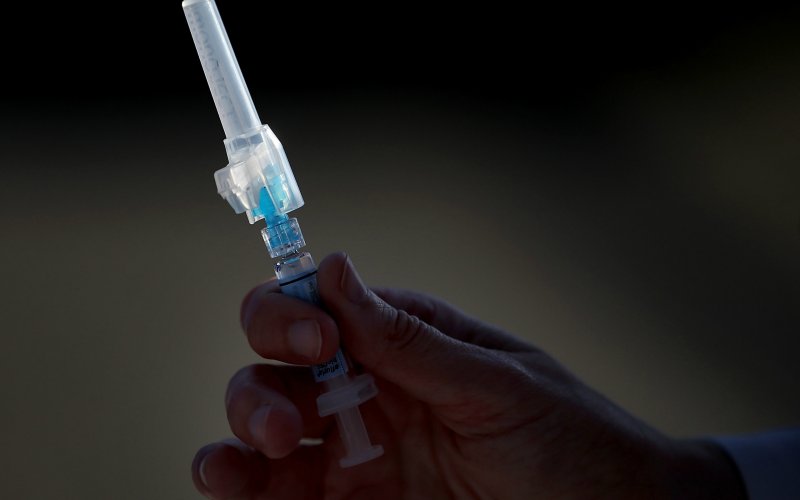

Defense Secretary Pete Hegseth said Tuesday that the Pentagon will no longer require American service members to receive a yearly influenza vaccine, marking a significant change in military health policy.
In a video shared on X, Hegseth explained that troops will now have the option to decide for themselves whether to get a flu shot, rather than being subject to a blanket mandate across the force.
“The notion that a flu vaccine must be mandatory for every service member everywhere in every circumstance at all times is just overly broad and not rational,” he said.
Hegseth framed the move as part of a broader initiative by President Donald Trump’s administration to shift away from sweeping requirements and return more decision-making to individual service members.
“We’re seizing this moment to discard any absurd, overreaching mandates that only weaken our war-fighting capabilities. In this case, this includes the universal flu vaccine and the mandate behind it,” he said.
A directive signed by Hegseth on Monday formalized the change, stating that “effective immediately, the annual influenza vaccine is voluntary for all Active and Reserve Component Service members” as well as civilian personnel within the Defense Department.
The decision follows a gradual rollback of the military’s strict vaccination requirements. In a May 29, 2025 memo, Deputy Defense Secretary Steve Feinberg indicated the Pentagon would scale back its policy, writing that it would “conserve its resources by requiring seasonal flu vaccination for service members only when doing so most directly contributes to readiness.”
Under that earlier guidance, only reservists called to active duty for 30 days or longer would be required to receive the flu shot. The Pentagon also ended compensation for reservists and National Guard members who previously were paid for time spent obtaining the vaccine on their own.
Despite the policy shift, military health officials have continued to emphasize the importance of vaccination. The Navy and Marine Corps Force Health Protection Command has stated that seasonal flu vaccination “is the most effective control measure to reduce the risk of severe influenza and mission degradation, minimizing the risk to force.” It also cautioned that the virus can spread rapidly, and outbreaks “may be widespread and can adversely impact Navy and Marine Corps force readiness and mission execution.”
During the previous administration, the Pentagon had also imposed a requirement for all service members to receive the COVID-19 vaccine. Approximately 8,700 active-duty and reserve personnel left the military, either voluntarily or involuntarily, after declining the shot before that mandate was lifted in 2023.
After returning to office, President Trump signed an executive order allowing those who were discharged over the COVID vaccine refusal to seek reinstatement. By last August, fewer than two dozen had returned to service, although several hundred applications had been submitted.
Mandatory vaccinations have been part of military life since the early days of the United States. In 1777, George Washington ordered widespread inoculation of the Continental Army to protect soldiers from smallpox, according to a Congressional Research Service report from 2021. Today, the Defense Department continues to require various immunizations, including those for hepatitis B, polio, and measles, mumps, and rubella.
The flu vaccine itself was first required for military personnel in 1945, leading to the immunization of millions of troops. That policy was later dropped in 1949, reinstated in the early 1950s, and remained in place for decades until this latest announcement.