
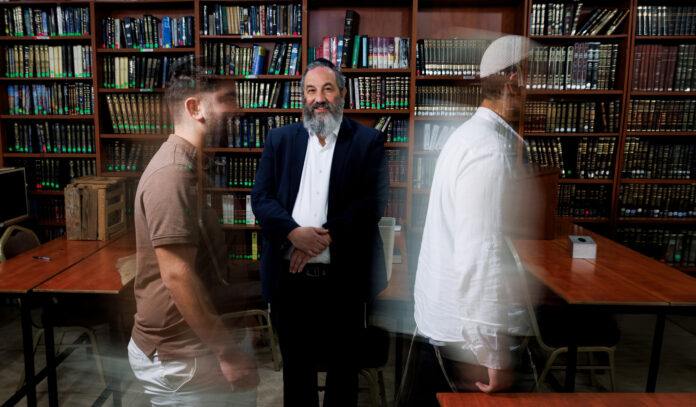

At first glance, Yeshivas Matisyahu appears like any other, with sefarim lining the walls and bachurim learning with zeal.
Yet here, the curriculum reaches beyond the text. The rosh yeshivah’s daily shiur begins kumzitz-style with guitars and communal song. Then as a combination mussar/group therapy, the shiur delves into topics like anxiety, failure and self-esteem. Here, questions and comments are encouraged, struggle is honored and peer support is built.
At the center of this is Rabbi Yoni Fischer. He smiles easily, hugs often and speaks about his own shortcomings without embarrassment. His mission: to live authentically and create a safe space for others to do the same.
Yet long before becoming a spiritual guide, he was occupied with his own basic questions: How do I find my authentic self? And what are the tools to get there?
Mussar and chasidus became his self-development regimen. Success, he learned, begins with self-honesty and the courage to confront inner struggle. He studied the practice of self-love and the quiet discipline of change, and he adopted a stance of radical positivity toward others.
Today, decades later, this defines Yeshivas Matisyahu, a place for 130 post-high school bachurim, many with challenging pasts. It is a living laboratory of the inner map that Rabbi Fischer has drawn.
THE GIFT OF IMPERFECTION
Rabbi Fischer’s growth model is, ironically, grounded in the notion of imperfection.
“Nobody is perfect,” he says. “We all carry some trauma. We all struggle with fear and hurt. Hashem doesn’t ask us to be angels. Our challenge is to be human. The fact that we struggle means we’re alive.
“Our problem isn’t that we have a problem. Our problem is that we don’t allow ourselves to have a problem. Accepting the problem is 90% toward solving it. Wherever you struggle, be there with it. As Hashem told Moshe, the place where you stand now is holy.”
Rabbi Fischer embodies philosophy-in-motion, courageously modeling the inner work he inspires others to do. At a recent shiur, he shared a personal challenge:
“After many years, I’ve concluded that I don’t always need to wear a tie. I realized that the only thing stopping me was a fear that people might say, ‘You’re a rosh yeshivah! Where’s your tie?!’”
This small example is very impactful. Bachurim hear a Torah figure speak with neither shame nor bravado about “working on myself,” which motivates them to do the same.
Rabbi Fischer’s message has spread beyond the walls of Yeshivas Matisyahu. He is a sought-after speaker at yeshivos, seminaries, camps and on podcasts. Thousands listen to his shiurim and video clips, and he mentors hundreds of loyal talmidim.
“I don’t see myself as a role model,” he says humbly. “I’m just trying to be a consistent, authentic version of me. People say, ‘Practice what you preach.’ I try to preach what I practice. The more I do that, the more good things happen. Success and impact are an outgrowth of me being me and you being you. People say, ‘Be the best you.’ I say, ‘Just be you.’ That is the best you!”
MAN AND MISSION
Yoni Fischer grew up in Baltimore, in his words, “a regular ‘80s American guy.” His father, Eugene Fischer, was an educator and Holocaust survivor. Their home valued professional success; his two brothers became doctors.
Although an introvert by nature, Yoni’s talent and charisma made him a natural-born leader: class president, general of camp color war, captain of the basketball team, etc.
His grandfather, Rabbi Leopold Fischer, served as rav of Zera Israel on Seven Mile Lane. “I got the best of both worlds,” he says. “From my mother’s side, the American sweetness and warmth. From my father’s side, the European strength and Yiddishe pride.”
His yeshivah journey began at Ner Yisroel where, via the Slabodka mesorah of Rav Yaakov Yitzchok Ruderman and Rav Yaakov Weinberg, he became steeped in the creed of gadlus ha’adam. It launched a lifetime quest to be a proud, positive and healthy Jew.
One day, he walked into a Baltimore bookstore and discovered I Am I by Rabbi Dr. Abraham Twerski. It revealed a world of possibility: the power of self-development, anchored in Torah sources.
In Eretz Yisrael, he learned in Yeshivat Hanegev and the Mir. From there, he went to Shor Yoshuv, where he found an attractive combination of Slabodka and chasidus.
Along the way, his hashkafah jelled into an eclectic mix of what he refers to collectively as “the tzaddikim”: the Ramchal, the Sfas Emes, Rabbi Yisrael Salanter, Rebbe Nachman, the Vilna Gaon, the Chofetz Chaim, the Kotzker Rebbe, Reb Tzaddok HaKohen, et al.
The central pillar remains gadlus ha’adam. He fondly recalls walking with Rav Aryeh Levy of Yeshivas Chevron, who would slap him on the back and say, “Yoni, walk with pride.”
To read more, subscribe to Ami

