
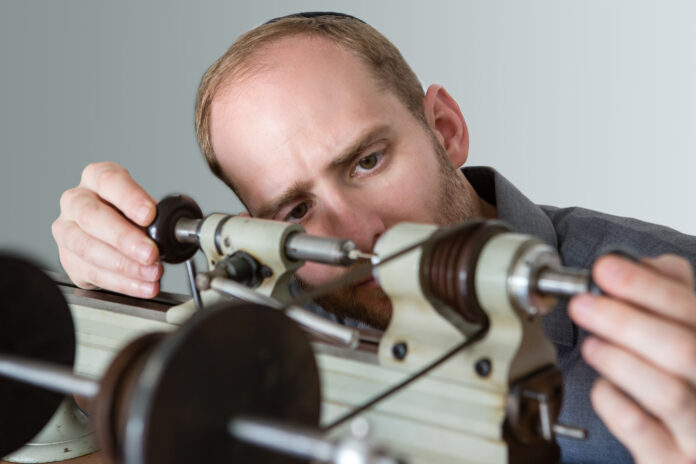

A while back, I was sitting and talking with friends of mine who have fancy watches, and I wondered out loud why no one in the frum world produces luxury watches. My friends said that, actually, someone does: JN Shapiro. They told me it’s very high-end, competing with the top brands, and the watches are true works of art. They are also quite expensive.
Intrigued, I did some research and got in touch with Josh Shapiro, the founder of JN Shapiro Watches.
It turns out that Josh stumbled upon watchmaking simply as a hobby and never intended it as a business.
We had a fascinating conversation about the world of luxury watches as a whole, and JN Shapiro Watches in particular. He was very transparent about his business, the pricing, the costs, and a lot more. If you ever owned a watch or are interested in this world, this is an eye-opener.
But as you’ll see, Josh’s story is about a lot more than luxury watches.
Enjoy!
—Nesanel
I was born in LA 41 years ago. I’m an only child. My mother’s side of the family grew up kind of Conservadox. My uncle was a baal teshuvah who went to Eretz Yisrael, came back, became a sofer, and opened his own shop, The Mitzvah Store in LA. My mother wasn’t interested in Yiddishkeit at all.
“My father’s side of the family wasn’t either. They were all craftsmen and machinists. My paternal grandfather, Max Shapiro, started his own machine shop business in the 1940s, in South El Monte, a small town in unincorporated LA County. It wasn’t a city yet. He and some other businessmen realized they needed to incorporate and become a regular city so they could get proper streets, gutters and services. My grandfather took care of it, and he was the mayor of the city for multiple terms. His Hebrew name was Meir, so he was Mayor Meir Shapiro. My son is named after him.
“My grandfather also started a sandblasting business, which my father managed. It began as part of the machine shop but overtook it. I grew up in that business. My maternal grandfather was a general surgeon who operated on everything from the neck down.
“I went to public school in Arcadia, a city next to Pasadena. When it came time for my bar mitzvah, my mother’s brother, Rabbi Shimon Kraft, suggested that my parents send me to him every Shabbos, and he would teach me for free. They agreed. I went to him every single Shabbos and developed a real kesher with him. At the time, I was not religious at all, but that year I kept every single Shabbos, and then I’d go back to my completely secular existence. I was living in two different worlds every week. But those Shabbosim really had an impact, and when I went off to college, my uncle persuaded me to go on a JAM (Jewish Awareness Movement) kiruv trip, and that’s how I got involved.
“I was interested in history and was also artistic, always tinkering with things. There were always lots of old things in my father’s shop, and I picked up a lot of interesting skills from hanging around there. As a kid, I smelted gold with my grandfather. I liked doing blacksmithing. I’d make jewelry, paint and draw things. But in college, I went with history rather than the arts. I got a master’s degree in history, and I didn’t work with my hands much anymore.
“As for my entrepreneurial skills, when I was a kid, my grandfather tried to warm me up to the idea of having a business. I was nine years old, and I wanted to get a complete set of a certain book series, but it was going to cost a few hundred dollars. Right across the street from my father’s shop was a big industrial recycling place. I was talking to Johnny McCardigan, the owner, about these books and how I could possibly earn enough money to buy them. Johnny said, ‘There’s enough steel scrap at your father’s business to buy you multiple sets.’ I didn’t believe him, so he made me a bet: If I didn’t bring over enough steel, he would buy me the set himself. So I started recycling everything around the shop—all the cans, all the papers, even the machinery. I lugged tons of steel on carts across the street, and sure enough, I was able to buy every single one of that author’s books in existence at the time from my summer recycling earnings.
“I always had some side work. In college I did track and field, specifically pole vault, which I really enjoyed. I competed in it, and in between yeshivah stints I also coached others in pole vault. A friend and I were good at Photoshop, and we started making brochures. I also started an SAT tutoring company. I did that while I was still coaching and before I went to yeshivah.
“The JAM trip was in 2005, and I learned at Aish HaTorah for most of 2006. From 2007 to 2009, I was figuring things out. Then I went back to Aish HaTorah for almost all of 2010 and about half of 2011. The first time I was there, Rav Noach was still alive. When I went back, he had passed away and his son had stepped in. I was very close to Rabbi Motti Berger and Rabbi Zeldman, and when I came back, Rabbi Rossman and Rabbi Rieber were running the program.
“When I went back to yeshivah in 2010, I gave up all my businesses. I got married at 26 and started teaching at yeshivos—American history at MBY (Mesivta Birkas Yitzchok, led by Rabbi Tendler), and history and PE at Yeshivas Ohr Chanoch, a Chofetz Chaim yeshivah. I also ran their summer camp. Within two years, Yeshivas Ohr Chanoch offered me the position of general studies principal, which I accepted. Watchmaking was still only a hobby.
“I also started another business at that point: tutoring, specifically designed for kids who were struggling with their Yiddishkeit. For a high schooler, self-esteem and how good you are at learning often go together. If a kid’s not great at learning, his self-esteem plummets. I offered tutoring tailored for their needs.
To read more, subscribe to Ami

