
 Vos Iz Neias
What Is Going Through Their Heads? Berkeley Students Applaud a Terrorist
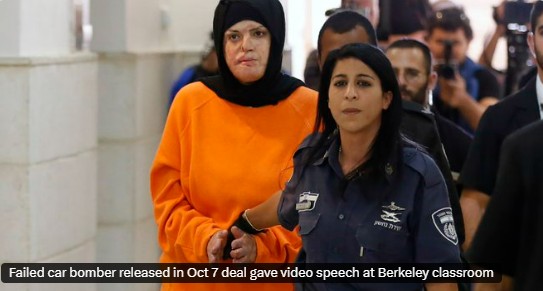
NEW YORK (VINNEWS/Rabbi Yair Hoffman) On Monday of this past week, in Room 170 of the Berkeley Law School, a convicted would-be car bomber addressed a classroom of American law students by video call No one protested or heckled nor walk outed.
They applauded. All of them.
The speaker was Israa Jaabis, a Palestinian woman who in October of 2015 drove a car loaded with gas canisters and flammable material toward an Israeli police checkpoint outside Maaleh Adumim. When an officer stopped her for driving alone in a commuter lane, she cried out “Allahu Akbar” and then attempted to ignite the vehicle.
The explosion wounded the officer and burned her own face. The Shin Bet found handwritten notes in her possession praising “martyrs.” She was convicted and sentenced to eleven years. In November of 2023 she was released early. Why? Because Hamas had kidnapped 240 human beings on October 7th, and Israel paid for a handful of those hostages with the release of terrorists. Jaabis was one of those terrorists.
This is the woman whom Berkeley Law Students for Justice in Palestine and UC Berkeley Students for Justice in Palestine chose to present, on “Palestinian Political Prisoners Day,” as a heroine. This is the woman for whom a full classroom of America’s future lawyers rose to applaud.
Shlomo HaMelech wrote long ago, “What has been is what will be, and what has been done is what will be done; there is nothing new under the sun” (Koheles 1:9). It is tempting, watching that video, to feel that we are living through something the world has never seen before. We are not. Educated people cheering for murderers — applauding those who hunt the innocent while dressing it up in noble-sounding words — is one of the oldest stories that Klal Yisroel know.
The question is not whether this is disturbing. It obviously is. The question that needs honest examination is: How did we get here? What, exactly, is going through these students’ heads? How does a bright young person, admitted to one of the most selective law schools in the country, sit in a climate-controlled classroom in Northern California and clap for someone who tried to murder innocents?
The Ideological Operating System
The answer is not that these students are stupid. They are not. Many of them have perfect LSAT scores. The real answer is that they have been trained — patiently and thoroughly through a woke filter – from elementary school to high school and through college — to process the entire world through a filter: Are they oppressors or the oppressed?
In this framework, moral questions are not answered by looking at what a person did. They are answered by looking at which identity category a person belongs to. If you are classified as “oppressed,” your actions are, by definition, resistance. If you are classified as “oppressor,” your actions are, by definition, violence — even when you are the one being attacked. Once the categories are assigned, the facts are mere decoration.
Under this wokism, Israa Jaabis is not a woman who tried to murder others with a car bomb. She is a “political prisoner.” The other potential victims and the wounded officer are not victims. They are all an instrument of a state that the framework has pre-classified as colonial.
The entire moral machinery is upside down before the first slide of the PowerPoint goes up. The students, in their minds, they are cheering for the abstraction of liberation. That the abstraction is wearing the face of a woman who wanted to kill a stranger in traffic is, to them, a detail — and inconvenient details do not survive contact with the category.
The Sanitizing Power of Distance
There is, probably, a second mechanism at work, and it deserves to be named honestly: physical and moral distance. None of these students have ever seen what a burning car does to a human body. None of them know the officer’s name nor have spoken to his children. The victim is an abstraction to them, and abstractions do not bleed.
Jaabis, on the other hand, appeared on a screen — composed, articulate, speaking the correct vocabulary. She was the vivid one. The officer she tried to kill is, to that classroom, a rumor.
Many also clapped because everyone around them was clapping. On today’s elite campus, pro-Palestinian activism is the status position — the one that earns invitations, friendships, faculty warmth, and the quiet approval of the people whose approval a twenty-four-year-old most wants.
To sit silent during that applause would be to mark yourself, socially, as the wrong kind of person. Most people, at twenty-four, do not have the spine to be the wrong kind of person in a room of a hundred peers. And so they clap.
And then, because more shallow human beings cannot tolerate the cognitive dissonance of doing something they know to be wrong, they reconstruct their beliefs to match their behavior. They leave the room more radical than they had entered it.
The Dehumanization of the Jewish Victim
There is one more element, and it is the most painful to write. What permits the applause is not only the elevation of the perpetrator. It is the prior quiet erasure of the victim. For these students to clap for Jaabis, they did not have to consciously hate Jews. They only had to have spent four years in an intellectual environment in which Jewish suffering — specifically Israeli Jewish suffering — had been steadily drained of any weight or significance.
October 7th itself demonstrated this with chilling clarity. Within hours of the massacre — while bodies were still being counted, before Israel had fired a single shot in response — Students for Justice in Palestine chapters across America were calling the slaughter a “historic win.”
Rachmana litzlan.
The rapes, the burned children, the grandmothers kidnapped from their beds — none of it registered as the horrific atrocity that it was. The real truth is that even animals don’t behave like that. October 7th was the day humanity died.
So What Should Be Done?
Diagnosing the sickness is easier than curing it, but a serious response requires action on several fronts. Outrage alone accomplishes nothing. Neither does the default Jewish communal reflex of writing strongly-worded letters that get filed and forgotten.
First, universities must be held to the standards they themselves have published. Every major university in America has a code of conduct that prohibits the glorification of violence and the harassment of students on the basis of national origin or religion. These codes are enforced — aggressively — when the targeted group is favored.
They are ignored when the targeted group is Jewish. The Department of Education is currently investigating universities for Title VI violations. Jewish parents, donors, and alumni should make continued financial support explicitly contingent on enforcement parity.
Second, the hosting of convicted terrorists in university classrooms is not a free-speech question. It is a platforming question. A classroom is not Hyde Park. It is a curated space allocated by the institution. Berkeley Law would not — and should not — host a convicted abortion-clinic bomber, or a convicted Klan arsonist, to present their life story to an admiring audience on “Political Prisoners Day.”
The selective application of the platforming principle to Palestinian perpetrators alone is itself a form of institutional bias that can and should be challenged, including in court.
Third, the K-12 pipeline deserves the attention it has not been receiving. These Berkeley law students did not arrive on campus as blank slates. They arrived already fluent in the oppressor/oppressed vocabulary. They learned it in high school history classes, in ethnic studies curricula, and in the social media ecosystem that filled whatever gaps the classroom left.
Jewish communal organizations have spent decades funding Holocaust education, which is necessary but insufficient. What is missing is engagement with the teaching of the present — the curricula, the textbook adoptions, the teacher-training pipelines — where the categories that produced Monday’s applause were first installed.
Fourth, Jewish students themselves need to be given permission to be visible. One of the quiet tragedies of the past two and a half years has been how many Jewish students have responded to campus hostility by hiding — removing the Yarmulkah, tucking in the Magen David necklace, skipping Shabbos at Hillel.
This is exactly backwards. Historically, invisibility has never protected us; it has only comforted those who wished we weren’t there. A proud, confident, publicly Jewish student body — one that refuses to be relegated to managing its trauma in private — changes the moral temperature of a campus more than any administrator’s statement ever will.
Fifth, and most importantly, we need to make the victim vivid again. The officer Jaabis wounded has a name. He has a family. He went home that night, after the emergency room, to children who were terrified they had almost lost their father. Bring him to campus. Put his face on the screen. Let the students who clapped for the woman who tried to set him on fire look at the man she tried to set on fire. Let them try to clap then. Most of them — most — will not be able to. The ones who can will have told us exactly who they are, and we will know what we are dealing with.
A Final Thought
It is tempting, after a week like this one, to conclude that the younger generation is lost. Shaming the clappers is satisfying but nearly useless. Recruiting the silent — that is the hishtadlus that must be done – that and, of course, Torah study and Tefillah.
The author can be reached at [email protected].