

Lakewood (VINNEWS/Rabbi Yair Hoffman) “Mah rabu maasecha Hashem, kulam b’chochmah asisa” — How many are Your works, Hashem; You made them all with wisdom (Tehillim 104:24).
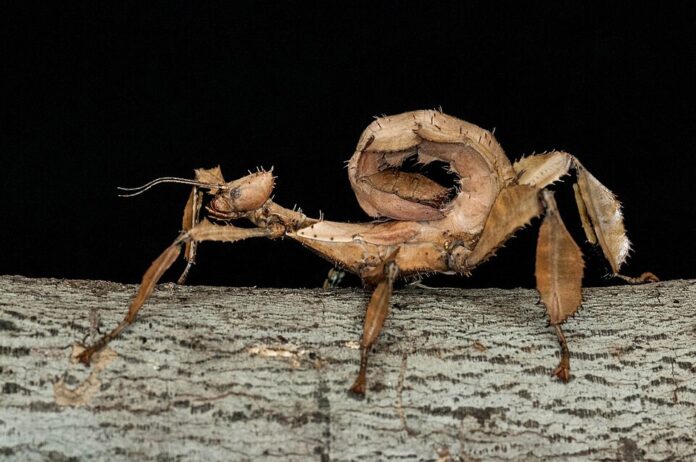
Dovid HaMelech wrote these words after looking at the wonders of Hashem’s world. A fantastic example of this is the Australian walking stick insect. This little creature gives us one of the clearest signs that the world had to be designed by a Borei Olam.
Here is its story. By the end, most thinking people will likely agree.
A Seed That Isn’t a Seed
Picture in your mind’s eye being deep in the forests of eastern Australia. A small object falls from a tree. It looks just like a seed. Ants find it on the ground, pick it up, and carry it down into their underground nest. They nibble off a tasty little cap on top, and then leave the rest of the “seed” alone in their nest.
Butm unbeknownst to that ant – that “seed” is no seed at all. It is the egg of the Australian walking stick insect.
Real seeds in that forest have a fatty bump on top called an elaiosome. The ants love to eat it. The walking stick’s egg has a bump on top too, called a capitulum. It is made of different stuff, but it does the same job — it tricks the ants into thinking the egg is a seed and carrying it home.
Why does the insect want its egg in an ant nest? Because the ant nest has the perfect humidity for the egg to develop. And the ants chase away parasites and predators that would eat the egg if it were left out in the open. It is the safe there, safer than the nursery in community hospital in Lakewood, New Jersey.
A Nymph That Pretends to Be an Ant
About four months later, something strange crawls out of the ant nest. It does not look like a stick insect. It looks like a red-headed spider ant.
The baby walking stick has never met its mother. It hatched alone underground. Yet somehow it knows how to look like an ant, walk like an ant, run like an ant, and even pose like an ant — curling its tail up over its back the way ants do when they are angry.
Why pretend to be an ant? Because birds and other predators leave ants alone. Ants bite. They sting. And they swarm. And red-headed spider ants taste terrible — like rotten coconut or bad cheese. So when a bird sees this little nymph racing up a tree, it flies away in disgust.
The disguise only needs to last but a few days. The red color on its head fades, and the nymph keeps climbing higher into the safety of the trees.
An Adult That Looks Like a Leaf
Over the next month, the insect sheds its skin some six times. Each time it changes more and more. The fast, jerky ant movements slow down. By the time it becomes an adult, it has turned into something completely different — a big, slow creature that looks exactly like a eucalyptus leaf.
It even sways back and forth like a leaf moving in the wind, even when there is no wind. Some adults grow as long as a human hand. Some are brown, some green, some look like crinkly lichen growing on a branch. Predators look right past them.
How do they find a shidduch when they are ready to emerge from the “freezer?” Surely they are so well hidden tht it would likely cause a shidduch crisis? They send out pheromones — special chemical scents that only walking sticks can smell.
After having found the shidduch, the female drops her seed-shaped eggs to the forest floor. The ants come along, think they have found seeds, and carry them home. And the amazing cycle starts over again.
The Problem for Evolution
Now how could all of this have happened by accident?
Evolution teaches that creatures change slowly, one tiny step at a time. Each small change has to give the animal some advantage, or else it will not be passed on to the next generation.
But look at the egg. For the ants to carry it underground, everything has to be exactly right. The egg has to be the right size. The right shape. The right color. And most importantly, the bump on top has to smell like a real seed’s elaiosome — because ants find seeds by smell, not sight.
What good is an egg that is almost like a seed? None at all. If the smell is wrong, the ants ignore it. If the shape is off, they leave it. The egg either works or it does not.
There is no halfway.
So how could it have slowly evolved? Each tiny step on the way to becoming a fake seed gives the insect no advantage at all. The answer is that there is a Borei Olam.
The same problem comes up with the baby ant disguise. A nymph that almost looks like an ant gets eaten. A nymph that almost moves like an ant gets eaten. A nymph that almost poses like an ant gets eaten. The disguise only saves a life if it is essentially perfect.
And the leaf disguise of the adult? Same problem. A bug that kind of looks like a leaf is just a bug. The whole package has to come together at once.
Three Disguises in One Life
Here is what makes the walking stick so impossible to explain by chance: it does not have one of these tricks. It has three.
It is a seed when it is an egg. It is an ant when it is a baby. It is a leaf when it is an adult.
Each disguise targets a different danger. Each disguise has to be coded into the insect’s body and brain from birth. And all three have to work together, because if any one of them fails, the species dies out.
How would random mutations build a fake seed, a fake ant, and a fake leaf — all in the same insect, all in the right order, all matching three different things in the very same forest where this insect happens to live?
The chance is zero.
Rav Yaakov Kamenetsky on Built-In Instincts
Rav Yaakov Kamenetsky zt”l, in his sefer Emes L’Yaakov on Bereishis (1:21), addresses this very problem from a Torah perspective. Commenting on the creation of the animal kingdom, Rav Yaakov explains that Hashem built into each creature, from the very moment of its creation, the exact instincts and tools it needs to survive in its world. These instincts, he stresses, cannot have been acquired bit by bit over time. A half-formed instinct is no instinct at all. An animal that almost knows how to flee from a predator gets caught. An insect that almost knows how to disguise itself gets eaten.
Rav Yaakov writes that the only way to make sense of the animal world is to recognize that Hashem implanted the complete survival package into each species at the moment of yetzirah. This is a profound idea, and it speaks directly to what we see in the Australian walking stick.
The insect does not learn its three disguises. It does not practice swaying like a leaf or posing like an ant. It comes out of the egg already programmed with behaviors that only work if they are essentially perfect from the start.
This is precisely what Rav Yaakov zt”l was teaching. Built-in, fully formed instincts are the signature of a Designer, not of slow accidental change.
The Rambam writes in Moreh Nevuchim (3:25) that everything Hashem creates has a purpose, and that the wisdom we see in nature points back to the Wisdom that put it there. The Chovos HaLevavos, in Sha’ar HaBechinah, teaches that anyone who really studies even one of Hashem’s creatures with honest eyes will see the Designer behind it.
The Vilna Gaon is said to have taught that a person who does not see Hashem’s hand in nature has not really learned how to look. The Australian walking stick is a wonderful teacher. There is no need for a microscope or a science degree to see the problem. One just needs to watch this little insect live its three lives — seed, ant, leaf — and ask honestly: could this really have happened by accident?
Mah rabu maasecha Hashem, kulam b’chochmah asisa.
The author can be reached at [email protected]