
 Matzav
Lapid Signals Willingness for Lower Placement to Broaden Opposition Alliance Ahead of Elections
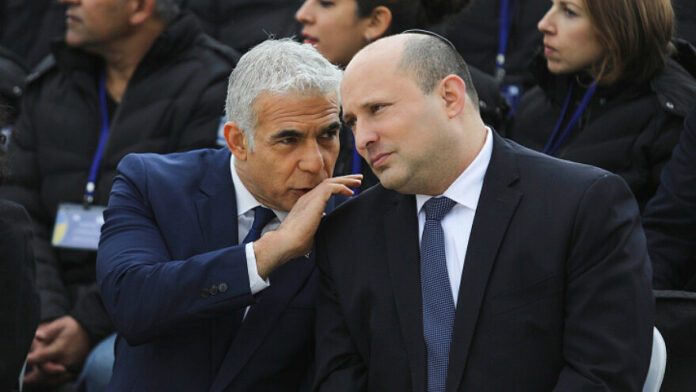
Opposition leader Yair Lapid has told his ally Naftali Bennett that he is prepared to accept a lower placement on their shared electoral list if it would help bring Gadi Eisenkot into a larger unified bloc, according to a source close to Lapid.
The development follows an announcement Sunday night in which Lapid and Bennett revealed they were combining their parties into a joint slate under the name “Together – Led by Bennett.”
According to the source, Lapid has made clear that his own position on the list is secondary to the broader goal of consolidating forces to improve the opposition’s chances at the polls. “Lapid says his personal ranking is far less important than the need to unite forces and win the election.”
Bennett, emphasizing momentum, declared that he and Lapid were “racing forward to victory,” and extended an invitation to Eisenkot to join the alliance, saying that “our door is open to you too.”
However, a figure close to Eisenkot downplayed the significance of Lapid’s proposal, despite earlier reports that Eisenkot himself had floated the idea of a merger back in January. “That’s not the point at all. We’re only interested in what will bring victory to the bloc,” the source told The Times of Israel.
While Eisenkot expressed support for the partnership between Bennett and Lapid, referring to them as “allies,” he also cautioned that their joint effort might struggle to pull voters away from the right-wing camp aligned with Benjamin Netanyahu.
“For this victory to happen, we need to bring in more votes — that is our only test. Every union must be judged by that,” Eisenkot said on Sunday.
He later called on most opposition leaders to meet and coordinate a strategy aimed at securing a “Zionist majority” over Netanyahu in the elections scheduled for October.
A Channel 12 survey released Monday suggested that if Eisenkot were to join forces with Bennett and Lapid, the combined list could secure 41 seats. Still, the broader balance of power would remain largely unchanged, with Netanyahu’s bloc projected at 50 seats, Zionist opposition parties at 60, and Arab parties holding 10.
Reacting to the merger, Benny Gantz, head of the Blue and White party, argued that the move weakens efforts to replace the current government. He maintained that a wider coalition remains the preferable path forward. “harms the ability to replace this terrible government,” he said, adding that “the best solution is a broad, Zionist government.”
Gantz criticized the focus on internal rivalries rather than outreach to new voters. “Instead of calling out to right-wing voters, Likudniks, and religious Zionists who are looking for a new home today — and telling them that we will ensure the establishment of a broad Zionist government without extremists, that will handle conscription and security and economic challenges — they chose to continue entrenching themselves in intra-bloc battles and obsessing over ‘who’ will lead, rather than ‘where’ we will lead,” Gantz wrote on Facebook.
He added that both Bennett and Lapid had once again prioritized their own political interests over national concerns. “Both Bennett and Lapid are people I respect, but each of them has once again chosen what serves them personally, rather than what serves the country,” he wrote.
Positioning himself as an alternative, Gantz appealed to voters seeking change across the political spectrum. For those looking for “a victory for the entire people of Israel,” he said, “I am your insurance policy to do everything possible to replace Netanyahu and the government of extremists, and to ensure the establishment of a broad Zionist government. In today’s political arena, only Blue and White guarantees that an extremist government won’t rise here again, nor a narrow minority government that relies on Arab parties and would collapse in the face of the first security challenge.”
Recent polling places Blue and White below the electoral threshold, and Gantz was notably absent from the list of opposition leaders invited to Eisenkot’s proposed coordination meeting.
Gantz has also distinguished himself from other opposition figures by signaling openness to joining a Netanyahu-led coalition and by resisting efforts to classify him firmly within the opposition bloc.