

I’ve always been in awe of people who can make matches. This is especially true since I lack the vision to view two individuals as a couple until they actually are one. Shadchanim have a unique and very useful insight into what might work. They look at two separate people and see a potential dynamic where none yet exists. To my way of thinking, that’s almost magical!
Some of the more interesting matches are the kind that put together a pair of apparent opposites. I once met a couple, for example, where the wife was vibrant, outgoing and talkative, while her husband tended overwhelmingly toward the quieter end of the spectrum. In social situations, she shone. Her husband looked as though he’d rather be elsewhere.
But it went deeper than that. The husband was a serious, deep kind of person while his wife, though no less intelligent, preferred to flit lightly on the surface of things. On the outside, they presented very differently. Even contradictorily. And yet, their marriage worked.
Maybe it worked because they were opposites. She helped ease him into the social world, while he served a role in grounding her. He admired her vivacity while she respected his wise and serious take on life. In a spirit of mutual appreciation, their relationship thrived.
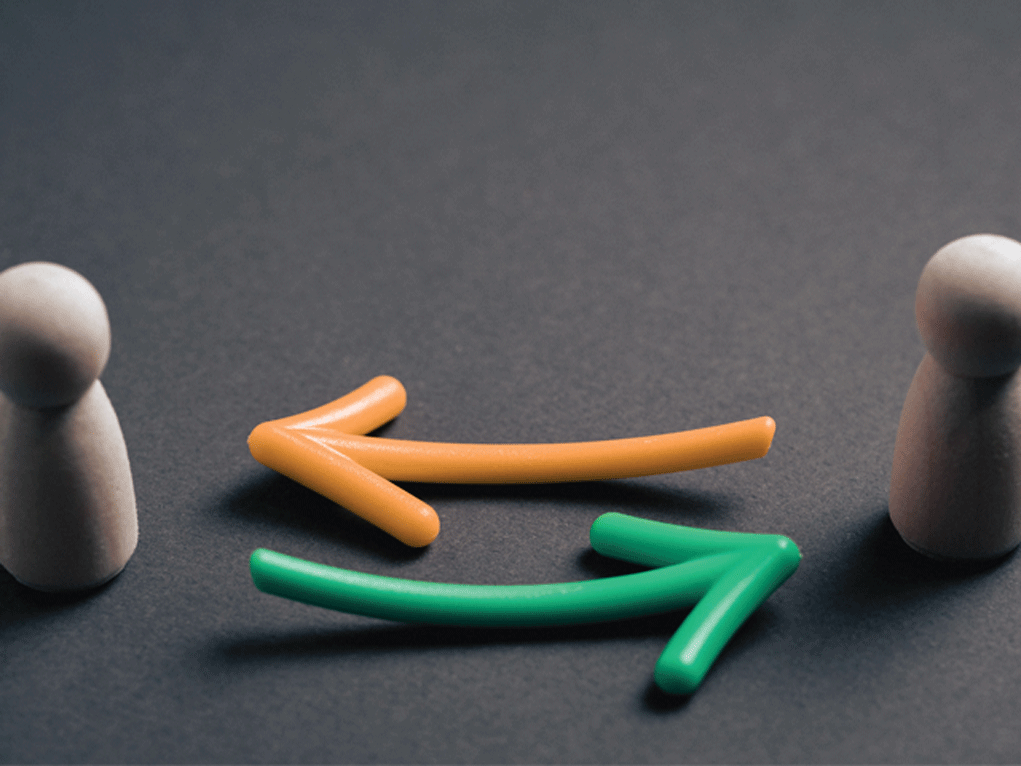
When two opposites marry, it’s usually because each see something in the other that they lack. The high-strung young woman, for instance, craves a partner with a chilled and upbeat personality who’ll be able to calm her fears and soothe her ruffled feathers. The young man who lives with his head in the clouds can benefit from a practical wife who’ll see to all the pragmatic details of their shared life. A timid girl feels safe with a husband who takes on the world with confidence. Problem meets solution. Heavy balances light. Opposites complement and complete one another.
I once knew an ambitious, hard-driving fellow who became engaged to a girl whom everyone knew as something of a cheerful airhead. When his friends indicated their surprise, he told them, “When I come home at the end of a long day, she’s just the type of person I want waiting for me at home!”
He didn’t feel the need for a wife as serious or even as bright as he was. He was not looking for a reflection of himself. What he was seeking was a partner who’d lighten up his life. And he found it.
Status Quo
As you may have noticed, life does not embrace the status quo. As time marches on, changes creep in. Nothing we go through in life, including the ordinary interactions of marriage and family life, leaves us untouched. In ways large and small, each new experience adds to the ballast of what we carry inside. Eventually, and inevitably, the accumulated experiences have their effect.
This effect can be positive, such as increasing our emunah and bitachon, sensitizing us to others, and generally refining our middos. If we’re not careful, however, the negative can creep in as well. When the going gets rough, instead of increasing our trust in Hashem we run the risk of sinking into a state of chronic discouragement or even cynicism. And even discounting the tough times, the tedium of the mundane can sour a person if she’s not careful. Disappointment can leave its mark as surely as disaster.
The point is that people change. And that means that relationships change. Nothing is more susceptible to being impacted by personal change than marriage. If one half of the equation shifts, it causes some sort of shift in the other half. Where opposites once attracted, they can start to repel.
The high-strung woman who once giggled at her new husband’s humor can begin reacting with annoyance at what she perceives as a lack of seriousness or sensitivity toward the weighty issues facing them. Where she once appreciated the role of humor in keeping her in a relaxed frame of mind, now she snipes at him whenever he cracks a joke. His otherness no longer comforts her. It grates.
The pragmatic woman can start to harbor resentment toward her head-in-the-clouds husband. Whereas she once cheerfully undertook the role of steering the family’s domestic course with plenty of hands-on hard work, now she wishes that her spouse was a little more capable so he could take some of the burden off her shoulders. Instead of admiring his ability to think deeply about abstractions, as she once did, she finds herself feeling annoyed about it. She wishes that her husband’s feet were planted more firmly on the ground.
The shy, timid wife grows up and develops her own self-confidence. She formulates her own opinions which, sooner or later, clash with those of her husband. Where once she was happy to let him interact with the outside world for both of them, now she has definite ideas which don’t always accord with his own. The result? Arguments and disharmony as they each struggle to have things their own way.
What went wrong with these once smoothly functioning couples? Nothing but life. People grow and, hopefully, improve. Gradual shifts in perspective, as well as conscious goals and practice, can change us in ways which bring two opposite personalities more in sync. The one who was timid grows self-assured like her husband. The nervous one learns to self-soothe. The one who was impractical develops new skills in the home and out of it.
All of which is why the most important gift we can give ourselves and our spouses is flexibility. Over the course of our shared life, we will inevitably change. The more we can each bend to meet the changes in our partner, the happier and more harmonious our marriages will be.
But flexibility, on its own, is not enough. The “opposites” need to hold onto the mutual respect and appreciation that once characterized their relationship. They need to remember why they married each other and recognize that, although the old give-and-take may not apply as much anymore, there’s a new dynamic in which they can still give to each other… although what they give may look different than before.
As life goes about its business of introducing change, in ways large and small we change along with it. The changes may come for each of us at different times and at different paces. If each spouse is willing to rise to the challenge of recreating him or herself in response to the other’s growth, it can only do the marriage good.
Such respectful flexibility serves as a token of the trust and goodwill that lies at the heart of all good marriages. Even one that started out as a marriage of complete opposites!