
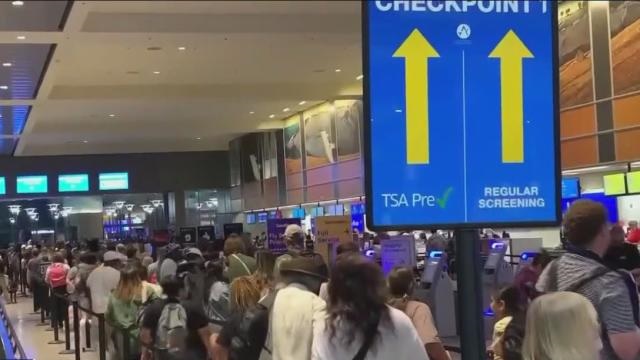

The White House is alerting lawmakers that funding for Department of Homeland Security personnel is on the verge of being depleted, raising the prospect of airport slowdowns and broader security risks as the House delays action on legislation aimed at ending what has become the longest funding gap in the agency’s history.
In a memorandum sent to Congress late Tuesday, the Office of Management and Budget said that stopgap funds President Donald Trump has been using to pay workers at the Transportation Security Administration and other divisions through executive measures are expected to run out by May. The memo urged House members to promptly pass the Senate-approved budget resolution, which cleared that chamber after an overnight session last week and is intended to set the stage for restoring full funding.
“DHS will soon run out of critical operating funds, placing essential personnel and operations at risk,” the memo said.
The administration’s warning adds pressure on House Speaker Mike Johnson, whose slim Republican majority has struggled to advance key legislation amid internal disagreements, including over Homeland Security funding, leaving the chamber largely stalled.
The House is expected to hold a vote as early as Wednesday on the Senate’s budget resolution, a procedural step that would begin a multi-phase effort to ultimately fund the department. Administration officials cautioned Republican lawmakers against making revisions that could delay the process further.
“Restoring funding for the Department of Homeland Security (DHS) has never been more urgent, as demonstrated by recent events,” the memo said, referencing an incident over the weekend in which an armed individual attempted to breach the annual White House Correspondents’ Dinner attended by Trump, the vice president, and senior Cabinet officials.
The Department of Homeland Security has been operating without its standard funding for more than two months after Democrats declined to approve financing for Immigration and Customs Enforcement and Border Patrol unless changes were made to those agencies, following fatalities linked to protests against Trump’s deportation policies.
Although immigration enforcement personnel have continued receiving pay through roughly $170 billion allocated in last year’s tax legislation backed by Trump, other employees—including those at TSA—have depended on temporary funding provided through executive action to maintain their salaries.
With payroll costs exceeding $1.6 billion every two weeks, Homeland Security Secretary Markwayne Mullin recently indicated that those emergency funds are nearing exhaustion.
Republicans in both the House and Senate have moved ahead without Democratic support, attempting to secure funding specifically for Immigration and Customs Enforcement and Border Patrol. Their plan calls for approximately $70 billion to cover those operations through the remainder of Trump’s term in office, aiming to prevent future funding disruptions.
The approach relies on a complex legislative path similar to the one used to pass Trump’s tax cuts last year and is expected to unfold over several weeks.
After initiating the process last week, the Senate is now waiting for the House to act. Once the budget resolution is adopted, both chambers will begin drafting the detailed funding legislation, a step that could take additional weeks.
Meanwhile, Johnson is expected to pivot quickly to separate legislation that would finance other components of Homeland Security, including the TSA, Coast Guard, and related agencies.
That measure, which has bipartisan backing, cleared the Senate about a month ago after Republicans agreed to exclude immigration-related funding opposed by Democrats. However, it has remained stalled in the House due to disagreements among Republicans over the Senate’s framework.
{Matzav.com}