
 Matzav
Newly Appointed Tel Aviv Chief Rabbi Says Compassion Is Key: “The Kohen and the ‘Chalalah’ Cried in Tears”
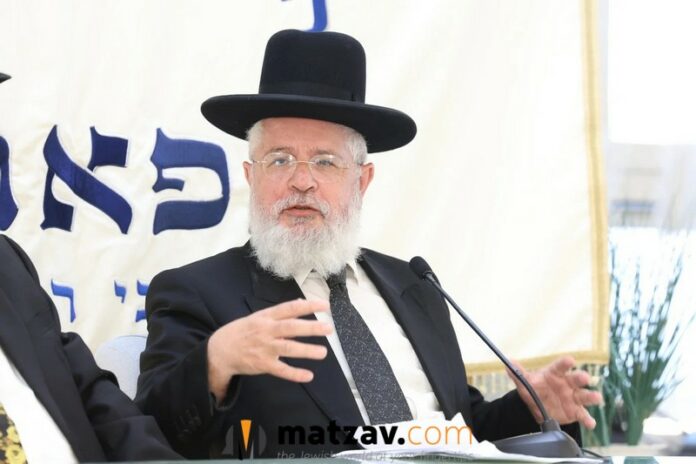
The appointment of Rav Zevadia Cohen as chief rabbi of Tel Aviv–Yaffo is being seen as a shift in tone in one of Israel’s most complex cities. In his first interview following his selection, Rav Cohen laid out a philosophy centered on connection rather than confrontation, sharing powerful stories from his work in the rabbinical courts and expressing confidence that even in Tel Aviv, hearts can be opened and people can be drawn closer to Judaism.
Speaking on Kol Chai’s main news program, Rav Cohen described his long-standing involvement in the city and emphasized that he is not an outsider. “I was elected in 2007 as head of the rabbinical court in Tel Aviv and came to the city. I deal with the most sensitive cases in the rabbinical courts,” he said.
He explained that his approach was shaped by years of handling complex issues such as lineage questions, divorce cases, and marriage permissions. Rather than taking a confrontational stance, he said his goal is to help. “I always say — I am not against you, I am with you, I am here to help you solve the problem,” he said, adding that “the moment the other side feels you are with them — hearts open.”
Rav Cohen rejected the notion that Tel Aviv residents are opposed to religion. On the contrary, he said most people retain an emotional connection to tradition. “I don’t think most people don’t want to see a rabbi… every Jew has something emotional toward tradition,” he said. He added that even those who seem distant often reconnect during difficult moments. “In times of mourning, in times of distress — that is when the heart opens, and you just need to light the candle.”
To illustrate his approach, Rav Cohen shared a story from the rabbinical court involving a man who had refused for years to grant a divorce, until he was eventually arrested in Israel. “He said to me — everywhere they called me wicked, they didn’t listen to me, I felt like I was nothing,” Rav Cohen recalled. When he gave the man a chance to speak, the situation changed. “He said to me — kevod harav, you listened to me, whatever you say I will do. We arranged the divorce on the spot.”
Rav Cohen said the moment left a deep impression on him. “He held my hand and cried, told me ‘you revived me today, I felt like a human being,’” he said. For him, the lesson is clear: “You have to give every person their place, even if you don’t agree with them — to listen to them, and then hearts open.”
At the same time, he stressed that a welcoming approach does not mean compromising on halachic standards. “Our role is to preserve the religion of Moshe and Yisroel,” he said, noting that when something cannot be permitted, that must be stated clearly. He recounted a case involving a young couple who wished to marry despite a halachic prohibition — the man being a Kohen and the woman a “chalalah.” Ultimately, they accepted the psak. “They told me: if according to the law of Moshe and Yisroel it is forbidden, we will not do it — and they cried in tears.”
Concluding the interview, Rav Cohen expressed optimism about the future of the city. “There is a lot to do in Tel Aviv, but you have to know the way — not with a threatening approach, but with pleasantness,” he said. He believes that this path will allow for bringing people closer and sanctifying Hashem’s name, even in what is often viewed as Israel’s most secular city.
{Matzav.com}