 Matzav
Ancient Statue Discovered in Egypt May Depict Pharaoh Linked to Yetzias Mitzrayim
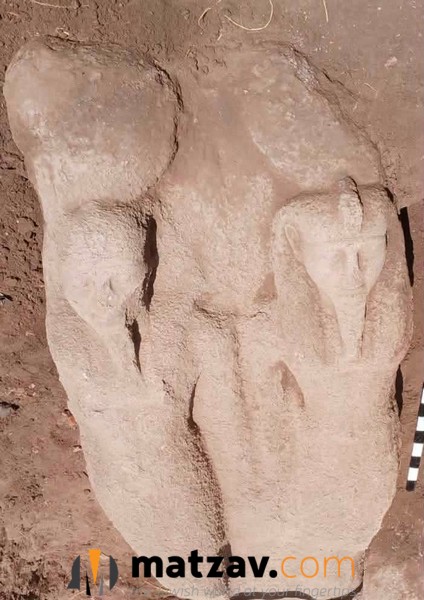
Egyptian authorities have uncovered a massive ancient stone statue believed to represent Ramses II, a powerful ruler of ancient Egypt whom some researchers associate with the Pharaoh described in the Torah’s account of Yetzias Mitzrayim.
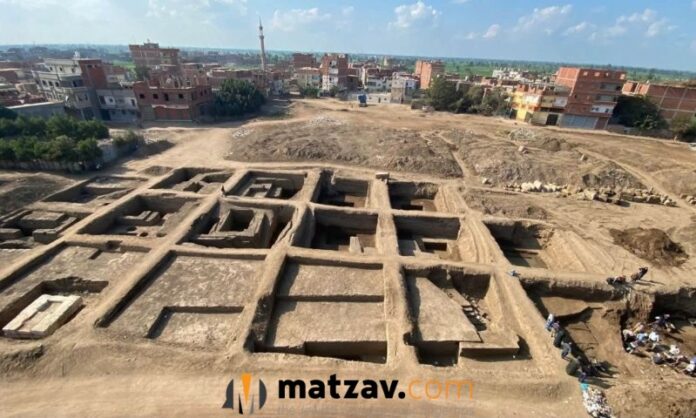
The discovery was announced by Egypt’s Ministry of Tourism and Antiquities, which said the statue was found at the Tel el-Fara site in central Husseiniya, in the Sharqia Governorate of the Nile Delta, northeast of Cairo. Experts believe the statue portrays Ramses II, one of the most prominent and influential kings of ancient Egypt.
Officials described the artifact as having “impressive” dimensions, weighing between five and six tons and measuring over 2.1 meters in length. Despite its size, the statue is in relatively poor condition, with its legs and base missing. Following the discovery, it was transferred from the temple complex where it was unearthed to museum storage facilities in San el-Hagar for urgent conservation and restoration work under strict scientific standards.
Egyptian antiquities officials noted that the statue was likely relocated already in ancient times from the city of Pi-Ramesses to the Tel el-Fara site, formerly known as Imat, where it was repurposed as part of a religious complex. This reuse, they said, highlights the enduring religious and historical importance of the region across different periods.
Ramses II, who lived from 1303 BCE to 1213 BCE, is widely regarded as one of the dominant figures of Egypt’s New Kingdom. Many scholars identify him as a leading candidate for the Pharaoh described in Sefer Shemos, even though his name does not explicitly appear in the Torah’s text. The Torah tells us that that Pharaoh refused Moshe’s demands to release the Jewish people, leading to the ten makkos.
The Ministry of Tourism and Antiquities said the find is among the most significant archaeological discoveries contributing to the understanding of royal and religious activity in the eastern Nile Delta. It joins a series of recent finds in Egypt, including eight rare papyrus scrolls dating back approximately 3,000 years whose contents have yet to be deciphered, as well as remains of an ancient religious complex in northern Sinai believed to be connected to a biblical city.