

New York (VINNEWS/Rabbi Yair Hoffman) Walk into a Kosher supermarket during Sefirah and you will hear music called acapello. The song v’attah banim shiru laMelech is one such example. What follows is a Shiru laMelech of a different type of a Kapello.
A study published in The American Naturalist (August ‘22) by Professor Robert Warren of SUNY Buffalo State and his team uncovered a hidden wonder. Their discovery involves three creatures that have nothing in common: oak trees, tiny wasps, and ants. Together, they perform a teamwork act so precise that it is impossible to believe it could happen by chance.
The Torah opens with the words, “In the beginning, Hashem created the heavens and the earth.” Chazal teach that Hashem looked into the Torah and used it as the blueprint for creation (Bereishis Rabbah 1:1). Every creature, every angle of every leaf, was designed with intention.
How Ants Plant Flowers
For more than a hundred years, scientists have known that certain wildflowers in the forest do not spread their seeds by wind or water. They spread them with the help of ants.
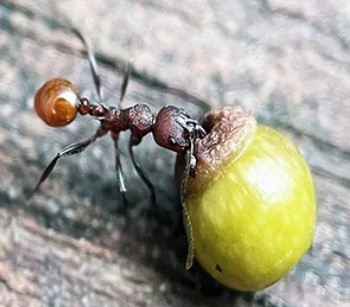
The seeds of these plants come with a small white attachment called an “elaiosome”—a tiny snack pack glued to the side of the seed, full of fats and oils that ants love. When the seed falls, ants find it, grab it by the elaiosome (which is shaped almost like a handle), and carry the package back to their underground nest.
Inside the nest, the ants chew off the elaiosome and feed it to their young. Then they place the seed in their nest’s garbage room—which turns out to be the perfect place for the seed to grow – underground, safe from mice and birds, protected from forest fires, and full of nutrients. The plant gets a free planting service while ants get a free meal. This partnership is called “myrmecochory,” Greek for “ant-carrying.”
This much we known. But the new discovery is a new k’naich in ma rabu.
The Wasp Copies the Plant
There is a tiny wasp called Kokkocynips. The female lays her eggs inside the leaves of red oak trees, and the oak leaf grows a little ball around each egg, called a “gall.” The wasp larva lives inside the gall, eating the gall tissue and growing safely inside this little fortress of oak.
Galls are not unusual—it is actually what halachic ink is made of. But the Kokkocynips gall does something no one had fully understood until now.
Now here it comes.. The connection between the acapello music and singing to Hashem.
On top of every gall, there is a special little cap. The researchers gave it the Greek name “kapéllo,” which simply means “cap.”
In the autumn, the gall (with its kapéllo) drops off the leaf and falls to the forest floor. And then—exactly the same thing happens that happens to the wildflower seeds. Ants find the gall, grab it by the kapéllo, and carry it to their nest. They chew off the kapéllo and eat it, leaving the gall itself, with the wasp baby still inside, safe and protected within the ant nest. In spring, the semi-adult wasp emerges, walks out of the ant nest unharmed, and starts the cycle all over again.
The Match Goes Beyond Coincidence
It is one thing to say ants happen to pick up both seeds and galls. It is another to look at how similar these two systems are. The researchers ran several careful tests, and what they found is amazing.
First, do ants treat galls the same way they treat seeds? The team set up bait stations with both. The ants picked up galls just as often as seeds, with similar levels of interest in both.
Second, is the kapéllo really what attracts the ants? The researchers cut the kapéllos off some galls and tested the bare galls against galls that still had their caps. Without the kapéllo, ants barely paid any attention. With it, the ants came a runnin’.
Third, what is the kapéllo made of? Using gas chromatography, the team measured the fatty acids inside both kapéllos and elaiosomes. They found the same key chemicals in both: lauric acid, palmitic acid, oleic acid, and stearic acid—the very chemicals known to attract ants. The wasp’s gall and the wildflower’s seed are using the same chemical recipe to call the ants over.
Fourth, how does the kapéllo come off? Under the microscope, there is a special line of woody (lignified) cells right where the kapéllo meets the gall, acting like a perforation (like in the packaging we can’t open on Shabbos) that lets the ant snap the cap off cleanly. Wildflower seeds with elaiosomes have the exact same kind of perforation line.
There Is a Third Player
And now – more ma Rabu. Stick insects (phasmids) lay eggs that have an attachment called a “capitulum.” It has the same fats and looks similar. It attracts the same ants, who carry the eggs into their nests where they are safe from predators.
So now we have three completely unrelated creatures—a flowering plant, a wasp that lives inside an oak leaf, and a stick insect—all producing the same kind of attachment, with the same chemicals, fitting the same handle-shape for ant jaws, with the same break-away point. None of these creatures is related to the others. They share only one thing: each developed, somehow, the same hidden code that summons the same partner ant.
Mah Rabu Maasecha—A Look at the Argument
Scientists call this kind of matching “convergent evolution.” The idea is that three different species supposedly stumbled, all on their own, onto the same chemical formula, the same shape, the same break-away seam, and the same perfect timing with the autumn ant season.
Professor Michael Behe, a biochemist at Lehigh University, has spent decades pointing out a serious problem with this kind of explanation. Behe calls it “irreducible complexity.” In Darwin’s Black Box, he argues that a system made of many parts, where every part must be present at the same time for the system to work at all, cannot be built up slowly, one mutation at a time. If even one part is missing, the whole thing fails, and natural selection has nothing to preserve.
Let’s look at what the kapéllo system needs. The wasp must lay eggs in exactly the right spot. Its saliva must reprogram the oak’s genes to grow not just any gall, but a gall with a cap. That cap must contain the exact fats that attract ants—not flies, not beetles. The cap must be sized exactly to fit ant mandibles. It must be attached by a lignified seam that breaks cleanly. The gall must drop at the right time of year. And the wasp must somehow walk out of an ant nest months later without being eaten.
Take away any one of these features, and the system collapses. Step-by-step random mutation has no way to assemble all those pieces at once—let alone three separate times, in three unrelated kinds of creatures.
The Rambam writes in Hilchos Yesodei HaTorah (2:2) that the way to come to true ahavas Hashem is to contemplate His wonderful works of creation. The Chovos HaLevavos, in Shaar HaBechinah, devotes the perek to looking carefully at the natural world for proofs of Hashem. Anyone who sees a complicated machine that works perfectly knows there must be a Designer behind it. No one would believe that an ink bottle spilled on a page produced a beautifully written sefer.
The partnership of the oak, the wasp, the ant, and the seed is exactly that kind of beautifully written sefer. The plant gets its seeds planted in safe ground. The wasp gets its babies stored in a fortress full of antimicrobial chemicals from the ants’ own glands, protecting the larvae from fungus that kills so many gall larvae out in the open. The ants get rich, fatty meals delivered to their door.
Walking Through the Forest with New Eyes
There is one more wonder the researchers pointed out almost as a side note. Kokkocynips galls in some forests are so common that they used to be called “black oak wheat” in the early 1900s. Farmers would gather them by the bushel to fatten livestock. They are everywhere. And until 2022, no one in the scientific world had quite realized that they were part of an ant-partnership system that mirrors flowers down to the chemistry.
How many other partnerships in creation has man still not noticed?
The next time we visit the Catskills and the autumn leaves fall in a forest, somewhere underneath them an ant is grabbing a tiny ball with a tiny cap, and carrying it home to feed others. The wasp inside that ball is sleeping safely in her enemy’s house. The oak tree above has done its job. And Hashem, who set up this whole arrangement, is being praised by all of them at once—whether they know it or not.
“Kulam b’chochmah asisa.” You have made them all with wisdom. The deeper one looks, the more obvious that becomes.
The author can be reached at [email protected]