
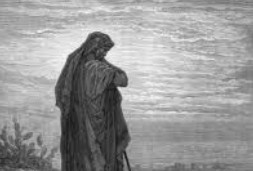

New York (VINNEWS/Rabbi Yair Hoffman) Open any volume of Rav Yerucham Levovitz’s Daas Chochmah u’Mussar, and the pasuk “Hikon likras Elokecha Yisroel” (Amos 4:12) returns again and again. Rav Yerucham built his entire avodah of hachanah — preparation — on that single pasuk, teaching his talmidim that kol ha-chayim hu hachanah, all of life is preparation.
But for the past four hundred years, the location of the kever of the author of these words, Amos HaNavi, was a mystery.
The site, a destination for Jewish and other pilgrims for some thirteen centuries, was abandoned in the early 1600s amid the regional insecurity of late Ottoman Eretz Yisroel — and then quietly disappeared. Now, after almost a decade of patient work, two researchers from the Israel Antiquities Authority claim to have found it.
Archaeologist Michael Chernin and IAA photographer Shai Halevi will present their findings this week at the 10th Judea Research Conference, in cooperation with the Israel Antiquities Authority, Bar-Ilan University, KKL-JNF, and the Kfar Etzion Field School. Pending security approval, a public tour of the newly identified site is planned for the day of the conference.
Their conclusion overturns a popular assumption.
For years, visitors and tour guides have placed the kever inside the modern Arab village of Tuqu’, at the eastern edge of Gush Etzion, where a sealed cave at the village entrance has long been pointed out as the burial place. Chernin and Halevi argue that the actual site lies roughly two kilometers away, on an isolated ridge overlooking the Judean Desert at a place known locally as Qasr Antar — the “Castle of Antar.”
The identification rests on the descriptions of fifteenth-century Jewish pilgrims, most notably Rav Yitzchak ben Alfara, who wrote of a church built directly above an ancient burial cave; on aerial photography of the ridge; and on physical findings that match the medieval accounts in detail. At Qasr Antar, beneath a small Byzantine-era church, a vertical shaft descends into a rock-cut burial chamber — precisely the structure the pilgrim accounts describe. None of the structures excavated at Tel Tekoa proper have ever been associated with a burial cave, a fact that has troubled scholars who placed the kever there.
THE NAVI FROM TEKOA
Amos HaNavi was contemporary with Hoshea, Yeshayahu, and Michah. Sefer Amos opens with the words: “Divrei Amos asher haya ba-nokdim mi-Tekoa, asher chazah al Yisroel bi-mei Uziyahu melech Yehudah u-vimei Yarav’am ben Yo’ash melech Yisroel, shenatayim lifnei ha-ra’ash” (Amos 1:1).
That earthquake is referenced again by Zechariah ha-Navi (14:5), who tells of the people fleeing “as you fled before the earthquake in the days of Uziyahu.” Chazal connect the tremor to the moment Uziyahu, in his arrogance, entered the Heichal to offer the ketores, and the earth itself recoiled. Amos, then, dates his nevuah to the very last years before the great fall of the king who began his reign in piety and ended it stricken with tzara’as.
Chazal record several traditions about the navi himself. Vayikra Rabbah (10:2) explains that he was called Amos because he was amus bilshono — heavy of tongue, a stammerer. The leitzanim of his generation mocked him with the Greek term Pesilus, “the stammerer,” asking, “Did the Ribono Shel Olam find no one upon whom to rest His Shechinah other than this stammering one?” The midrash draws an unmistakable parallel to Moshe Rabbeinu, who was kvad peh u-kvad lashon, and who was likewise taken to nevuah from behind the flock.
Tekoa was no obscure village. The isha chachama mi-Tekoa came from there to bring back Avshalom (See Shmuel II 14). Yirmiyahu, with the Babylonians at the gate, called out “Tik’u shofar bi-Tkoa” (Yirmiyahu 6:1) — a play on the town’s name itself. After the galus, Tekoites returned to work on the walls of Yerushalayim under Nechemyah, (Nechemyah 3:5).
Rav Shlomo Wolbe, who heard that pasuk above directly from Rav Yerucham in Mir, opened Sha’ar HaHachanah of Alei Shur on its strength. Reb Chatzkel Levenstein returned to it in Or Yechezkel; Rav Dessler tied it to hisbonenus in Michtav Me’Eliyahu. And Rav Shimon Schwab famously remarked that in our times one ought to put on a necktie before davening to fulfill “Hikon likras Elokecha Yisroel.” An entire literature of avodas Hashem — drawn from a single pasuk of this Navi.
Then there is “Aryeh sha’ag, mi lo yira; Hashem Elokim diber, mi lo yinaveh” (Amos 3:8). Rav Chaim Shmuelevitz devoted a sicha in Sichos Mussar to it, teaching that a person of true sensitivity hears Hashem’s roar in the events of his generation even when no thunder accompanies it. The Chofetz Chaim invoked the pasuk repeatedly between the World Wars, demanding that Klal Yisroel hear what Hashem was saying through the events of the time. Rav Elchanan Wasserman built on it in his (newly republished) Ikvesa D’Meshicha.
And then there is the pasuk, which was used as the basis for the song that has perhaps moved more baalei teshuvah than any other pasuk in Trei Asar: “Hinei yamim ba’im… v’hishlachti ra’av ba’aretz; lo ra’av la-lechem, v’lo tzama la-mayim, ki im li-shmoa es divrei Hashem” (Amos 8:11). A famine not for bread but for the word of Hashem. Rav Aharon Kotler zt”linvoked it in Mishnas Rebbi Aharon to characterize post-Churban American Jewry and ground his appeal for building yeshivos on these shores.
Sefer Amos, for all its tochachah and its searing condemnations of injustice, ends not in destruction but in nechamah: “Bayom ha-hu akim es sukkas David ha-nofeles” — on that day, I will raise up the fallen sukkah of David. The Gemara in Sanhedrin reads the pasuk as a kinui for Mashiach himself.
The navi who suffered ridicule for his stammering tongue, whose pesukim built the avodah of generations of baalei mussar, and whose own resting place likely fell into oblivion for four hundred years, ends his sefer with the promise that what has fallen will be raised again.
That his own kever now begins to emerge from the ground after four hundred years of forgetting may be a small siman of the larger promise.
The author can be reached at [email protected]