
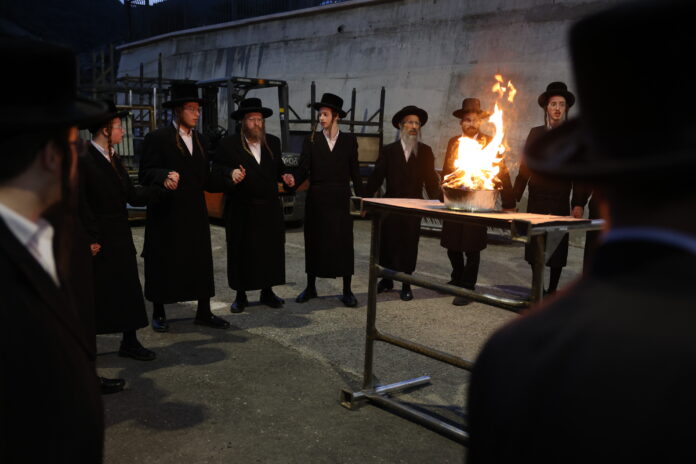

New York (VINNEWS/Rabbi Yair Hoffman) The Mogen Avrohom records a sobering account from the Kavanos HaArizal. A certain individual had the habit of reciting Nachem every day. He continued the practice on Lag BaOmer as well – ignoring its significance. For doing so, he was punished severely.
The story raises a sharp question. Why should the words of Nachem, words of mourning over Yerushalayim, generate punishment specifically on Lag BaOmer? What is so weighty about this day that even a private and pious practice can become a transgression?
The answer lies in the Ramah’s ruling (Shulchan Aruch OC 493:2) that on Lag BaOmer one engages slightly in Simcha. The brevity of the Ramah’s words masks the seriousness of the obligation. Commemorating Lag BaOmer, even with only a small measure of joy, is no minor matter.
Torah authorities cite four reasons for marking the day:
First, it commemorates the students of Rabbi Akiva who ceased dying on this day, although the deaths persisted between Pesach and Shavuos (Shla Pesachim 525).
Second, it is the Yahrtzeit of Rabbi Shimon Bar Yochai, who revealed the inner secrets of the Torah (Chayei Adam, Moadim 131:11).
Third, it is the day Rabbi Akiva granted ordination to his five remaining students, among them Rabbi Shimon Bar Yochai, who did not die in the plague (Pri Chadash OC 493).
Fourth, it commemorates the Manna, which began to fall on this day after Bnei Yisroel left Mitzrayim (Responsa Chasam Sofer YD 233).
Each of these four reasons deserves examination.
The Students of Rabbi Akiva
The Talmud (Yevamos 62b) teaches that 12,000 pairs of Rabbi Akiva’s students died because they did not extend honor to one another. Rav Chatzkel Levenstein zatzal asked the obvious question. How could the great students of Rabbi Akiva have neglected so basic a principle?
His answer is illuminating. Chazal teach that Kinah, Kavod, and Taavah, jealousy, the pursuit of honor, and the pursuit of desires, take a person out of this world. The students of Rabbi Akiva reasoned as follows. If honor is so spiritually toxic, how can we extend this poison to one another?
Rav Levenstein explains that they did not realize a critical distinction. Honor is poisonous only when one seeks it for oneself. When one extends honor to another, when one builds the self-esteem of a fellow Jew, the dynamic is entirely different. Such honor is not poisonous. It is healthy. It is the very stuff of which a holy community is built.
Why then were the students punished if the insight was so subtle?
Because they were great enough to have figured it out.
Their level of Torah and middos was such that this nuance should have been within their grasp. The failure to delve into the psychology of honor, to ask the second-order question, was their error. There is a sobering lesson here. A chumra, a stringency, when misapplied, can itself become a spiritual failure. Refusing to honor another out of a misplaced fear of spiritual harm is not piety. It is a tragedy.
Rabbi Shimon Bar Yochai
Rashbi, whose Yahrtzeit we commemorate on Lag BaOmer, merited to compose two extraordinary sections of the Zohar, the Idra Rabbah and the Idra Zuta. Rav Yoseph Chaim, in his Responsa Rav Pe’alim (YD 156), explains why Rabbi Shimon Bar Yochai, beyond his masters the Tannaim, merited to commit these teachings to writing.
Although his teachers were greater than he was, Rashbi possessed a particular gift. He could couch the deepest secrets in language so esoteric that the teachings could be expounded publicly without fear. Only those who genuinely merited the inner meaning would penetrate the surface and grasp what lay beneath.
On Lag BaOmer we commemorate not only that Rashbi transmitted these remarkable teachings, but that he safeguarded them. He ensured that the deepest truths of Torah would not be cheapened, abused, or taught to those who were unprepared to receive them.
Jewish Continuity
The semicha that Rabbi Akiva conferred upon his five remaining students was a heroic act that altered the course of Jewish history and, with it, the course of the world. The five were Rabbi Meir, Rabbi Yehudah, Rabbi Yossi, Rabbi Shimon, and Rabbi Elazar Ben Shamoa.
Under the pressure of Roman tyranny and religious oppression, these scholars knew what was at stake. They were entrusted with the noblest ideals of Tanach, with the Oral Tradition, with the future of Klal Yisroel itself. They understood that no matter the cost, the chain of transmission must not be broken. They were the future educators of every generation that would follow. It was a moment when the forces of darkness pressed hard against the light, and the light of Torah won out. Torah Judaism would go on to alter the moral consciousness of the world.
This is what Lag BaOmer commemorates. The words of the Mogen Avrohom about the man punished for failing to mark the day are now better understood. To overlook Lag BaOmer is, in some measure, to overlook the moment when Jewish continuity itself hung in the balance and held.
The Manna
The Manna represents the spiritual nourishment that Hashem granted Klal Yisroel upon their departure from Mitzrayim. It was the food that allowed the Jewish people to develop a deep Dveikus, a clinging bond, with the Creator, a bond that has defined who the Jewish people are as a nation.
Although the Manna no longer falls, the obligation it represents has never ceased. The Jewish people are charged to continue that bond, to continue imitating Hashem, to continue striving to be like Him. The Talmud (Shabbos 133b) teaches, Mah Hu Rachum af attah Rachum veChanun. Just as He is merciful, so should you be merciful. Just as He is kind, so too must you be kind. Just as He clothes the poor, so should you clothe the poor. Just as He buries the dead, so should you bury the dead.
This is the message of the Manna that endures, and this is what Lag BaOmer commemorates.
Meron, Bonfires, and Upsherin
No discussion of Lag BaOmer would be complete without addressing the customs that have come to define the day in the popular imagination, namely the pilgrimage to Meron, the lighting of bonfires, and the upsherin of three-year-old boys.
The Arizal is central to all three. The Arizal himself made the journey to Meron, and the practice of lighting hadlakos at the kever of Rashbi traces back to the kabbalistic tradition that grew around him. The bonfires are understood by some to allude to the great spiritual light that Rashbi brought into the world through the teachings of the Zohar. Others connect the fires to the tradition that on the day of Rashbi’s passing the world was filled with light, and his students saw fire surround the room.
The minhag of bows and arrows is tied to the teaching that a rainbow was never seen during Rashbi’s lifetime. The rainbow is a sign of Divine restraint in the face of a generation that would otherwise be deserving of destruction. Rashbi’s merit was so great that the rainbow was unnecessary in his day. Children carry bows on Lag BaOmer as a tribute to that merit.
Upsherin, the first haircut for a three-year-old boy, is conducted at Meron on Lag BaOmer in many communities. The custom is rooted in the Arizal’s practice and in the halachic reality that haircuts are permitted on this day after the restrictions of Sefirah. For many families, bringing a child to Meron for his first haircut is among the most cherished moments of religious life.
It should be noted that the Chasam Sofer expressed reservations about elements of the Meron practice, particularly the festive nature of a Yahrtzeit observance, since the Talmud itself does not establish Lag BaOmer as a holiday. Nonetheless, the minhag has been embraced across the breadth of Klal Yisroel, and the spiritual outpouring at Meron each year is a sight that must be seen to be believed.
How the Day is Observed
Perhaps because of the deaths of so many of Rabbi Akiva’s students, the minhag is to celebrate only modestly, not to make Lag BaOmer into a full-fledged Yom Tov. The Chasam Sofer points out that the Talmud itself does not mention Lag BaOmer as a holiday at all.
How then is the day marked? The Bnei Yissasschar writes that the custom is to light a number of candles in shul on this day. Fasting is not permitted, even for a Yahrtzeit, with the sole exception of a fast for a bad dream. Tachanun is omitted on Lag BaOmer and at the preceding Mincha. Weddings are held and attended. Singing, dancing, and music are permitted (see Pri Megadim, Eishel Avrohom 493:1).
The Lessons of the Day
As the song and dance of Jewish weddings rises this Lag BaOmer, and the words ring out, Od Yeshama, let it still be heard in the cities of Yehudah and in the outskirts of Yerushalayim, the sound of joy and the sound of happiness, the sound of the groom and the sound of the bride, four lessons should accompany the music.
Building the self-esteem of others and according honor to one’s fellow is among the most important avodos a Jew can perform. Safeguarding the teachings of Torah, protecting them from cheapening, is paramount. Jewish continuity and the chinuch of the next generation is the axis on which everything turns. And the Dveikus, the bond with Hashem that the Manna once made tangible, must remain the center of a Jewish life.
May Hashem bring the Geulah Sheleimah speedily in our days.
The author can be reached at [email protected]