
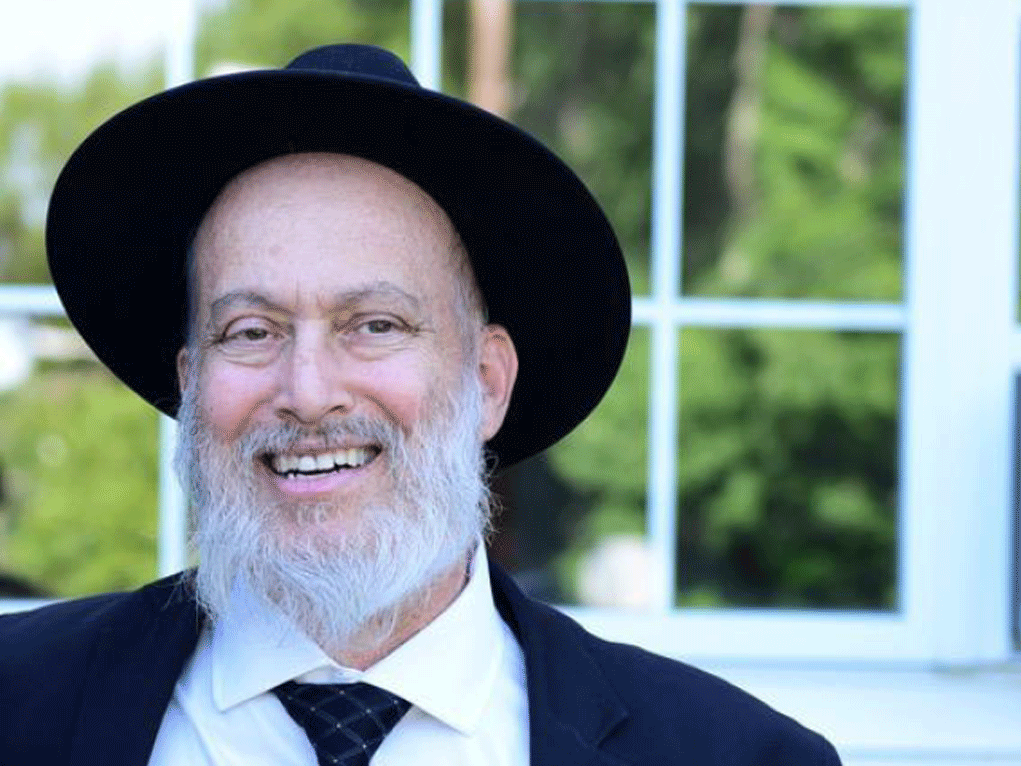

There are levayos that mark the end of a life. And then there are levayos at which the tzibbur stands in stunned silence, beginning to grasp — only now, only too late — the magnitude of the greatness that walked among them. The levayah of Rabbi Chaim Yisroel Abadi zt”l, niftar this past Shabbos, Parshas Emor, at the age of 66 after a long machlah, was the second kind.
He was, in the simplest and truest sense, an oheiv Yisroel, a man whose ahavas Yisroel was not a middah he worked on, but the very air he breathed. He loved Yidden the way a father loves his children, without conditions, without calculations, and without giving up. Especially without giving up.
A Son of Lakewood, A Father to Lakewood’s Lost Children
Rav Chaim was a son of Rav Yitzchok Abadi, the noted posek who, at the age of 19, was sent by the Chazon Ish to learn under Rav Aharon Kotler, and who was later appointed posek of Bais Medrash Govoah and the Lakewood kehillah while still in his 20s. Rav Abadi was niftar only five months ago, on the second day of Chanukah. Now, within a single calendar year, Lakewood has lost both the father who shaped its halachic landscape and the son who refused to let its struggling children fall through the cracks of it.
Rav Chaim’s avodah took a strikingly different path than his father’s. Rav Yitzchok carried the Torah of psak. Rav Chaim carried the Torah of pikuach nefesh, quite literally saving neshamos that the mainstream system had, in too many cases, given up on. He loved his father deeply, was mechabed him endlessly, and was sho’el eitzah from him constantly, but the path he walked was his own.
To understand what Rav Chaim built, one must remember what Lakewood looked like in the late 1990s. The Torah metropolis it is today was already taking shape, but beneath the surface, a crisis was unfolding. Hundreds of teenagers were finding themselves alienated from the system in which they had been raised. Some were technically still frum but spiritually adrift. Almost all of them had stopped davening, because there was simply nowhere they felt welcome to walk in.
Today, we take it for granted that there are tracks and options, programs and people, ways to help boys and girls who don’t fit the mainstream mold. We take it for granted that such teens are not to be marginalized, that there is hope for them, that they have a place. Today, if you don’t believe that, most people would think there is something wrong with you.
It is so taken as a given that we may forget who started it all. Rabbi Chaim Abadi was the one who brought this concept into existence. There were others who played a significant role too, Rav Dovid Trenk and Rav Shlomo Gissinger most prominently among them. But while they often worked quietly on individual cases, Rabbi Abadi revolutionized the idea of giving these boys and girls a chance on a wholesale level.
The amount of fighting and resistance and naysaying that he endured to get to the point where Lakewood is today regarding at-risk youth is staggering. He sat through countless meetings and phone calls where people didn’t simply discourage him from his efforts, but literally yelled and screamed at him over his work to save neshamos. And somehow, Rabbi Abadi was completely unfazed. He marched forward as if nobody had said anything at all.
He led a revolution. And he did it better than anyone else.
The Birth of “The Minyan”
Minyan Shelanu began, as so many great things in Klal Yisroel begin, around a small group of friends.
A handful of bochurim who were not enrolled in yeshiva used to gather at Rav Shlomo Gissinger’s shul after the regular minyan had dispersed. They would daven, eat breakfast, smoke a cigarette, and head to work. Rav Chaim, who had semicha but worked as a successful real estate developer, gave several of them jobs at his own company. For some, it was the first stable framework they had known in years.
Out of that informal gathering was born Minyan Shelanu — “Our Minyan.” It quickly became something far larger than its founders had even imagined: a bais medrash, a social center, a refuge, a surrogate home, and the only place in Lakewood where a kid who didn’t fit in could feel that he wasn’t a broken outcast.
Rav Chaim was emphatic on one point: The Minyan was not a kiruv operation. The teenagers walking through his doors were not strangers to Yiddishkeit. They were sons of bnei Torah. What they were missing was not Yiddishkeit itself, but simply a feeling of belonging.
The method to reel in these youngsters was deceptively simple: unconditional acceptance, an insistence on telling a boy or girl the truth, and a staunch loyalty to each and every person who came into Rabbi Abadi’s orbit.
Under Rabbi Abadi’s leadership, The Minyan grew into an entire ecosystem. A daytime kollel and night seder opened under the direction of Reb Yaakov Bess, a yeshiva placement program under Reb Shneur Olshin, a Thursday night cholent and speech, with addresses delivered over the years by leading roshei yeshiva. Then came the game room, an annual Shabbaton, and a road trip at the end of the year that, during one famous summer, took the boys through 13 states from the Smoky Mountains down to Florida. And, when needed — and it was often needed — full payment for drug rehabilitation, therapy, and yeshiva tuition for those whose families could not, or would not, help.
Years later, he opened The Chill, a parallel division for girls kept entirely separate from the boys’ program, which served as its own haven for young women in similar straits. When a fire ripped through The Chill’s Jackson headquarters early one morning, destroying everything in its path, the girls who had called it home spoke of it the same way the boys spoke of The Minyan: as the place where, when every other door in their lives was locked, this one was always open.
The Father Who Never Gave Up
To outsiders, Rav Chaim might have seemed like a man who simply provided love — hugging and laughing and giving exciting speeches. That is not who he was at all.
Instead, he gave every kid who needed it the feeling that he was their father, that he was in their corner, and that nothing would ever change that. He created a framework in which every teen who came under his influence understood that they would be loved endlessly and would never be given up on, but at the same time, there were rules for everybody, including themselves.
Rabbi Abadi didn’t give fake compliments. He didn’t tell every kid how amazing they were. He gave them the unvarnished truth, but the truth was always wrapped in a love so genuine that the boys and girls trusted him like a father, and often more than a father.
It was a special, unique balance that nobody else had ever managed to pull off.
In one instance, there was a boy he had to essentially throw out of Lakewood because he was causing tremendous harm to his peers. Several years later, at The Minyan’s annual Lag Ba’omer celebration, Rav Chaim approached a local baal achrayus, deeply agitated. He had just learned that this boy was holed up with a family in Brooklyn, and the family dynamic was not good. He needed to find an alternative family for this boy to stay with — right now. This was a kid he had to expel. And it didn’t matter. He couldn’t set the boy up for failure. He had to give him the best opportunity to succeed.
Giving up on someone simply did not exist in his worldview.
Facing Adversity with Resolve
Rabbi Moshe Rotberg, rov of Khal Zichron Yechezkel in Toms River, recounts a story that illustrates the steely, unbending resolve that Rabbi Abadi was legendary for.
As Rabbi Rotberg was leaving first seder one morning, he got a call from Rav Chaim. “Come on over. I need to show you something.”
When he arrived, Rav Chaim pulled out his phone and showed him a text message he had just received. It was, Rabbi Rotberg says, “filled with the most vile, hateful, despicable words I have ever seen sent to anyone.” He immediately tried to console Rav Chaim, but was brushed off.
“No, I don’t need that. I just want you to come with me.”
“Come with you where?”
“To meet this guy.”
“To meet him? Why would you want to meet him?”
“What do you mean?” Rav Chaim said. “He sent me a message, so clearly he needs me to talk to him.”
“What’s his story?”
“Eh, what’s the difference?”
Hesitantly, Rabbi Rotberg went with him. They knocked on the door. The door opened. “Hi, Rabbi So-and-so,” Rav Chaim said warmly. “I got your message. I see there’s a lot to discuss. So let’s sit down and talk.”
The man, stunned and bewildered, invited them in. For the next hour, Rav Chaim sat and spoke with the man who had just cursed him out in the most vile terms imaginable. At the end of the meeting, the man apologized.
That episode is a window into who Rav Chaim was. Vicious words could not cow him. He was made of steel. But beneath the steel — and the reason for it — was an unshakable belief that every Yid, even one who had just sent him hateful messages, was someone worth showing up for, worth talking to, worth hearing out.
The Chesed Nobody Knew About
Rabbi Abadi’s son-in-law, Rabbi Avi Bensoussan, who now leads The Minyan, spoke at the levayah about how much of Rav Chaim’s avodah was hidden even from his own mishpacha.
“None of us can comprehend what he did. He kept everything so quiet. Even his own family didn’t know,” he said through tears. “A year ago, when he got sick with his final machlah, I took his phone to help out as best I can. I had no idea — 24/7 the phone didn’t stop. Texts and calls from around the world. People calling about everything! I had no idea. I am his family, and his own family had no idea how much he was doing. We had no idea that we were sitting with a gadol, with a gaon. He didn’t stop!”
Rav Chaim ran from kavod with the same intensity that he ran toward struggling Yidden.
Rabbi Bensoussan related that someone once called him about a shidduch, not knowing his relationship to Rav Chaim. The caller said that he was inclined to say no, because he had looked into the “rabbi” the boy named on his resumé, and he was disappointed to learn that it was “some contractor named Chaim Abadi.”
The man had no idea. Rav Chaim had kept his profile so low that an outsider would mistake him for a simple tradesman. He was a gadol. But nobody knew.
There were calls he would take from absolute strangers. He would listen to their problems, give a solution or pull a lever to help, and hang up without ever learning their names. On numerous occasions, when someone asked him afterward who had just called, he answered, “I have no idea.”
“You don’t know who you were talking to?”
“No. Why does it matter?”
It made no difference to him who you were. If you needed help, he was there.
“Who Are We Going to Ask Now?”
Rabbi Bensoussan quoted a Medrash at the levayah that captured the moment perfectly.
The Medrash in Vezos Habrocha asks: When Moshe Rabbeinu was niftar, shomayim v’aretz cried, the Borei Olam cried, Klal Yisroel cried, and Yehoshua Bin Nun cried. The obvious question is: Was Yehoshua Bin Nun not part of Klal Yisroel? Why is his crying mentioned separately?
The answer is that Yehoshua, of course, cried with Klal Yisroel. But then he had a shailah that he needed to ask. And when he went looking for his rebbi and the realization dawned that his rebbi was gone — that there was no one to turn to — he cried again, a different kind of cry.
“That’s the question I keep hearing,” Rabbi Bensoussan said. “Who are we going to ask now? With Rabbi Abadi gone, who will guide us?”
It is a question being asked everywhere. The original Minyan guys are grandparents today. Rav Chaim was with them through their teenage years, through their yeshiva years, through their shidduchim, through building their families — up until his very last day. There is nothing to replace him, because what he built was not a movement, a philosophy, or a shitah that can be replicated. It was the whole package of him as a person. And there was nothing like him.
The Final Months
In recent months, as his physical condition deteriorated, Rav Chaim refused to stop. The phone never stopped ringing, and he never stopped answering.
In one instance, there was an event taking place somewhere near Lakewood that would be harmful to teens in attendance. Rav Chaim — already so weak he could barely breathe — made a call, insisting that this event had to be shut down. He called and texted, again and again, until he received confirmation that the event had been cancelled.
That was who he was: a man whose body was failing, whose breath was short, refusing to let go of even one teenager whose neshomah might be at risk.
“I Am Alive Because of Him”
Moshe Heinemann, a former Minyan member and close talmid, spoke at the levayah as a representative of The Minyan boys.
“One thing that stood out to me about this levayah is that everyone here can speak about him for an hour,” he said. “To so many of us, he was something more than we can possibly define. Some called him Chaim, others called him ‘Rabbi.’ But one thing is certain: He was an Abba to everyone — someone you could go to with anything, who made you feel you weren’t alone, someone who was non-judgmental no matter what, someone you could ask any shailah to.
“The list of hats he wore is endless. But at the same time, he was also someone we would just call to hang out with, to go eat out with, to take a ride in his pickup truck. Minyan Shelanu was his heart. It was a place of acceptance, where everyone belonged.”
There are countless alumni today who say it plainly: “I am alive because of him. It is that simple.”
What He Leaves Behind
There are those whose lives are measured in the Torah, seforim, or gemillus chassodim they leave behind. Rav Chaim’s life is measured in the neshamos he refused to abandon. And the void he leaves cannot be measured at all.
He is survived by his devoted wife, Mrs. Fraidy (Wanouno) Abadi, his beloved children and grandchildren, and by countless talmidim, admirers, and families who exist today because he refused to let them go.
At Rav Shlomo Gissinger’s levayah in 2019, Rabbi Abadi rose to be maspid. His voice broke as he spoke directly to the niftar: “When you go up to Shomayim, I want you to ask the Ribono Shel Olam: What’s the plan? Who is going to take care of the kids in Lakewood? What’s the plan?”
Today, countless Yidden are begging Rav Chaim to do the same.
Yehi zichro boruch.
***
Rabbi Abadi’s Legacy
By Rabbi Yitzchok Hisiger
Rabbi Chaim Abadi zt”l had a way of seeing people that most of us don’t.
He didn’t just notice who was sitting in front of him. He noticed who was slipping away. He saw the boy whose eyes had already wandered far beyond the walls of the bais medrash, the one who still showed up but no longer felt like he belonged.
I once watched him pause in the middle of a crowded room, his attention pulled not to the speaker or the center of the action, but to a quiet boy lingering near the doorway, half in, half out. While others continued talking, he walked over, placed a hand gently on the boy’s shoulder, and began a conversation that lasted long after the room had emptied. There was nothing dramatic about it. No audience. No recognition. Just one person refusing to let another disappear unnoticed.
He saw the girl who carried within her a quiet distance that no one else seemed to pick up on.
And once he saw them, he didn’t look away.
He chose the ones who didn’t fit. The ones who sat in the room but were never quite part of it. The ones who asked questions that sounded like chutzpah but were really cries for clarity. The ones whose struggles were too complicated, too messy, too exhausting for a system that prefers things to be neat and predictable.
He did not write them off. He did not label them. And perhaps most importantly, he did not stand at a distance and talk about them.
He went to them.
And he brought them to him.
He understood something that most of us only understand in theory but rarely live in practice: Before you can guide a young person, you have to first see them. Not the version of them you wish they were, not the version that fits comfortably into your expectations, but the person they actually are, with all the confusion and contradiction that comes with it.
Instead of reacting with frustration or disappointment, Reb Chaim approached them with patience and understanding, recognizing that what looked like resistance was often pain, and what looked like indifference was often confusion.
And if we are being honest, most of us have seen that same resistance and chosen the easier path: to dismiss it, to label it, or simply to move on.
He did not try to force them back into a mold that had already rejected them. He tried to understand where they were, how they were thinking, what they were feeling, and only then did he begin to guide them, slowly, carefully, with a sensitivity that cannot be taught in a training manual.
That is why he succeeded.
Not because he had better techniques, but because he cared enough to see each neshomah as an olam malei, not as a problem to be solved.
And now he is gone.
It is tempting, in moments like this, to speak about how rare he was, how unique, how irreplaceable. All of that may be true, but it also allows us to distance ourselves from what he represented. If he was one of a kind, then we are not expected to follow in his path. If his work required something extraordinary, then the responsibility does not rest on ordinary people.
But that is not the truth.
The boys he worked with are still here.
The girls he understood are still here.
The same confusion, the same quiet drifting, the same sense of being unseen has not disappeared with him. If anything, it has grown.
We have all seen them, and far too often, we have convinced ourselves that someone else will take care of it.
And the question that remains is a simple one, though it is not an easy one: What are we going to do about it?
Are we going to continue speaking about “kids at risk” as if they are a category that exists somewhere else, affecting someone else’s children? Are we going to keep telling ourselves that this is the responsibility of professionals, of organizations, of people who have the time and the training to deal with it?
Or are we going to recognize that this is happening all around us and that ignoring it does not make it go away?
Reb Chaim did not wait for someone else to take responsibility. He did not say, “This is not my problem.” He did not say, “I’m already carrying too much.” He saw a need and he stepped into it, again and again, even when it was difficult, even when it was draining, even when there were no guarantees of success, and even when people criticized him for what he did or how he did it.
If we truly want to honor him, then it cannot end with words.
It has to begin with a shift in how we look at the children around us. It has to mean that when we see someone struggling, we do not immediately define them by that struggle. It has to mean that we are willing to listen a little longer, to judge a little less, to stay present even when it is uncomfortable.
It has to mean that the next time we notice someone quietly drifting, we do not look away, even when getting involved feels inconvenient, uncomfortable, or beyond what we think is our responsibility.
It has to mean that we refuse to accept a reality in which children quietly slip away while we continue on as if nothing is happening.
Because that is the reality Reb Chaim refused to accept.
He believed that every neshomah was worth fighting for, even when the fight was slow, even when it was complicated, even when it did not look like success to the outside world.
That belief defined him.
And now, in his absence, it is the only thing that can truly carry his legacy forward.
Not admiration. Not praise. Not even memory.
But action.
If we can learn to see as he saw, to care as he cared, and to take responsibility as he did, then his life’s work does not end with him. It continues in every child who is given another chance, in every young person who is seen before it is too late.
That is how Rabbi Chaim Abadi should be remembered.
Not only for the lives he touched, but for the lives we will choose to touch because of him.