
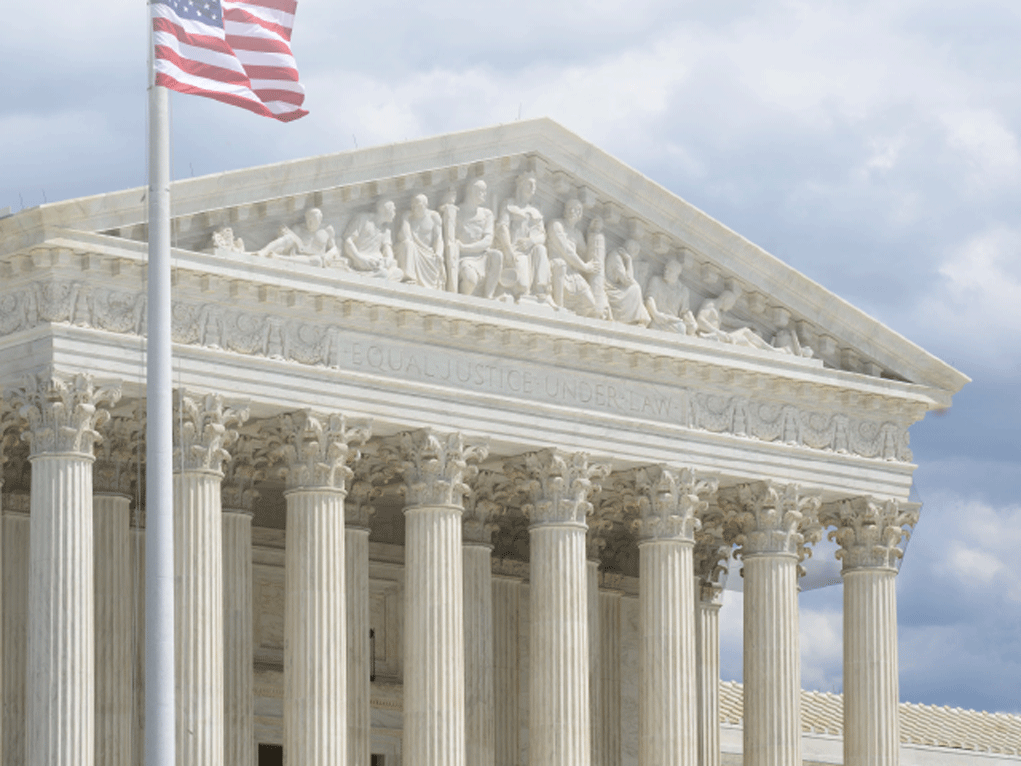

In a historic and revolutionary decision, the Supreme Court has quietly dismantled the racially-based Voting Rights Act (VRA)—a federal law designed to prohibit racial discrimination in voting.
The VRA has for decades governed the process of drawing up voting districts throughout the country, often carving out boundaries in odd ways to ensure that certain candidates in these districts win office.
The case, Louisiana v. Callais, was brought by Louisiana citizens challenging a revised congressional map that created two black-majority districts, on the presumption that the state’s black population was entitled to greater representation in Congress.
The Court’s 6-3 ruling, written by Justice Alito, disagreed, siding with the plaintiffs and knocking out the lynchpin of an entire political structure.
Alito significantly narrowed a key provision of the 1965 VRA law, ruling that to prove a map unfairly discriminates against minority voters, there must be evidence of discriminatory intent in the drawing of voting districts.
In a bombshell opinion, the Court said that the Voting Rights Act provides “no right to have members of a protected class elected in numbers equal to their proportion in the population.”
Yet the drive to equalize the numbers has fueled Democratic lawsuits against Republican districting for more than 40 years!
The manipulation of district boundaries to give one political party an unfair advantage—referred to as ‘gerrymandering”—had evolved into creating voting districts based purely on race, which is illegal, the Court underscored.
This practice has become the norm not only in Louisiana but in dozens of states, ever since the VRA, with its often-cited Section 2, became law in 1965. Section 2 bars racial discrimination and is often used to justify redistricting.
The ruling handed a win to conservatives who have argued that lower court judges were prompting states to unconstitutionally prioritize race in forcing more “minority-majority” districts (voting districts designed so that one racial minority group forms the majority).
“This is one of the most politically explosive Supreme Court decisions ever issued,” wrote Florida attorney and political commentator Jeff Childers. “What the Court did in Louisiana v. Callais was not just about one badly drawn Louisiana map, or even about potential GOP seat pickups in the 2026 midterms. This story is so much bigger than that.”
“SCOTUS quietly unwound four decades of racist politics that corrupted our body politic top-to-bottom,” he stressed.
“To hear the critics tell it, the Supreme Court on Wednesday gutted the 1965 Voting Rights Act and made it harder for racial minorities to vote. It did no such thing,” the Wall Street Journal editorial board stated in its response to the decision. Conservatives view the decision as restoring the Voting Rights Act to its proper form, the paper argued.
Supporters saw in the Court’s ruling an affirmation of a principle that liberals consider almost blasphemous: minority groups don’t have rights. In the American system, individual citizens —not groups— hold the rights. The “rights of minority groups” is a notion coined by liberals with no Constitutional foundation, supporters of the ruling say.
Ruling Torpedoes Myth of ‘Systemic Racism’
The ruling’s fallout is already being felt far beyond Louisiana. Across Congress, state legislatures, councils and courts, a new political chessboard is emerging, as GOP-led states move to redraw maps and dismantle Democratic gerrymandering ahead of the midterms.
NBC reported on these aftershocks with the headline, “US Supreme Court Ruling Shakes up Battle for Congress.” The story quoted two prominent political analysts, Amy Walter and Matthew Klein, who admitted the consequences of Louisiana vs. Callais are so “potentially vast” that it is difficult to imagine all the implications. “We are swimming in uncharted waters,” they wrote.
Republicans and conservatives are celebrating the landmark ruling, saying it demolishes a core tenet of leftist dogma—that “systemic racism” in American institutions warrants government-endorsed policies of “reverse” racism.
“Hail to the Supreme Court for slapping down the obsessive use of race in drawing electoral lines — recognizing that it has nothing to do with boosting equality,” wrote the NY Post editorial board.
“The Court’s common-sense 6-3 ruling struck down a Louisiana districting scheme that added a second majority-black district in the name of complying with the 1965 Voting Rights Act,” the article said. Justice Alito’s majority opinion explained that the VRA has been grossly misinterpreted.
“The Voting Rights Act,” the Court’s opinion clarified, “did not require Louisiana to create an additional majority-minority district” since there was “no compelling interest” to justify such “use of race.” Indeed, that voting map “is an unconstitutional gerrymander, and its use would violate the constitutional rights of [Louisiana’s citizens],” the Court said.
A Changed Country Since the VRA Became Law
Alito also took direct aim at the “woke” claim that racism is so deeply embedded in American life that it justifies sweeping government intervention. He said today’s framework needs to reflect the reality of the past 40 years of American life, including vast social change in the South, once a hotbed of discrimination and persecution of black people.
Justice Alito acknowledged that the VRA was a response to “nearly a century of entrenched racial discrimination in voting, a pervasive evil which had been perpetuated in certain parts of our country in defiance of the Constitution.”
As a result of the Voting Rights Act, he wrote, black Americans, once barred from the polls, now vote at similar rates as the rest of the electorate.
The NY Times, in its response to the ruling, acknowledged this fact by quoting Justice John Roberts in a similar 2013 case. ‘Our country has changed,” the chief justice wrote. The Voting Rights Act was ‘strong medicine,’ he said, but it was the right response at the time to ‘entrenched racial discrimination.’
When it was first enacted, Justice Roberts noted, the voter registration rate of black people stood at 6.4 percent in Mississippi. The gap between black and white registration rates was more than 60 percentage points.
Forty years later, Chief Justice Roberts wrote, the black registration rate in Mississippi was 76 percent, almost four percentage points higher than the rate of registration for white people.
“Sixty years ago, Congress imposed intrusive racial laws in districting as a remedy to once-systemic discrimination [against] black citizens, the NY Post editorial pointed out. “But the civil-rights laws, and America’s social progress, have produced a very different country today, even in the deepest South,” where these racial remedies are no longer needed.”
Supreme Ct: To Redraw Voting Districts, Must Prove ‘Intent’ to Discriminate
“The high court didn’t completely strike down the Voting Rights Act,” the NY Post editors noted. “It only limited obsessive government use of race when no one can point to any actual wrong to be righted.”
Before this landmark ruling, challengers could justify redrawing a voting map by showing that it failed to produce equal representation for minority groups. Now, under the Court’s decision in the Louisiana case, plaintiffs must demonstrate intentional discrimination—a far more demanding standard.
While no one is asserting that racism has been completely vanquished, a mismatch between the size of a minority population and its share of congressional representation, on its own, is no longer treated as sufficient evidence of unlawful discrimination.
The Court’s ruling, with its direct negation of woke dogma, triggered an outpouring of hand-wringing from Democrats and liberal groups. Some high-profile black activists castigated the conservative Court for the majority opinion.
“Not since Jim Crow have we seen this level of systematic disenfranchisement of black voters,” lamented Congressional Black Caucus Chairwoman Yvette Clark. “With the stroke of a pen, this rogue Court has effectively signed the death certificate of the Voting Rights Act, undoing decades of black progress.”
Raphael Warnock, D-Ga., one of a handful of black U.S. senators, warned that the Supreme Court’s decision to trim back the Voting Rights Act will have “a devastating impact on democracy.”
“What happened this week is nothing less than a devastating blow — not only to our democracy, but particularly to people of color in the South,” Warnock said during an appearance on CBS’ Face the Nation. “This question about intent is misleading, and it ignores our history.”
“The Court has acted egregiously,” fumed the Brennan Center for Justice. “The decision is a devastating setback in the long fight for equality for all Americans. It has dismantled the ability of voters of color to have a fair chance for representation in government.”
“The reality is this is much deeper and much further than Louisiana,” Democratic Rep. Troy Carter told CBS News. “This can impact up to 19 or 20 seats in the congressional Black Caucus. It can impact school boards. It can impact city councils and legislative seats. This is, in fact, an explosive move to turn the clock back all the way to pre-1965,” he added.
Do Minorities Need Special Districts Carved Out Just For Them?
In an ironic twist, the NY Times quoted some Republican state officials who took a very different view, applauding last Wednesday’s decision.
“The court rightly acknowledged that the South has made extraordinary progress, and that laws designed for a different era do not reflect the present reality,” the paper quoted Steve Marshall, Alabama’s attorney general.
“We will act as quickly as possible to apply this ruling to Alabama’s redistricting efforts and ensure that our congressional maps reflect the will of the people, not a racial quota system the Constitution forbids,” Marshall said.
Josh Williams, a Republican state representative of a majority-white district in Ohio, also expressed his support for the landmark ruling. “The idea that Black Americans need special districts carved out just for them is complete nonsense,” Williams posted on social media this week.
“It’s a violation of the law and blatantly unconstitutional.”
Last week’s ruling aligns closely with the Supreme Court’s broader shift toward what some call a “colorblind Constitution.” In line with that ideology, the Court ended affirmative action in college admissions, with Chief Justice John G. Roberts Jr. writing that “eliminating racial discrimination means eliminating all of it.”
Other supporters of the Louisiana ruling praised its courage in elevating “content over skin color.”
“The high court’s decision moves the country forward, closer to the day when politics is driven by the content and quality of candidates’ programs, and not by the color of anyone’s skin,” the NY Post editors concluded.
Ruling Expected to Trigger Strong GOP Majority in House
“The Supreme Court ruling is a game changer,” Brad Parscale, Trump’s former campaign manager, observed in an appearance on CBS News.
“Right now, the court’s ruling only applies to Louisiana, but states can challenge their congressional maps based on this ruling, obtain the right to redraw them, and pick up Republican seats. If states are aggressive, we could see a healthy majority in the House for the foreseeable future.”
The ruling blocks states from drawing “majority-minority” districts that favor black voters, giving Republicans a chance to rewrite the congressional maps, particularly in Southern states.
As a result, Republican-led states can now move to eliminate black and Latino electoral districts that were drawn purely to ensure black and Latino candidates would win office.
As the ruling’s fallout filters down to the states, it could enable one to nine more GOP-friendly districts for the 2026 midterms, a CBS News analysis stated. (The current margin is only a GOP lead of three seats.)
Other outlets predicted a much greater lost for Democrats. NPR estimated that “about 15 House districts at risk of being eliminated. And Axios reported the ruling “might enhance the Republican majority in the House by an estimated +19 seats compared to the electoral maps for 2024.”
Some political analysts went even further, estimating that the Court’s ruling would cost Democrats as many as 40 seats in the House.
Rep. Cleo Fields, D-La., whose Louisiana black-majority district was invalidated by the court’s ruling, urged the state to redo its map quickly (or else the court might do so). “It is what it is,” he said. “The final court has spoken. Louisiana now must now redraw lines.”
A proposed map from Republican Gov. Ron DeSantis has already passed the state Legislature and is waiting for his signature. Having anticipated the U.S. Supreme Court’s ruling, Florida expects to add four more Republican-leaning seats by eliminating or shrinking Democratic-leaning districts in Tampa, Orlando and parts of the state’s southeast coast.
Many eyes are on Alabama, whose primaries are scheduled for May 19. The state now has two House seats with predominantly black constituencies, both of which are held by Democrats; Reps. Sanford Bishop in Georgia and Shomari Figures.
Previously, the state had just one Democratic House member which changed after the voting map was redrawn. In light of the Supreme Court’s ruling, Bishop and Figures are likely future targets for having their districts redrawn, predicted the NY Post.
The article said that Alabama Attorney General Steve Marshall has asked the Supreme Court to expedite its review of the two black constituencies this week. Marshall noted the state “will act as quickly as possible” to apply the Louisiana ruling to Alabama’s redistricting efforts, to “ensure that our congressional maps reflect the will of the people, not a racial quota system the Constitution forbids.”
***
Effects of Bombshell Ruling in Blue States
The NY Times predicted the court’s ruling would have far-reaching ramifications. “Some fear,” the paper said in a clear understatement, “that the court’s decision will reverberate beyond the halls of Congress.
The Supreme Court’s rollback of the Voting Rights Act has already had striking effects in blue states. In Illinois, for example, lawmakers were on the verge of approving a constitutional amendment to enable a more favorable Democratic gerrymander, but the Court’s ruling halted the effort just before ratification.
Just the News reported another aftershock: “The Justice Department says it will enforce SCOTUS ruling in every state with racially gerrymandered districts.” The report began with a letter from Senator Eric Schmitt, R-Mo., to the DOJ, reminding that it has federal authority to enforce new rules in all fifty states.
Assistant Attorney General Harmeet Dhillon promptly replied, “We are ON IT!”
Experts say the DOJ can, and likely will, systematically review existing maps across blue states to identify districts where race was an explicit or overriding factor in district drawing. In some cases, a mere look at the map makes it obvious that the Voting Rights Act framework was used as an excuse to draw weirdly shaped “majority‑minority” districts. (Illinois’s 4th Congressional District, for instance, looks like two pretzel-shaped neighborhoods connected by a highway.)
Race Against Time
While many legal scholars expected the Supreme Court ruling to arrive at the end of the term in June—leaving too little time to redraw maps before the midterms—the decision instead came late last week. It set off a scramble among GOP-majority states with districts drawn based on race to revise these legislative boundaries before looming deadlines.
Federal courts cannot change voting or election rules too close to an election. The issue of time thus remains a major factor that could potentially block large-scale redistricting before the 2026 midterm elections.
In many states, primary elections are fast approaching, or candidate filing deadlines have already passed—making large-scale redistricting before 2026 implausible without immediate aggressive action.
Florida, for example, is in the process of redrawing its congressional map. And, in Tennessee, Republican Senator Marsha Blackburn, who is running for governor, called on the state legislature to reconvene and redraw the state’s districts: “I urge our state legislature to reconvene to redistrict another Republican seat in Memphis,” Blackburn said.
Georgia’s primary is set for next month; it would be hard for the state to redraw that map, given that the ballots have already been set. South Carolina is a likely candidate to redraw its map under the Supreme Court’s ruling, but with filing deadlines passed and primaries set, changes this year are highly unlikely.
Mississippi is also considered a strong candidate for a new map, but it has already held its primaries for this election cycle, the article noted.
Press Robinson, a Black activist from Louisiana who was involved with Louisiana v. Callais litigation, predicted the case is “going to affect elections at every single level of the political process.”
“Congressmen, judges, school board members, councilmen. Doesn’t matter. It will affect them all,” Robinson said.