
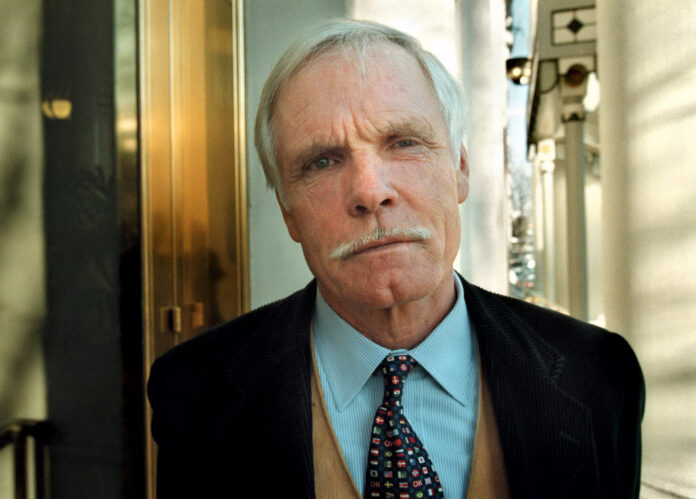

His death was confirmed by Phillip Evans, a spokesman for Turner Enterprises. Mr. Turner revealed in 2018 that he had Lewy body dementia, a progressive brain disorder.
A serial entrepreneur known as “the Mouth of the South” for his bellicosity and bravado, Mr. Turner took over his family’s Georgia-based billboard company at 24, after his father’s suicide, and transformed the business into a media juggernaut that would forever alter broadcasting.
“CNN really heralds the world of Twitter and social networks and interactivity,” said Ken Auletta, a Turner biographer and media writer for the New Yorker. “During the Persian Gulf War, you had a live war for the first time, without commercial breaks. You’d see bombs dropping and people screaming and fire engines roaring. Everything is immediate. It’s the world we live in today. He’s the father of that world.”
Mr. Turner’s achievements transcended journalism and business, and his much-publicized personality made him one of the most captivating public figures of his generation.
The billionaire Mr. Turner championed a world free of conflict but was on friendly terms with dictators and despots, including Saddam Hussein and Vladimir Putin. A Goldwater Republican turned unabashed liberal, he had friends running the political gamut – from former president Jimmy Carter to Sen. Jesse Helms (R-North Carolina), from televangelist Jerry Falwell to communist Cuban leader Fidel Castro, who became a duck-hunting companion.
CNN was initially laughed off as the “Chicken Noodle Network,” in part because of its conspicuously low-budget look and its headquarters in the distinctly non-media capital of Atlanta. In CNN’s first five years, it hemorrhaged tens of millions of dollars.
Gradually, CNN upended the way news was consumed, riveting audiences by covering historic events and dramatic human-interest stories as they unfolded: the space shuttle Challenger explosion in 1986; the 58-hour rescue of a toddler from a well in Midland, Texas, in 1987; the Chinese government’s massacre of pro-democracy student demonstrators in Beijing’s Tiananmen Square in spring 1989; and the demolition of the Berlin Wall – amid the dissolution of the Soviet bloc – in fall 1989.
CNN and its Headline News sister station, which launched in 1982, paved the way for cable ventures by CBS, NBC, ABC and Fox and served, in the view of CNN admirers, as a constant visual watchdog.
“The idea of 24-hour news and global news is his creation,” Christiane Amanpour, who became the network’s chief international correspondent, told the New Yorker. “That’s changed the world. It’s changed people’s relations with their governments. It’s meant that governments can no longer crack down with impunity on protests.”
Mr. Turner, who was treated for bipolar disorder, was powered by hasty enthusiasms and a tolerance for high-wire risk.
After CNN’s distinguished Persian Gulf War coverage in 1990-1991 and its high ratings during the 1995 O.J. Simpson murder trial, Mr. Turner seemed to be at his career apogee when he sold Turner Broadcasting System to Time Warner in 1996 for nearly $7.5 billion.
Biographers observed that, in work or in play, Mr. Turner strove to disprove his father’s dim view of him when he was a young man. The elder Turner was said to have disparaged his son, then a sailing-obsessed college dropout, as a wastrel and an unworthy heir to the family business.
In 1984, having landed on Forbes magazine’s list of the richest people in America, Mr. Turner was speaking to Georgetown University undergraduates when he held aloft a copy of Success magazine with his picture on the cover.
His voice, according to biographer Porter Bibb, trailed off into an eerie whisper, and his eyes searched somewhere above the crowd. “Is this enough?” he asked. “Is this enough for you, Dad?”
Survivors include two children from his first marriage, Laura and Teddy; three children from his second marriage, Rhett, Beau and Jennie; 14 grandchildren; and two great-grandchildren.
(c) 2026, The Washington Post · Adam Bernstein