
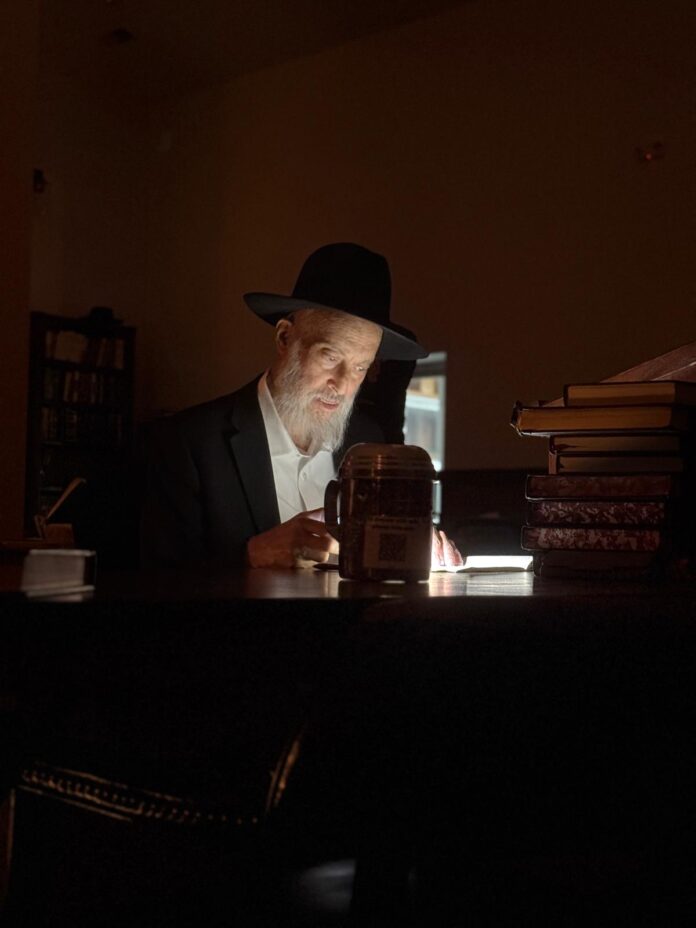

On any given day— Shabbos or weekday, rain or heat—you could find Rabbi Chaim Abadi there. Sitting quietly, watching, noticing, intervening when needed, invisible when not.
When Rabbi Abadi passed away last Shabbos, hundreds of people across Lakewood were left bereft. To them, Rabbi Abadi wasn’t just a brilliant rabbi or a businessman running a construction company. He was “Abba”—the person who was always there for them, no matter where they were or what they had done.
Reb Chaim was a master at helping “at risk” children long before it became mainstream. He gave bachurim who felt out of place in the community a space where they could feel comfortable davening and learning without fear of being judged, where they could connect to Hashem and to others in their own way and develop their Yiddishkeit at their own pace. Acting as an unofficial mechanech and menahel, Reb Chaim, in his unassuming way, took care not only of these teenagers but of their entire families as well.
He didn’t do it with money, speeches or flashy events. He did it with love, patience and acceptance. He did it by listening to them, seeing the good in every person, and pointing it out to those who could no longer see it in themselves.
Reb Chaim was born into a house of greatness. His father, Rav Yitzchak Abadi, zt”l, had been sent by the Chazon Ish at age 19 to learn under Rav Aharon Kotler, zt”l, rosh yeshivah of Beth Medrash Govoha; in his 20s, he was appointed as posek of BMG and the Lakewood kehillah, and he trained many of the next generation of American poskim.
After learning in yeshivos in America and Israel, Reb Chaim joined his father’s kollel in Lakewood while still a bachur, where he learned with tremendous hasmadah and became fluent in Shas and halachah. He was the first person to use aerial maps of Lakewood to work out the complicated techum Shabbos.
For several summers, he served as a counselor in a kiruv camp, introducing the children to Yiddishkeit with the same warmth and strength of character that would later allow him to guide so many teens back to a Torah life.
Friends from those days recall him as a “geshmake Yid” who was fun to be around. With his warm smile, Reb Chaim knew how to make everyone around him feel good. He wasn’t a very talkative person, but he always knew just what to say to brighten up someone’s day.
Reb Chaim and his father were extremely close. Reb Chaim often stated that he never made a move without consulting his father, who provided sage guidance for all aspects of his subsequent klal work. Rav Yitzchak, in turn, recognized his son’s unique maalos and had great faith in his abilities. Reb Dovid Lax, a fellow member of Rav Yitzchak’s kollel and a longtime friend and chavrusa of Reb Chaim, recalls that when Rav Yitzchak moved to Eretz Yisrael in 1993, Reb Dovid asked him who would be able to answer his halachic questions now. Reb Yitzchak responded, “I will be just a phone call away, but you can always ask Chaim.”
In the early 1990s, while still a young man, Reb Chaim was diagnosed with cancer for the first time. He later shared that he “made a deal with Hashem” at that point that if he would recover, he would dedicate his life to helping Hashem’s children. The resilience he displayed in overcoming that first illness became his trademark.
Several years later, he survived a difficult relapse and eventually suffered a serious eye condition that made him almost blind in one eye. Yet those challenges never deterred him from keeping his word to help others. That was his driving force until the end.
Reb Chaim’s construction company provided him with parnasah, but its true purpose was to serve as a vehicle for his chesed. Despite his quiet demeanor, he was adept at making connections and building relationships. He developed close ties with employees and officials in the local government and building department who facilitated permits and approvals for individuals, schools and yeshivos. It was often quipped that “when all else fails, call Chaim Abadi,” as he was known as a man who could get things done.
That Reb Chaim helped so many different people in so many different ways became apparent at the levayah, where all segments of the community were represented. He helped many people with shidduchim, shalom bayis and parnasah. He was a man of discreet, targeted interventions. Reb Dovid Lax remembers that Reb Chaim once asked him to deliver a paper bag to a certain address before a Yom Tov, instructing him, “If they ask, tell them that you’re just making a delivery and don’t know what it is, but you’re certain that it is the correct address.” The bag contained cash, intended for a family he had discovered was in need.
But the legacy for which he would be most remembered was still to come. In 2001, the Lakewood kehillah was still mainly based around BMG, with most residents being either current or former talmidim of the yeshivah. However, a small group of teenagers didn’t blend into the uniform yeshivah environment. As one of them recalls, “We were not ‘at-risk’ per se, but we just didn’t fit into the mold. Since there were only a few boys in Lakewood then who wore blue shirts or jeans and the like, we gravitated toward each other. We became a chevrah and hung out together. We didn’t feel comfortable in any of the local shuls since we stuck out like sore thumbs, so we weren’t davening anywhere.”
One day, several of these boys were in what was then the only pizza shop in Lakewood, when Reb Chaim walked in. Noticing the group, he came over with a smile to say hello and ask how they were doing. When he asked where they davened, one boy, Uri Beane, bluntly replied that he didn’t daven in any shul because he didn’t feel comfortable in any of them. He added that many of his friends felt the same way. Reb Chaim asked, “If I can arrange a place for you to have your own minyan, will you get the guys together?”
Uri said that he would.
An hour or so later, Uri got a phone call. Reb Chaim—always the doer—had found a place and a time for them: a 9 a.m. daily Shacharis minyan in Rav Gissinger’s shul, to be followed by breakfast from Bagel Nosh. Uri called his friends, and the minyan started the next day. “Making those phone calls was the extent of my contribution,” Uri recalls. “From then on, Chaim did everything. He was the type of person who never asked for help. He did it all on his own. He would personally call or go to boys’ homes to wake them up for davening. He arranged everything.”
Another early member of the group, Ovadia Malachi, relates that after the minyan started, some local residents who found the later time convenient began davening with them, and they were finding fault. Someone complained that some of the boys were davening in shorts, saying it was not b’kavodig. The next day, Rav Gissinger came into the shul at the end of davening and banged on the bimah. He announced to his congregants, “This is not your minyan. This is their minyan, and they can dress however they want in their minyan.”
From then on, the boys began referring to it as “Minyan Shelanu,” and the name stuck. A few years later, Reb Chaim opened a parallel haven for girls, called The Chill.
As Lakewood grew, so did the Minyan; it moved several times before settling into its current location. Over the past 26 years, hundreds of boys have become part of the Minyan family. For every one of them, Rabbi Abadi was their Abba: a rav, mentor, guide, counselor, adviser and trusted friend.
To read more, subscribe to Ami

