

A newly published report indicates that the Trump administration’s abrupt decision to suspend its naval escort effort in the Strait of Hormuz came after Saudi Arabia denied critical military access, effectively halting the operation shortly after it began.
President Donald Trump had unveiled the mission, known as Project Freedom, on Sunday, describing it as an effort to safeguard international shipping by escorting foreign vessels through the strategically vital waterway. By Tuesday, however, he announced that the initiative would be paused to make room for diplomatic engagement with Iran.
According to the NBC News report, the suspension was driven in part by Riyadh’s decision to block the United States from using key military facilities and its airspace. Without access to Saudi bases and overflight routes, the operation was unable to proceed, coming to a stop roughly 36 hours after it was launched.
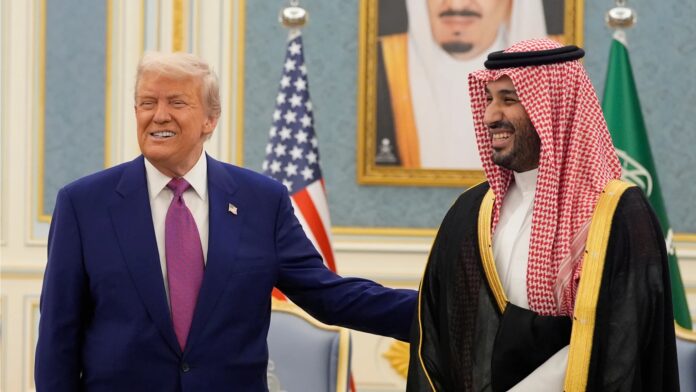
Tensions reportedly escalated after Trump publicized the operation without prior coordination with Saudi leadership. Sources said that in response, the Kingdom withheld access to Prince Sultan Airbase and limited U.S. flights across its territory, removing essential logistical support needed to protect commercial ships traveling through waters affected by Iranian interference.
Although a White House official maintained that “regional allies were notified in advance” of the plan, officials in Oman and Qatar suggested they only learned of it after the announcement had already been made public. Efforts to resolve the disagreement—including a reported conversation between President Trump and Crown Prince Mohammed bin Salman—did not succeed in closing the gap, leading to the current pause in operations.
Military planners have long emphasized the importance of regional cooperation in Middle Eastern operations, often referring to the concept of ABO—access, basing, and overflight. Without support from neighboring countries such as Saudi Arabia, Jordan, and Oman, U.S. forces face significant limitations in their ability to defend maritime traffic from threats posed by Iran.
“Because of geography, you need cooperation from regional partners to utilize their airspace along their borders,” one US official quoted by NBC News said.
At the same time, Trump delivered a pointed message to Iran on Wednesday, posting on Truth Social, “Assuming Iran agrees to give what has been agreed to, which is, perhaps, a big assumption, the already legendary Epic Fury will be at an end, and the highly effective Blockade will allow the Hormuz Strait to be OPEN TO ALL, including Iran.”
He also issued a stark warning, writing, “If they don’t agree, the bombing starts, and it will be, sadly, at a much higher level and intensity than it was before.”
Later, speaking with reporters at the White House, Trump said negotiations with Iran had been progressing positively, noting that its leadership appears eager to reach an agreement and has signaled a willingness to forgo nuclear weapons.
“They want to make a deal badly. And we’ll see if we get there. If we get there, they can’t have nuclear weapons. It’s very simple,” Trump stated.
He went on to describe what he characterized as a severe weakening of Iran’s military capabilities, saying that its naval fleet, air force, and defensive systems have been largely destroyed.
“They had a Navy with 159 ships, and now every ship is blown to pieces and lying at the bottom of the water. They had an Air Force, lots of planes, and they don’t have any planes. They don’t have any anti-aircraft. They don’t have any radar left. Their missiles are mostly decimated. They have some. They have probably 18, 19 percent, but not a lot by comparison to what they had. And their leaders are all dead. So I think we won.”
Trump added that while the administration is seeking a diplomatic resolution, further escalation remains an option if talks do not produce results.
“Now we have to get what we have to get. If we don’t do that, we’ll have to go a big step further. But with that being said, they want to make a deal. We’ve had very good talks over the last 44 hours, and it’s very possible that we’ll make a deal,” said Trump.
He reiterated his central demand, stressing once more that “Iran cannot have a nuclear weapon. And they won’t. And they’ve agreed to that, among other things.”
{Matzav.com}