
 Matzav
New Polls Show Netanyahu Expanding Lead as Bennett-Lapid Alliance Loses Ground
New polling indicates shifting political momentum in Israel, with Prime Minister Bibi Netanyahu widening his advantage while the joint political effort of Naftali Bennett and Yair Lapid shows signs of weakening.
A Channel 12 News survey published Thursday night found that if elections were held today, Netanyahu’s Likud would be tied with the Bennett-Lapid “Together” party, with each receiving 25 seats. The figure represents a one-seat drop for the Bennett-Lapid alliance compared to the previous week’s poll.
The survey also showed a slight decline for Gadi Eisenkot, whose “Yisra!” party fell by one seat to 14. The broader opposition bloc dropped to 59 seats—down one from the previous poll—without counting Arab parties.
In contrast, Yair Golan’s Democrats party gained one seat, rising to 11. Avigdor Lieberman’s Yisrael Beiteinu held steady at 9 seats, as did Aryeh Deri’s Shas and Itamar Ben-Gvir’s Otzma Yehudit, each also at 9.
United Torah Judaism, led by Yitzchak Goldknopf, strengthened to 8 seats. Among Arab parties, Mansour Abbas’s Ra’am and the Hadash-Ta’al alliance were each projected to win 5 seats.
Several parties remained below the electoral threshold, including Bezalel Smotrich’s Religious Zionism (2.9%), Yoaz Hendel’s Reservists party (1.0%), Benny Gantz’s Blue and White (1.5%), and Sami Abu Shehadeh’s Balad (0.8%).
The poll also explored hypothetical political alliances. If Eisenkot’s party were to merge with Lieberman’s Yisrael Beiteinu, the joint list would become the largest faction with 25 seats, surpassing both Likud and the Bennett-Lapid alliance, each projected at 24. In that scenario, the opposition bloc would reach 60 seats—without Arab party support—while the coalition would fall to 50.
Another scenario examined a potential alliance between Hili Tropper and Hendel. In that case, Likud would drop slightly to 24 seats but still emerge as the largest party. The Bennett-Lapid list would decline to 23 seats, and Eisenkot’s party to 13. The new Tropper-Hendel list would cross the threshold with 5 seats.
When respondents were asked who is best suited to serve as prime minister, Netanyahu led in every matchup. Against Bennett, he received 39% support compared to Bennett’s 36%. The same margin held against Eisenkot, 39% to 36%. Against Lieberman, Netanyahu maintained 39%, while Lieberman trailed with 24%.
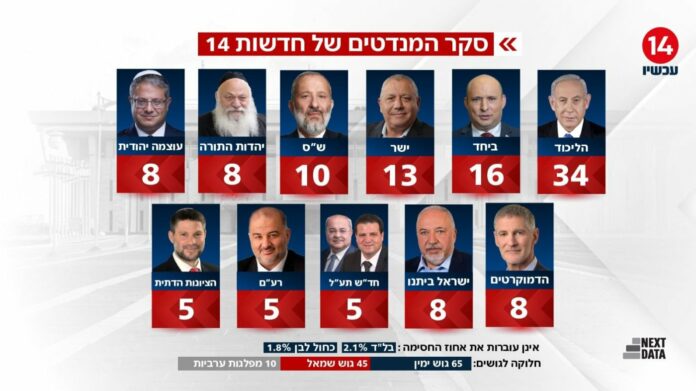
A separate poll conducted by Channel 14 and the NEXT DATA research firm painted an even stronger picture for Netanyahu. Based on a sample of 721 respondents, the survey showed the right-wing bloc maintaining a solid 65-seat majority—enough to form a stable government under Netanyahu’s leadership.
In that poll, Likud surged to 34 seats, making it the clear largest party. The Bennett-Lapid alliance dropped sharply to 16 seats—four fewer than it had received in the first poll following its formation. Eisenkot’s party climbed slightly to 13 seats.
Among other parties, Shas was projected at 10 seats and United Torah Judaism at 8. Otzma Yehudit, the Democrats, and Yisrael Beiteinu each received 8 seats, while Religious Zionism stood at 5.
The broader center-left bloc lagged far behind, totaling just 45 seats. Arab parties Hadash-Ta’al and Ra’am each received 5 seats but were not seen as playing a decisive role in coalition-building. Balad (2.1%) and Blue and White (1.8%) remained below the threshold.
On the question of leadership, Netanyahu held a commanding lead, with 56% of respondents saying he is best suited to serve as prime minister. Eisenkot placed a distant second with 20%, followed by Bennett at 18%, Lieberman at 5%, and Gantz at just 1%.
The poll also measured public opinion on security issues. A majority of 59% said Israel should seize additional territory in Lebanon to eliminate the threat posed by Hezbollah, while 32% opposed such a move and 9% said they had no opinion.
Another question examined perceptions of coordination between Netanyahu and U.S. President Donald Trump regarding the campaign against Iran. A majority of 58% described the cooperation as “full and close,” while 33% said it was only partial, and 9% believed there was no coordination at all.