
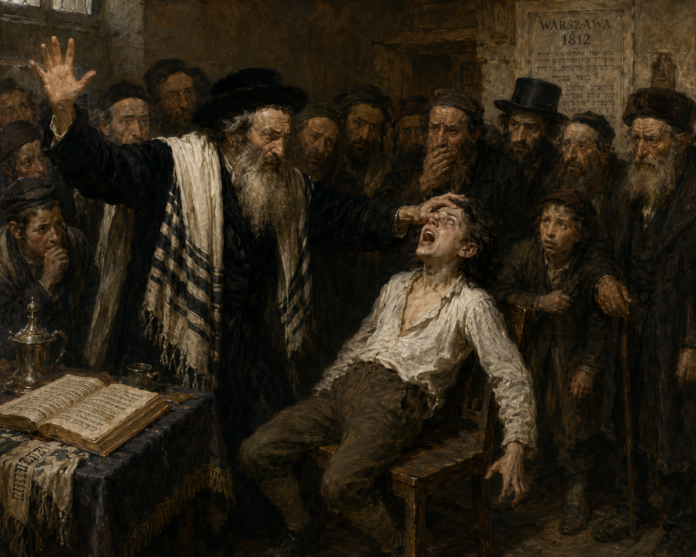

New York (VINNEWS/Rabbi Yair Hoffman) Few things in Jewish religious life have provoked such enduring fascination — and such enduring controversy — as the dybbuk.
The notion that the floating neshama of a deceased Jew, denied even the cleansing process of Gehenam and a rest in the grave on account of aveirah, might attach itself to the body of a living person and speak through that person’s mouth, is grounded in serious sources: in the writings of the Arizal as transmitted by Rav Chaim Vital, in the Sha’ar HaGilgulim, and in numerous responsa and case-records from the sixteenth century onward.
Yet it has also been a recurring object of skepticism — sometimes from within the rabbinic establishment itself, more often from the maskilim, who found in such accounts a convenient instrument for ridiculing what they regarded as the credulity of traditional Jewish society.
Four interpretive possibilities present themselves at the outset:
- The mekubal, the father, and the child were jointly engaged in an elaborate scheme to extract money from the credulous.
- The proceedings were a carefully constructed pious fraud — subterfuge in the service of strengthening religious observance.
- The account is a substantially accurate record of a genuine gerush ruchos.
- The document is the creation of a maskil who fashioned the episode, in whole or in part, to discredit traditional Jewish piety.
That such possibilities must even be entertained is itself instructive. There is a story told of two men who once succeeded in defrauding none other than the Chofetz Chaim. As the Chofetz Chaim walked through the street, one of them, carrying a heavy sack of flour, contrived to spill its contents over him. A second man, feigning outrage that anyone could so mistreat the saintly figure, rushed forward to brush him clean — and, in the course of his ostentatious solicitude, picked the Chofetz Chaim’s pocket. That such an episode was even possible reminds us that financial chicanery and religious charlatanism were no less prevalent in earlier generations than in our own.
In 1818, Warsaw was only a few years removed from the collapse of the Napoleonic-era Duchy of Warsaw and was now under the Russian-controlled Congress Kingdom of Poland. The Russian-backed bureaucracy was increasingly interested in monitoring Jewish communal life, especially anything deemed irrational, separatist, or socially destabilizing. This may explain why this story was preserved in the account of the police.
The account that follows is preserved in the Wyznaniowe Królestwa Polskiego (Central Religious Authorities of the Kingdom of Poland) collection, File 1424, pages 2 through 5, which contains materials bearing on Jewish communal affairs in nineteenth-century Congress Poland. It is a Polish police report describing a mekubalic exorcism performed in Warsaw during the Aseres Yemei Teshuvah of 5579 (early September 1818). The original report was composed by some unnamed observer, almost certainly affiliated either with the Haskalah or with the Russian-Polish administrative apparatus, which took a documentary interest in what it regarded as Jewish superstition. The reporter’s tone is hostile: he describes the proceedings as “fanatical works,” characterizes the mekubal as a “joker” and “fanatic,” and dismisses the assembled spectators as “blinded.” I originally saw it in Glen Dynner’s “Men of Silk.”
Regardless, the document preserves a remarkable wealth of accurate mekubalic detail, each element of which corresponds with striking precision to the Lurianic and the dybbuk tradition: the imposition of cherem and the sounding of the shofar; the binding of parchment inscribed with shemos; the gartel invoked as a spiritual seal; the prescribed egress of the spirit through the small toe of the left foot; the chicken designated as the vehicle of tikkun through ritual shechitah; the pidyon nefesh collection from those present; and the deliberate selection of the Aseres Yemei Teshuvah as the propitious moment for the proceedings.
A SHORT DESCRIPTION OF THE FANATICAL WORKS OF A JEWISH MEKUBAL HERE IN WARSAW, RECENTLY ARRIVED FROM BIAŁYSTOK, DURING THE PAST MONTH
Two months ago, a Jew from Wyszogród arrived in this city together with his twelve-year-old son, who suffered from an affliction resembling convulsions, with the intention of admitting him to the Jewish Hospital for treatment. When, after some time, the boy’s condition failed to improve, the father agreed to go to a mekubal who had recently arrived from Białystok, and inquired whether he might be of assistance. The mekubal, having examined the boy, pronounced that the affliction was in fact possession by an evil spirit — the soul, as he explained, of a Jew who had apostatized to Christianity, and who, condemned in consequence to eternal wandering, could find no repose in the grave. This jester thereupon undertook to expel the spirit by means of cherem, the invocation of angelic names, the sounding of the shofar, and the like. He appointed a day for the operation, on which a great multitude of the Jewish populace assembled, that they might bear witness to the wonders of this holy man. The mekubal conducted the following exchange with the spirit:
[Reporter’s footnote in the original: The afflicted boy answered throughout on behalf of the spirit, but the mekubal insisted that it was the spirit itself that spoke; and the bystanders were so blinded that they maintained the boy’s lips and tongue did not so much as stir during the conversation.]
MEKUBAL: Declare yourself. Who are you, from where were you summoned, and by what right have you entered into this child, who has not yet attained the age of accountability?
“RUACH”: (makes no reply)
MEKUBAL: Will you not answer? Then I shall place you under the ban — in the names of Tac, Tacyock, Tartarach, and the rest.
“RUACH”: What would you have of me?
MEKUBAL: That you depart from this child. Where shall I send you?
“RUACH”: Send me to the forest, that I may enter into some tree.
MEKUBAL: That I will not do, for there I should know no rest from torment.
“RUACH”: Yet I command you to depart; and should you persist in your refusal, I shall employ harsher measures against you. (Turning to the crowded assembly:) Bring me the shofar!
(The shofar is brought. Blasts are sounded.)
At this harsh tone the boy fell into convulsions and began to heave his chest and snort. The mekubal, observing this, instructed the bystanders to recite a psalm; the convulsions immediately ceased; and he declared that “the spirit had sought to depart by way of the throat and so to strangle the boy.” Since this operation had been begun on Friday, and the Sabbath — upon which even spirits rest — was drawing near, the consummation of the wonder was deferred until Sunday. The mekubal’s first act on Sunday was to remove the afflicted boy to another house, where he might do battle with the spirit more conveniently. There he bound the head and hand of the possessed boy with parchments inscribed with Divine Names; upon his stomach he laid the cherem, written upon half a sheet of paper. The interrogation then resumed:
MEKUBAL: And now — will you at last consent to depart?
“RUACH”: I shall depart. But know that I shall enter into one of the great magnates of the realm, and shall declare to him that the Jews compelled me to possess him, and I shall move him to do you grave injury.
MEKUBAL: You shall not dare. See — I am even now gathering money on your behalf, that your soul may be redeemed. (Each spectator was required to contribute something.) And I shall gather more besides — only depart!
“RUACH”: Then I shall enter into an unsealed vessel — that is to say, into a Jew who wears no gartel.
MEKUBAL: (to the assembly) For the love of Heaven — fasten your belts at once!
(All comply. The boy now falls once more into convulsions and begins to snort. The mekubal orders a psalm to be sung, whereupon the convulsions cease. The fanatic declares once again “that the spirit had sought to depart by way of the throat and to strangle the boy.”)
MEKUBAL: I charge you: do this child no manner of harm. You shall depart through the small toe of his left foot.
(He resumes his incantations.)
“RUACH”: I will go — but suffer me to depart at the same hour at which I entered.
MEKUBAL: And at what hour was that?
“RUACH”: On Tuesday, between nine and ten of the night.
To this the rabbi consented, and the operation was postponed accordingly until Tuesday. When the hour arrived, the spirit requested a further extension, until that watch of the night when the angels offer their praises to God. The mekubal granted this also, and instructed the spirit to enter into a hen — for, as he explained, when Jews should recite their prayers over the bird and slaughter it according to the laws of shechitah, the spirit would thereby be released from its torment, while he himself would intercede on its behalf through prayer before the Almighty. At half past twelve in the night, the spectators are said to have heard a sudden report and a cry; and at that very moment, as the mekubal averred, the spirit took its leave.
On the following day, when the mekubal approached the boy, he asked him: “Who is this before you?” The boy replied that it was a rabbi. He extended his hand to him and remarked that this was the first occasion on which he had ever beheld him. The mekubal then bade him to daven, and he did so — though previously he could not even bear to hear words of holiness, and had recoiled even from pronouncing the Name of Hashem.
(This section marked “omit” in the original)
I myself was present with the boy on the eve of the spirit’s departure, on the seventh of September, 1818. Casting his eyes upon me, he inquired: “Is this man also a Jew? I do not recognize his garments.” I answered that he was. The boy then said: “If you are indeed a Jew, show me your cyces” — these being the threads that a Jew binds to his garment, worn in the form of a shawl.
He was bidden to be silent. Yet he pressed further: “And why does he shave his beard, if he is a Jew?” The reply was given that this is the custom of the German Jews. “But it is against the commandment that the beard may not be shaved!” the boy cried. At this every man fell silent, and I was no little discomposed, for every eye in the room turned upon me. The boy was asked what ailed him. “My head, my bones, my whole body — all of me is in pain,” he answered. I observed, however, that his sight was clear, that he was cheerful, smiled often, and spoke with full sense and coherence. After the spirit’s departure, it is reported, he suffered neither convulsions nor any other affliction — save only that the small toe of his left foot remained crooked, a thing which the mekubal forbade him to display for a long while afterward.
Closing Reflection
This document — datable to early September 1818, with the exorcism itself concluded on the sixth of Tishrei, 5579 — constitutes a remarkable piece of historical evidence, valuable in spite of, or perhaps because of, its hostile Haskalah framing. The reporter’s contempt does not prevent him from preserving authentic ethnographic detail, and every element so preserved corresponds to the Lurianic and chassidic dybbuk removal tradition that descends from Rav Chaim Vital, through the Baal Shem Tov, to his disciples and theirs.
The account captures a moment of profound cultural collision: a Białystok-trained mekubal, almost certainly operating within the chassidic stream — the gartel detail is decisive on this point — performing an exorcism upon a possessed boy from Wyszogród, before the assembled Jewish community of Warsaw, during the Aseres Yemei Teshuvah of 5579, while a Haskalah reporter records the proceedings with the avowed intention of exposing what he termed “fanatical works.” That the apparent voice of the dybbuk should itself rebuke German Jewry for the shaving of beards is suggestive: even the maskilic reporter could not wholly remove from his account the proceedings’ character as an authentic Polish-Jewish religious and cultural protest against the reforms emanating from Berlin and Hamburg.
The narrative deserves a place alongside the better-known cases preserved in Sha’ar HaGilgulim, Shivchei HaBesht, Niflaos HaRebbe, and the various nineteenth-century kuntreisim documenting gerush ruchos in Poland and Lithuania. It deserves to be read not as its maskilic reporter intended it to be read, but as a window onto the living world of Polish-Jewish activity on the eve of Yom Kippur, 5579.
The author can be reached at [email protected]