
 Vos Iz Neias
They Are Someone’s Child: A Viral Burrito Shop Sign and the Mitzvah of Onaas Devarim
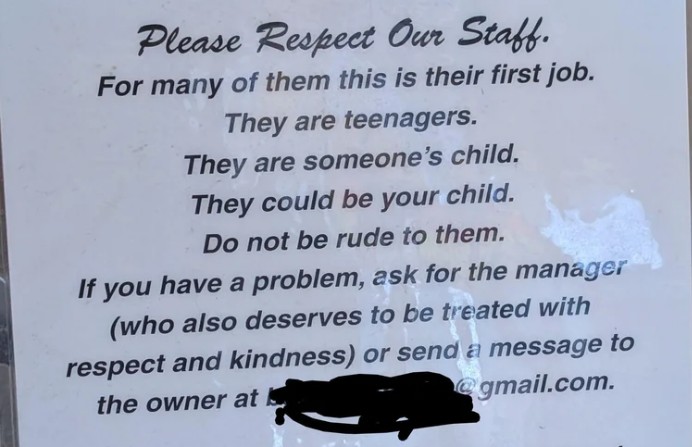
New York (VINNEWS/Rabbi Yair Hoffman) A burrito shop somewhere in heartland America has gone viral this week for posting a simple sign outside its establishment. The sign, photographed and shared on Reddit this week, read: “Please respect our staff. For many of them, this is their first job. They are teenagers. They are someone’s child. Do not be rude to them. If you have a problem, ask for the manager (who also deserves to be treated with respect and kindness) or send a message to the owner.” The shop concluded sadly that it is unfortunate they have to post this, but “some people need reminding.”
According to a University of Missouri study, young workers today value respectful communication in the workplace above trendy perks. A separate study published in the International Journal of Environmental Research and Public Health found that approximately 82% of hospitality industry employees face violent or rude customers.
But what does the Torah say about all this?
THE PROHIBITION OF ONAAS DEVARIM
The verse in VaYikra (25:17) states, “velo sonu ish es amiso” – do not cause pain to your fellow. This Mitzvah is generally referred to as Onaas Devarim, or simply Onaah. The Sfas Emes explains that the underlying purpose of this Mitzvah is to ensure that we have a sense of complete oneness as a people. Causing another pain is prohibited because it creates division among people.
The Talmud in Bava Metziah 58b records the teachings of three sages who explain that the prohibition of Onaas Devarim – verbal abuse – is by far more serious than the prohibitions of Onaas Mamon, monetary abuse. A person can recover financial loss; emotional pain is something else entirely.
THE TEENAGE WORKER
Now consider the teenage cashier or counter worker at a restaurant. He or she may be 16, perhaps 17 years old. This is often the first job that he or she has ever held. The young employee is learning how to handle money, how to deal with the public, how to manage stress, and how to function in an adult environment for the very first time. The customer who barks at him for getting an order slightly wrong, or who berates her because the line is moving slowly, is not merely being unpleasant. According to the Torah, he is committing a serious aveirah.
The Rambam in Hilchos Mechirah (14:12) lists numerous examples of Onaas Devarim. Among them is causing embarrassment to another in any way. The Gemara in Bava Metziah explicitly mentions that one who causes another’s face to turn pale in public has, in a sense, shed blood. The worker who is publicly humiliated by an angry customer in front of a line of people experiences exactly this type of pain.
INACTION TOO
Rav Yechiel Michel Stern cites the Chikrei Laiv (YD Vol. III #80) that this prohibition can even be violated through inaction. If a customer ignores the cheerful “Hello, how can I help you?” of a teenage employee, refuses to make eye contact, and treats the worker as though he or she does not exist – this too may fall under the prohibition. The young worker, just trying to do his or her job, walks away feeling diminished and invisible.
A particularly sad aspect of this prohibition is that violators are often completely unaware that they are causing pain. They may even characterize the worker as “overly sensitive” if a complaint is raised. But the Torah does not measure the prohibition based upon whether the perpetrator believes himself to be hurtful. The Torah measures it by the actual pain caused.
RAV ELYASHIV ZATZAL’S PRINCIPLE
A question was once posed to Rav Elyashiv Zatzal: A man was refusing to give his wife a get. Was it permissible to pressure his parents by threatening to expose an illegal activity that one of them had been involved in, in order to force him to give the get? Rav Elyashiv responded with a clear, “No.” There is no permission to cause pain to another, no matter what the underlying purpose may be.
The kal vachomer is striking. If one cannot cause pain to a third party even to free an agunah, how much more so does one have no right to cause pain to a teenage worker because the burrito wrap is not tight enough.
WHAT GOES AROUND
There is a fascinating debate between Rav Henoch Leibowitz zatzal and Rav Chaim Shmuelevitz zatzal regarding Pnina and Chana. Pnina taunted Chana with the intention of pushing her to daven harder. Rav Chaim Shmuelevitz zatzal (Sichos Mussar) explains that the principle of “what goes around comes around” – middah keneged middah – applies even when the underlying intention is 100% leshaim shamayim. Rav Henoch Leibowitz zatzal held that there must have been some infinitesimally small trace of improper motivation involved.
Either way, the lesson is clear: causing pain to another is so serious that even with completely pure intentions, there are consequences. How much more so when the customer is causing pain merely because he is having a bad day, or because he is impatient, or because he simply does not view the teenage worker behind the counter as a fellow human being deserving of dignity.
The Midrash Rabbah (Bereishis 14:19) explains that Menashe, Yoseph’s son, was punished for “finding” the goblet in Binyamin’s sack – even though he was acting on his father’s instruction. He caused the Shevatim pain, and they ripped their clothing in agony. The Midrash teaches that Menashe’s portion of inheritance was therefore “ripped” as well. Causing pain has consequences, even when one is following orders.
EXAMPLES IN HALACHA
The Rambam in Hilchos Mechirah (14:12) lists examples that are remarkably relevant to the restaurant context. Asking someone a question in a subject area where the person being asked does not know the answer is a violation of Onaah. How often does a customer demand to know obscure ingredient details from a worker who has only been on the job for two weeks? The Gemara in Bava Metziah 58b states that inquiring about the price of an item without any intention of purchasing it is also a violation. The customer who keeps a teenage worker tied up at the counter for fifteen minutes asking endless questions, with no intention of ordering, is in violation of this prohibition.
Other manifestations of Onaas Devarim include displaying anger toward another, name-calling, threatening, and blaming one’s own behavior on someone else’s actions. The customer who shouts, “You’re an idiot! How hard is it to get an order right?” is potentially in violation of multiple aspects of this aveirah simultaneously.
THE BURRITO SHOP’S WISDOM
The sign at the burrito shop captured something profound, perhaps without realizing it. “They are someone’s child.” This is the very essence of how the Torah views every human being. Every person standing behind a counter is the son or daughter of parents who love them. Every teenage worker is a tzelem Elokim. Would the irate customer behave that way toward his own son? Would he scream at his own daughter for getting an order slightly wrong?
The shop’s management asked customers to consider, essentially, the principle that Hillel famously taught a potential convert: that which is hateful to you, do not do to your fellow. Hillel was paraphrasing the very Mitzvah of “velo sonu ish es amiso.”
RECTIFYING THE VIOLATION
What if one has already violated this prohibition? What must be done? The Talmud (Yoma 87a) teaches that there is an obligation to attempt to placate the offended party. The Gemara cites verses in Mishlei: “Press your plea with your neighbor.” There are opinions that one must even apologize before three rows of three people.
In practical terms, this means that the customer who realizes after the fact that he was rude to a teenage worker has an obligation to return, apologize sincerely, and seek mechilah. Yes, this is uncomfortable. Yes, it requires swallowing pride. But it is the halachic obligation.
A FINAL THOUGHT
The fact that a burrito shop in America had to post a sign reminding adults to be respectful to teenagers is, indeed, sad. But perhaps the silver lining is this: the message resonated with millions of people online. Perhaps somewhere within all of us, we recognize that this is correct, that this is how it ought to be.
It is almost Shavuos. The Torah told us this 3,338 years ago minus 11 days or so. Maybe the world is finally catching up.
The author can be reached at [email protected]