
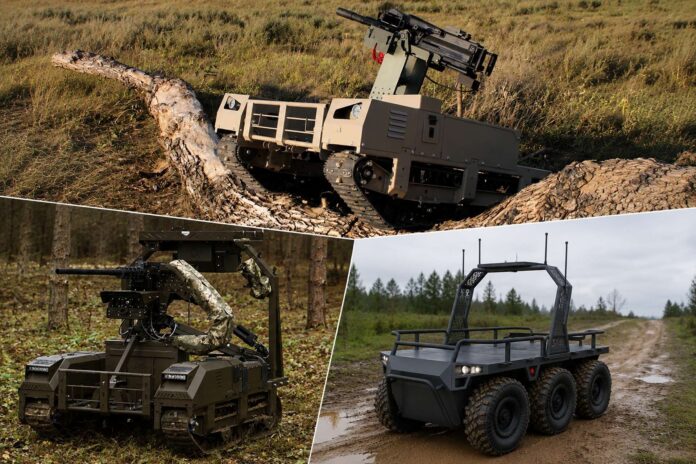

Ukraine is dramatically increasing production of unmanned ground vehicles as the country pushes to shift dangerous front-line logistics and evacuation work away from soldiers and toward robotic systems.
The Ukrainian Defense Ministry said it intends to sign contracts for 25,000 unmanned ground vehicles during the first half of 2026, a sharp increase from previous years as Kyiv accelerates its investment in battlefield automation.
Defense Minister Mykhailo Fedorov announced the initiative after discussions with domestic defense manufacturers, describing the effort as part of a broader strategy to have robots eventually carry out all front-line resupply operations.
In an April 18 Facebook post, Fedorov wrote that “UGVs perform important logistics and evacuation tasks on the front line” and revealed that Ukrainian troops completed more than 9,000 robotic missions during March alone.
The ministry has now established a goal of making robotic systems responsible for 100% of front-line logistics missions, marking a major shift from traditional manned supply operations that have become increasingly vulnerable to Russian drone surveillance and attacks.
The planned procurement would represent a major jump from earlier production levels. Ukraine aimed for 15,000 ground robots in 2025 after managing to field only several hundred units in 2024.
According to Ukrainian officials, the Defense Procurement Agency has already finalized 19 agreements totaling 11 billion hryvnias, or approximately $250 million. Authorities have also started arranging contracts extending into 2027 in an effort to provide manufacturers with longer-term production stability.
Ukraine recently approved one of its newest robotic systems, the Bizon-L, under NATO cataloging procedures. The robot, capable of carrying payloads weighing up to 300 kilograms across distances of 50 kilometers, was formally cleared on April 23 for use by Ukrainian and allied forces.
Officials say NATO standardization could eventually allow the system to be exported and integrated with partner militaries.
The unmanned vehicles are designed for a range of battlefield tasks, including transporting ammunition, evacuating wounded troops, laying mines, and even participating directly in combat operations.
Ukrainian forces have reportedly experimented with mounting RPG-7 grenade launchers onto robotic platforms. Ukrainian media reports also described at least one machine-gun-equipped ground robot that allegedly maintained an infantry position by itself for roughly six weeks.
President Volodymyr Zelensky highlighted the expanding use of robotic systems during an April 14 speech marking Arms Makers’ Day. Zelensky said Ukrainian units conducted more than 22,000 unmanned missions over the previous three months and unveiled a goal of producing 50,000 ground robots during 2026.
Ukraine’s defense-tech sector has rapidly expanded since the war began. Officials say the number of companies involved in ground drone production has grown from none in 2022 to approximately 300 firms operating under Brave1, a state-supported military technology initiative focused on grants and battlefield testing.
The Defense Ministry has also introduced a digital procurement platform that allows military units to place direct orders with more than 280 domestic defense manufacturers.
Despite the rapid growth, significant obstacles remain.
A Ukrainian developer identified as “Flash” told Euromaidan Press that communications systems — rather than the robots themselves — remain the biggest challenge limiting large-scale deployment. According to the developer, electronic warfare continues disrupting the control signals needed to operate the vehicles effectively on the battlefield.
Ukrainian engineers are continuing work aimed at improving communications reliability, signal protection, and the overall survivability of the robotic systems under combat conditions.
{Matzav.com}