

As President Donald Trump prepared to leave for his delayed visit with China’s leader, Xi Jinping, in Beijing, he warned that the future of the shaky ceasefire with Iran is comparable to that of a gravely ill patient on “life support” with no more than a 1% chance of recovery. Trump issued that dire prognosis to White House reporters after flatly rejecting as “unbelievably weak” the latest response to his demands that Iran’s leaders give up their nuclear weapons program, re-open the international waters of the Strait of Hormuz, halt its production of ballistic missiles, and end support for its terrorist proxies, including Hezbollah, Hamas, and the Houthis.
After reading the latest Iranian proposal, Trump responded in a written message on his Truth Social account, declaring, “I have just read the response from Iran’s so-called ‘representatives.’ I don’t like it — TOTALLY UNACCEPTABLE.”
In an earlier Truth Social post, Trump wrote that, “Iran has been playing games with the United States, and the rest of the World, for 47 years, [but] they will be laughing no longer!” signaling his dissatisfaction with Iran’s latest response to his demands, which Trump had been led to believe he would receive on Friday, May 8, but which was not delivered by Pakistani mediators to U.S. negotiators until Sunday, May 10.
Trump told White House reporters Monday that among several non-starters in Iran’s response was a demand that the U.S. recognize Iran’s sovereign right to dictate which ships will be permitted to pass through the Strait of Hormuz. The strait has long been considered to be international waters, and therefore open to free passage by ships flying the flags of all nations. The Iranian response also demanded the withdrawal of all U.S. military forces from the region, and billions of dollars in cash reparations from the United States for the damage Iran suffered during the 40-day campaign of joint U.S.-Israeli air strikes.
Iran’s Latest Offer to Trump Was “A Waste of Time”
Trump said that he considered their latest response to be so unacceptable that he did not “waste his time” by reading it to the end. In its response, Iran refuses to even begin discussions on the fate of its nuclear weapon program until 30 days after the U.S. had agreed to Iran’s initial demands for a permanent ceasefire and the reopening of the Strait of Hormuz under full Iranian control, including the right to charge tolls for any ship passing through. The main problem with that proposal is that the most crucial issue from the American point of view, the fate of Iran’s nuclear program, would be left completely unresolved until a later stage in the negotiations, while Trump has demanded that the first requirement of any deal would be for Iran to make an immediate and binding commitment to end its uranium enrichment for as long as 20 years, turn over all of its highly enriched uranium and pledge never to seek to develop a nuclear weapon capability again.
According to a report from Iran’s semi-official Tasnim news agency, last week’s Iranian response also demanded the immediate end of the American naval blockade of Iran’s ports in the Persian Gulf, a guarantee of no further attacks, an end to all Israeli attacks on Hezbollah in Lebanon, the release of all of Iran’s financial assets that are frozen in foreign banks and the lifting of all U.S. sanctions on Iran’s economy, including the ban on Iranian oil exports.
Iran Keeps Going Back on Its Concessions
Trump told White House reporters that the latest written Iranian peace proposal, which was presented to the U.S. through Pakistani mediators last week, also omitted several key concessions to which Iran’s leaders had verbally agreed. One of them was the surrender of Iran’s 972-pound (440 kilograms) stockpile of 60% highly enriched uranium, which American weapons experts believe is enough for Iran to quickly build 11 nuclear weapons with a minimal amount of further enrichment to 90% purity. According to Rafael Mariano Grossi, the director-general of the U.N.’s nuclear monitor, the International Atomic Energy Agency (IAEA), about 440 pounds from that stockpile was buried by the 15-ton bunker buster bombs that American B-2 warplanes dropped last June, destroying the tunnels of the underground Iranian nuclear facility at Isfahan.
Trump also said reporters that in a discussion of the current disposition of Iran’s enriched uranium stockpile two days earlier, Iran’s negotiators had told their American counterparts, “You’re going to have to [go into the bombed sites] to take it.” That was because what Trump had referred to as the dangerous “nuclear dust” of highly enriched uranium is now buried so deep under the rubble of the bombed nuclear sites that only the U.S. and China have the sophisticated excavation tools necessary to retrieve it. But, Trump said, that key concession was also entirely missing from the written response that Iran presented last week.
According to a Wall Street Journal report, the Iranians had proposed diluting some of its 60% highly enriched uranium so that it would no longer be suitable for making a nuclear weapon, and transferring the remainder to a third country, such as Russia, for safekeeping.
Trump Says Iran Is Defeated, but the War Is Not Yet Over
Meanwhile, in an interview with independent television journalist Sharyl Attkisson, Trump emphasized that the Iranian site that contained the highly enriched uranium was being “very well surveilled” by the U.S. Space Force, and warned that “if anybody got near the place, we will know about it, and we’ll blow them up.” He also said that the enriched uranium could be easily removed by U.S. forces “whenever we want.”
Trump also made it clear that when he says that Iran has been defeated, he was not saying that all U.S. combat operations against Iran are now finished. “No, I didn’t say that,” he said, and then explained that while Iran is “defeated, that doesn’t mean they are done [fighting].”
Trump also said that if he decided to resume the air strikes on Iran, the U.S. military could “go in for two more weeks and do every single target. We have certain targets that we wanted, and we’ve done probably 70 percent of them, but we have other targets that we could conceivably hit… that would just be final touches” of the plan for Iran’s complete destruction.
Last week, the White House also sought to portray “Operation Epic Fury,” the original military campaign against Iran, which began on February 28 with the joint U.S.-Israeli decapitation raid on Tehran, as having, in fact, ended with Trump’s ceasefire announcement on April 7, long before the operation had reached the 60-day limit for congressional authorization under the 1973 War Powers Act.
On the other side, in an interview with Iranian state media, General Akrami Nia, a spokesman for the Iranian military, said that its forces were at “full readiness” to protect the sites where the enriched uranium is stored, against the possibility that American or Israeli forces might try “to steal it through infiltration or helicopter-borne operations.”
Trump said that Iranian negotiators had also verbally “guaranteed that Iran wouldn’t obtain nuclear weapons for a very long period of time,” but that promise, too, had been omitted from the official written proposal that Iran presented through the Pakistanis.
Iran’s Leadership Is Divided Between Pragmatists and “Lunatics”
Nevertheless, when White House reporters asked Trump whether he thought that a peace deal was still possible with the current leaders of Iran’s Islamic regime, he responded that it was.
Trump said that one of the reasons that a deal has remained elusive is the fact that the United States and Israel had wiped out the top ranks of its leadership on the first day of the war, and that more than two months later, those dead Iranian leaders have not yet been fully replaced.
The president then added that breaking the current diplomatic deadlock depends upon the outcome of the increasingly bitter dispute between the more pragmatic Iranian government officials who desperately want to reach an agreement to end the conflict with the United States, against the hardline “lunatics” of the powerful Islamic Revolutionary Guard Corps (IRGC) who want to keep fighting the U.S. to the bitter end, regardless of the suffering it will cause for the Iranian people. Trump also said these “lunatics” believe that their stubborn resistance will eventually force him to give in to their demands. But they are wrong.
Trump also offered a response to his critics who complain that he has no clear plan for dealing with Iran’s obstinate leaders. “I do have a plan,” Trump insisted. “The plan is that Iran cannot have a nuclear weapon.”
Trump indicated that another fundamental problem with trying to negotiate any deal with Iran’s current leaders is the lack of certainty. For example, he said that when Iran’s negotiators had agreed to his demand that it abandon its nuclear ambitions, “it [didn’t] mean much because the next day they forgot.” Trump also added a warning that if Iran did not agree to the latest deal that he has offered them, it was “going to [suffer] a lot of pain.”
Last week, while Iran was reviewing President Trump’s latest offer, he revealed some of its specifics. “It’s an offer that basically said they will not have nuclear weapons. They’re going to hand us the nuclear dust and many other things that we want,” Trump explained.
Over the weekend, as the White House was waiting for the latest Iranian proposal to arrive, Secretary of State Marco Rubio and White House Middle East envoy Steve Witkoff met in Miami with the Qatari Premier Mohammed bin Abdulrahman Al Thani, who has been serving as one of the key intermediaries in the negotiations between the U.S. and Iran.
Trump Planning His Next Move Against Iran
On the day before Trump left Washington for his trip to China, he held a high-level meeting in the White House Situation Room to discuss America’s next step in the ongoing conflict with Iran. The other participants included Vice President JD Vance, Secretary of State Marco Rubio, Defense Secretary Pete Hegseth, CIA Director John Ratcliffe, Chairman of the Joint Chiefs of Staff General Dan Caine, and Trump’s special negotiating envoy Steve Witkoff.
They discussed America’s various diplomatic and military options now that the extended ceasefire has transformed the conflict from a war of missile and drone attacks by Iran on Israel and U.S. allies, in response to the intensive campaign of air strikes by the U.S. and Israel on Iran, into a war of slow economic attrition for both sides due to the extended closure of the Strait of Hormuz to virtually all maritime traffic.
Many believe that Trump decided to wait until after his trip before making his next move against Iran in the hope that he could persuade China’s leader that it is very much in his own country’s best interests to persuade Iran to give up its nuclear program and to permit the resumption of free passage for all shipping through the Strait of Hormuz.
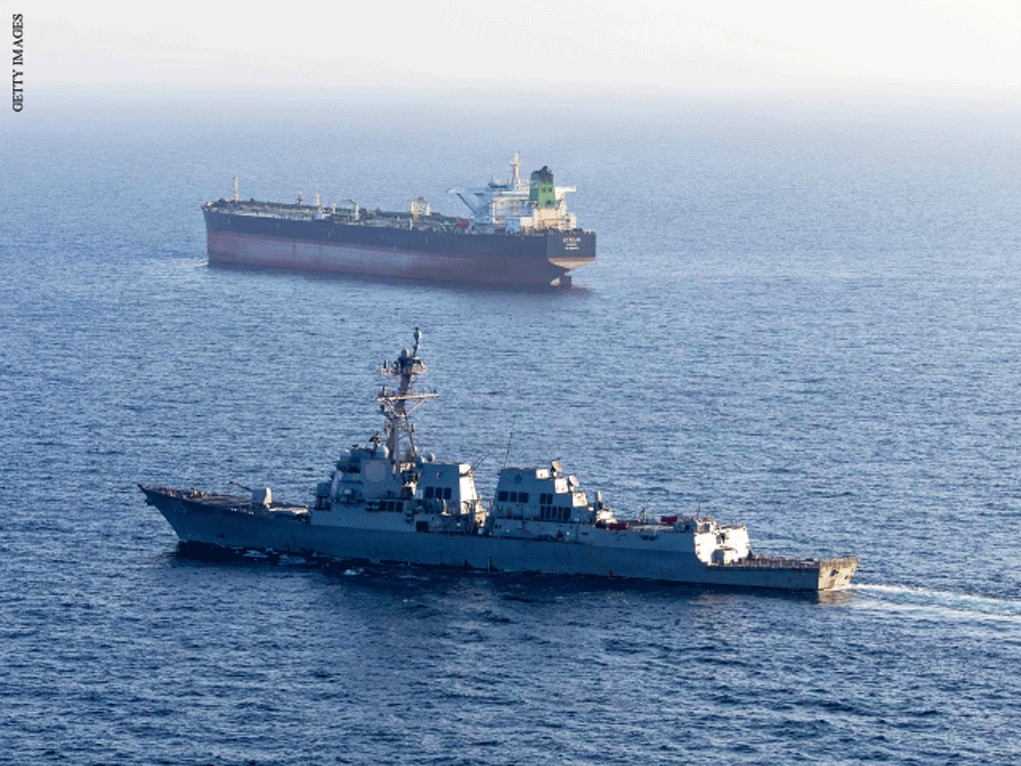
One of Trump’s current options is to restart Project Freedom, a military initiative under which American guided missile destroyers and up to 100 American warplanes to escort commercial maritime traffic to assure their safe passage through a new passage in the Strait of Hormuz along its southern coastline that is within the territorial waters of Oman, and as far away from the Iranian coastline on the other side of the strait as possible.
Iran’s Leaders Are Betting That Trump Will Give In to Their Demands
Meanwhile, the continued American naval blockade of Iran’s Persian Gulf ports means a loss to Iran’s economy of more than $440 million a day, most of that from lost oil export income.
Nevertheless, Iran’s ability to maintain its closure of the Strait of Hormuz in the face of the massive American military buildup has apparently encouraged its current hardline leaders to believe that they can dictate terms to President Trump. They are betting that Trump will be forced to accept their demands to get them to reopen the strait to all maritime traffic, because if the spike in the price of gas at the pump for American consumers due to the global oil shortage continues for much longer, it will threaten Trump’s hopes for maintaining Republican control over the House and Senate in the upcoming November midterm election.
As a result, according to Raz Zimmt, the director of the Iran research program at Israel’s Institute for National Security Studies, “Iran is not prepared to return to the prewar status quo and is demanding long-term economic and security guarantees that the war will not resume and that it will be able to derive economic benefit from the situation.”
The growing confidence of Iran’s regime that it will not only survive the current conflict but actually emerge triumphant was reflected in a recent post on X by Iran’s President Masoud Pezeshkian in which he declared: “We will never bow down to the enemy, and if there is talk of dialogue or negotiation, it does not mean surrender or retreat.”
Iran Claims Its New Supreme Leader Is Recovering From His Injuries
Iran’s new Supreme Leader, Mojtaba Khamenei, according to Iranian reports, has recovered from the serious injuries he received from an Israeli bombing on February 28, the first day of the war. Iran’s military chief, Ali Abdollahi, has told Iranian state television that during a recent meeting with him, he received “new directives and guidance for the continuation of operations to confront the enemy.”
In a previous Iranian state media press release, Khamenei was reported to have issued a written statement on April 30 declaring that Iran will never give up its nuclear weapons program. “We and our neighbors across the waters of the Persian Gulf and the [Gulf] of Oman share a common destiny,” the statement said. “Foreigners who come from thousands of kilometers away to act with greed and malice have no place in it — except at the bottom of its waters.”
In addition, the Wall Street Journal reports that for the first time since he was injured, an Iranian official, Mazaher Hosseini, has issued a report confirming the nature of those injuries to Khamenei’s back and kneecap. Hosseini also reported that since his back problem has been resolved, and his injury appears to be healing, Khamenei is expected to resume a normal schedule of public appearances soon.
As Iran Keeps Attacking Its Neighbors, the UAE Quietly Strikes Back
Meanwhile, Iran has continued to attack its Persian Gulf oil-producing neighbors. The United Arab Emirates (UAE), Kuwait, and Qatar have all reported that they had come under attack again, likely by Iranian drones, on Sunday.
The Defense Ministry of the UAE said that Iran launched two attack drones at it on Sunday, both of which the UAE claimed were “successfully engaged.” While Iran denied having launched those drones at the UAE, it also warned the UAE that it risked a “crushing response” if it were to take any retaliatory actions against Iran in response.
That warning was particularly interesting because of a report by the Wall Street Journal that back in April, shortly after Trump announced the ceasefire, the UAE secretly launched its own retaliatory strike against Iran’s oil refinery on Lavan Island in the Persian Gulf, independent of the ongoing U.S. and Israeli air strikes. Iran did report at that time that the refinery had been attacked, igniting a large fire which would disable its operations for a few months. Even though Iran did not make any specific accusation as to who was responsible for that attack, it did launch retaliatory attacks against both the UAE and Kuwait at that time.
According to the Wall Street Journal, the Trump administration was aware that the UAE had carried out the attack. However, instead of being upset about the violation of the newly announced ceasefire, the Trump administration, according to the report, “welcomed the participation of the UAE, and any other Gulf states that want[ed] to join in the fight” against Iran.
While the UAE’s foreign ministry declined to confirm or deny on the Wall Street Journal report, it did point to its previous statements, issued immediately after some of the 2,800 times during the 40 days of war following February 28 that Iran attacked the UAE with ballistic missiles and drones, in which the UAE reserved the right to retaliate military at whoever was responsible for targeted it with a hostile act.
Shortly before the first air strike of the war by the U.S. and Israel, all of the Gulf countries agreed not to participate, nor permit their airspace or air bases to be used for attacks on Iran.
Nevertheless, once the war started, Iran decided to launch numerous missile and drone attacks against all of the Gulf’s population centers, energy infrastructure, and airports. This was an apparent effort to generate more diplomatic pressure on the United States from the Gulf states it had targeted to halt its air strikes on Iran.
The retaliatory attack by the UAE on Iran was also significant because it represented a break with the unanimous practice by all of the other neighboring Persian Gulf states, which chose not to respond in kind when they were attacked by Iran many times during the 40-day war, even though many of those Iranian attacks did significant physical damage and caused several casualties.
Iran Has Damaged Its Image Among Its Friends
However, because Iran’s attacks on the UAE were far more numerous than against any other target, they did significantly more economic damage by forcing the UAE to close its airports, hurting its tourism business. It also damaged the UAE’s luxurious hotels and many other buildings, hurting the country’s real estate market and triggering a wave of worker furloughs and layoffs. According to the Wall Street Journal report, the repeated Iranian attacks generated a “fundamental shift in the [UAE’s] strategic outlook. . . that now sees Iran as a rogue actor bent on undermining the country’s economic and social model based on expatriate talent and a reputation for safety and stability.”
The report that the UAE did join at least once in attacking Iran did not come as a complete surprise because of the publication in mid-March of news photos taken of a jet fighter in one incident, and a drone in a second incident, flying over Iran, which did not appear to belong to Iran, Israel, or the U.S. The jet fighter in the first picture was later identified as a French Mirage, and the drone in the second photo was identified as a Chinese-made Wing Loong drone, both of which are known to be in regular use by the military of the UAE.
It was also no surprise that the UAE decided to retaliate against Iran with an air strike because, according to former U.S. Air Force General Dave Deptula, the UAE’s air force is widely known in the region to be well-trained and well-equipped with a variety of modern warplanes and surveillance drones. As a result, General Deptula asked, rhetorically, “If you have that capable of an air force, why would you sit back and absorb attacks from Iran without responding?”
According to the Wall Street Journal report, the UAE also retaliated against Iran using non-military means. For example, it backed a draft resolution at the United Nations that authorized the use of force if necessary to in order to break Iran’s closure of the Strait of Hormuz to all maritime traffic. It also reportedly closed several schools and social clubs in the city of Dubai that have known ties to Iran, and began denying applications submitted by Iranian citizens for tourist visas and transit rights through its territory.
Iran responded to that move by publicly accusing the UAE of joining with the U.S. and Israel in their attacks on Iran.
In addition, the UAE has broken with its oil-exporting Persian Gulf neighbors by recently announcing its resignation from OPEC, thereby declaring its independence from the global oil-producing cartel. The UAE was also the only state in the region that received Israeli assistance in defending itself against Iranian attacks in the form of an operational Iron Dome missile defense battery, complete with a small contingent of Israeli troops trained in its use.
Other reports of suspected Iranian attacks on its neighbors include a statement on X Sunday from the general staff of the Kuwait army, which said that, “At dawn today, the armed forces detected several hostile drones in Kuwaiti airspace, which were dealt with in accordance with established procedures.”
That was in addition to reports in April by the Kuwaiti army of two separate drone attacks on its northern border posts, as well as an undefined infrastructure target causing significant damage.
Also on Sunday, Qatar’s Defense Ministry reported that a commercial cargo vessel coming from Abu Dhabi was attacked by a drone in Qatari territorial waters, causing a small fire that was contained before doing extensive damage. However, in that case, Iran’s Fars news agency reported that “the bulk carrier that was struck near the coast of Qatar was sailing under a U.S. flag and belonged to the United States.”
The Shaky Ceasefire Is Hanging by a Thread
All of these attacks took place despite the ceasefire with Iran that President Trump announced on April 7. That truce is supposedly still in place, but “hanging by a thread,” because Trump is rapidly running out of patience while waiting for a more acceptable response from Iran’s new hardline leaders. Each new Iranian attack on its neighbors, or American interdiction of a ship traveling to or from an Iranian Persian Gulf port, is making the continuation of the currently shaky ceasefire increasingly unlikely.
The IRGC’s navy on Sunday also issued a warning in response to an incident the previous Friday in which U.S. warplanes opened fire and disabled two old Iranian oil tankers, which had been retired from regular service. They were apparently being moved to Iran’s Kharg Island oil terminal in the Persian Gulf to serve as makeshift floating storage tanks for oil being pumped by Iranian wells that can no longer be shipped because of the American naval blockade of Iran’s Persian Gulf ports.
Iran is trying to store as much of that excess oil as possible to avoid the necessity of shutting down its oil wells, which might cause lasting damage, reducing their total oil production capacity.
The IRGC Navy warned that any attack on Iranian oil tankers or commercial vessels would be met with a “heavy assault” against one of the many U.S. military bases in the region or one of its “enemy” ships.
Netanyahu’s Revealing “60 Minutes” Interview
Meanwhile, in a lengthy interview with CBS News “60 Minutes” reporter Major Garrett, Prime Minister Binyomin Netanyahu said that the war against Iran would not be finished, from the Israeli point of view, until all of the large stockpile of 60% enriched uranium was “taken out of Iran.”
In addition, Netanyahu explained. “There are still enrichment sites [in Iran] which have to be dismantled. There are still proxies that Iran supports. There are ballistic missiles they want to produce. Now we’ve degraded a lot of it, but all of that is still there, and there is work to be done.”
When he was then asked how Iran’s enriched uranium could be removed from the country, Netanyahu replied simply that “You go in, and you take it out.”
“If you have an agreement, you go in, and you take it out. Why not? That’s the best way,” he said, but he also made it clear that if there was no agreement, the U.S. and Israel would eventually have to go into Iran to remove it by force.
Netanyahu also said that Iran is not really interested in a permanent ceasefire in Lebanon, because it wants Hezbollah fighters to remain in their military positions in South Lebanon, threatening Israel’s border permanently in order to “hold its people [living in northern Israel] hostage.”
The prime minister also suggested that “If this [Iranian] regime is indeed weakened or possibly toppled, I think it’s the end of Hezbollah. It’s [also] the end of Hamas, [and] it’s probably the end of the Houthis, because the whole scaffolding of the terrorist proxy network that Iran built collapses if the regime in Iran collapses.”
However, Netanyahu then clarified that even though the toppling of the Islamic regime would be the ideal outcome, it was possible, but not guaranteed.
Netanyahu Ready to Start Reducing Israel’s Dependence on the U.S.
Netanyahu also stated that he intends to start immediately the process of weaning Israel off the current level of military support it receives from the U.S., which is $3.8 billion each year. He wants to bring that number down to “zero over the next decade,” because that is the only way, he believes, to establish Israel’s status as a truly independent military power.
He also said that when he told that to President Trump, and to his own people in Israel, “their jaws dropped,” in amazement and disbelief.
“I don’t want to wait for the next Congress” to start that process, Netanyahu insisted, “I want to start now.”
At the end of the interview, Netanyahu revealed how he was changed by the impact of Hamas’ heinous attack on Israel on October 7, 2023. “Before October 7, I was considered perhaps the most restrained prime minister in Israel’s history,” Bibi said, with regard to his reluctance to engage Israel in military battles. “Obviously, it changed on October 7, because they [Hamas] were going to annihilate us.
Netanyahu also said that when it first took place, “I didn’t think it was just an attack by Hamas. I saw it as it was an attack by the [entire] Iranian axis to try to annihilate us. . .
Israel Is Now in the Ultimate Battle Between Good and Evil
“And I said on the second day of the war, ‘We’re going to change the Middle East. We’re going to change this condition where they’re ganging up on us, thinking they’re going to wipe out the one and only Jewish state, wipe out 3,500 years of Jewish history. It’s not going to happen, not on my watch. And I said to Israel’s citizens, ‘Not on your watch’ either.”
It is clear that Netanyahu sees the battle against Hamas in Gaza, the battle against Hezbollah in Lebanon, and the remaining threat from Iran’s reduced but still dangerous nuclear and ballistic missile threat, and Iran’s continuing support for its network of Islamic terrorism, as a parts of a historic, global war between the forces of good and the forces of evil, with Israel and the Jewish people once again on the front line.