

Republicans Poised to Flip up to 14 US House Seats
“Republicans just won the redistricting war — and boosted their slim hopes for holding the House in November,” an explosive article in the left-wing Politico proclaimed.
The article went on to explain that, against all expectations, a liberal Virginia Supreme Court struck down a congressional map that would have potentially netted Democrats as many as four seats in the 2026 midterm elections.
Only 3 extra seats are needed to flip the U.S. House of Representatives to a Democratic majority.
“Shell-shocked Democrats are scrambling to pick up the pieces after the Virginia Court quashed a new map designed to help them seize control of the House in November’s midterms,” The Hill wrote, echoing the media’s doomsday tone over the Democratic defeat.
The ruling constitutes a significant setback to the party’s efforts to counteract the Republicans’ redistricting push in red states around the country, political analysts say.
“House Democrats fell into a state of anguish after the ruling came out,” reported Axios. “Depression dominated Democrats’ public statements and private text threads as the party absorbed its third redistricting loss in 12 days.”
With mid-term elections around the corner, fierce battles between the major political parties over congressional redistricting have erupted across America, as Democrats and Republicans seek to secure a majority in the House of Representatives in November.
The race to redistrict to gain an electoral advantage received a major boost after last week’s bombshell Supreme Court decision that ruled that “gerrymandering” by race (manipulating voting districts based purely on race) was unconstitutional.
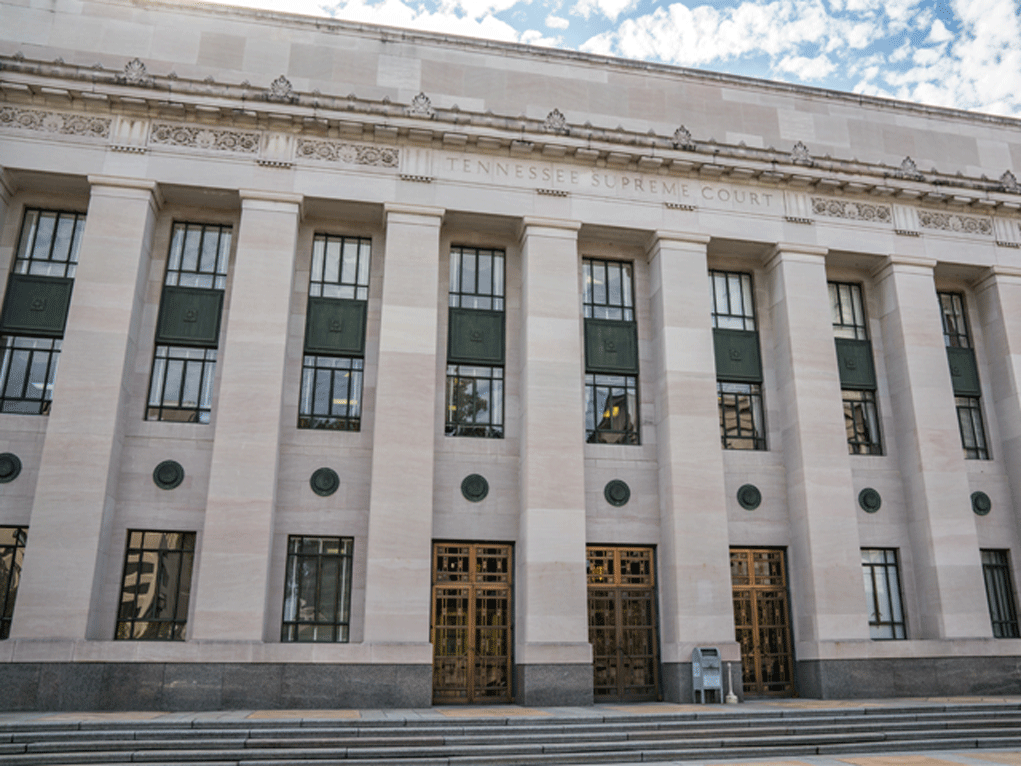
On the heels of that landmark decision, new court rulings in Virginia and Tennessee striking down Democrats’ race-based districts have all but locked in Republican gains through “redistricting,” giving them as much as a 10-seat boost,” Politico reported.
Virginia Victory
Virginia’s legal battle unfolded after voters approved the Democrat-backed referendum in an April special election by a narrow margin.
Republicans quickly challenged the process in court, arguing that Democrats rushed the amendment through the Legislature to bypass constitutional safeguards and secure an unfair advantage.
Democrats lost at the trial court; the case went all the way to the Supreme Court of Virginia, which tossed it out.
The referendum was so flawed, experts say, that not even Virginia’s liberal Supreme Court could rescue it. The justices struck down the entire plan, ruling that all votes for or against the proposed redistricting amendment were unconstitutional.
Virginia Circuit Court Justice Jack Hurley said the Democratic-led legislature had violated procedural requirements by placing a referendum on the ballot that missed the deadline for such an initiative, because early voting for the 2025 election had already started.
“This violation irreparably undermines the integrity of the referendum vote and renders it null and void,” the majority wrote.
Using even stronger language later in the opinion, Hurley underscored that the legislature’s failure to follow the rules “incurably taints the resulting referendum vote and nullifies its legal efficacy.” The state’s Supreme Court said Virginia will therefore need to use its congressional map from 2021 instead.
Immediately following the stinging defeat, Virginia’s Democrats launched an overnight petition asking the U.S. Supreme Court to intervene. Legal experts say the petition stands little chance of succeeding, with even a NY Times article predicting it would be rejected.
“Some legal experts believe the petition will fail,” the paper admitted, “because the case is not about federal law or the U.S. Constitution but rather a challenge to a state law which is outside federal jurisdiction.”
After investing eight months and nearly $70 million to pass the referendum,” the Times wrote, “the ruling was a huge blow to Democrats.” This was $70 million of donor money that can no longer be spent on the midterm races.
Virginia Senate Minority Leader Ryan McDougle, the main plaintiff in the case, told Fox News that the entire state of Virginia should be applauding the state supreme court.
The Supreme Court ruling today affirms what we all know: you cannot violate the Constitution to change the Constitution,” McDougle said. “The Justices of the Supreme Court of Virginia affirmed that even the General Assembly must follow the law. This ruling is not a partisan one — it is a constitutional one.”
“The rule of law is the foundation of our Commonwealth,” the Virginia Senate Minority Leader added, “and today it has been upheld.”
Furious Pushback
Furious Democratic leaders have vowed to fight the verdict. House Minority Leader Hakeem Jeffries, D-NY, accused Virginia’s high court of “defying the will of the voters,” saying he was exploring “how to unravel this decision.”
He pledged to “employ maximum warfare, everywhere, all the time,” a fitting priority for the aspiring Jeffries, who stands first in line to become the House Speaker should Democrats reclaim the House in November.
Democrats had hoped the Virginia changes—later invalidated by the Supreme Court—would help offset Republican gains elsewhere, particularly after GOP-led states such as Texas redrew congressional boundaries favorable to Republicans.
Democrats had been aiming to implement maps that would turn their party’s current 6-5 edge in the U.S. House into a 10-1 advantage, but those hopes are fading.
“The recent court ruling gives Republicans a decisive edge in the redistricting war,” Politico said.
Chaos at Tennessee Capitol
The court rulings outlawing the use of race in districting have thrown the Democratic Party into a state of frustration and frenzy, media outlets report.
“Fury and Desperation Grip Dems After Friday’s Ruling,” the NY Times declared after the Virginia Supreme Court handed down its opinion.
“Democrats in Panic Mode after GOP Set to Gain 10 Seats,” Sky News reported. “Chaos erupts at Tennessee Capitol as Redistricting Maps Move Forward,” a local Tennessee paper cautioned.
The paper quoted the shocking observations of an eyewitness to the proceedings at the Tennessee Capitol as Democrats and protesters resorted to throwing fits inside the Capitol building.
“The final vote in the Tennessee State House sounded less like a legislative proceeding and more like a group meltdown in a psychiatric ward,” the eyewitness wrote. Demonstrators howled, Democrats pounded their desks, flailed their arms and stomped out, and state troopers removed raucous gallery members.
“One Democrat Senator leaped onto on a table waving a banner, and refused to come down.
“Despite the cacophony, the Republicans calmly approved the map, presumably using sign language to communicate their “yea” votes through the racket.”
After the Capitol cleared out, Lt. Gov. Randy McNally called out Rep. Charlane Oliver for her crude and raucous protest from the top of her desk, as a vote was taken on a new congressional map.
“Senator Oliver’s outrageous and unprecedented display on the Senate floor today was disgraceful. She disrespected her colleagues, her constituents and this state,” McNally said. “There is simply no excuse for what she did.”
“The Senate floor is for deliberative debate, not calculated performative disruption,” McNally said. “It was conduct unbecoming of a senator — pure and simple.”
Despite the orchestrated uproar, Tennessee Republicans got the vote done. Governor Bill Lee has already signed the redistricting bill designed to give Republicans one more seat in Congress and protect President Trump’s control over the House.
Tennessee currently has eight Republicans and one Democrat — Rep. Steve Cohen, whose district is centered in the city of Memphis — in its House delegation. Under the new map, Republicans would be favored to sweep all nine seats, while Tennessee’s only Democratic representative may lose his seat.
Under the old map, Cohen’s “majority-minority” district seat was created under the Voting Rights Act, whereby voting districts are designed so that one racial minority group forms the majority.
But last week, the Supreme Court overturned that regulation, and effectively ruled that courts must first determine that there’s a provable case of racial discrimination before ordering race-based redistricting.
A mismatch between the size of a minority population and its share of congressional representation, on its own, is no longer treated as sufficient evidence of unlawful discrimination.
Mayhem in Alabama
Alabama is one of several states attempting to install new congressional district boundaries ahead of the November midterm elections. Its capital, Montgomery, was the scene of mayhem last month, similar to the raucous uproar in Memphis, as Republican lawmakers completed the redistricting vote during a thunderstorm evacuation.
Observers described Democrat officials screaming incoherently, gibberish, refusing to leave the lectern, and pulling fire alarms that blared incessantly throughout the proceedings.
As the thunderstorm escalated, evacuation notices lit up everyone’s phones, water began floating lawmakers’ cars away, and floodwaters seeped into the state house’s ground floor, puddling in the hallways.
Ironically, the violent storm ended a Democratic filibuster, which allowed Republicans to call the vote. The lawmakers cast their votes even as they were evacuating the chamber amid blaring fire alarms, with State Senator Greg Albritton standing guard at the chamber doors, making sure each member voted before they left.
The video scenes from the two legislatures “were so troubling and bizarre they almost defy description,” a journalist wrote. “Terrible optics for Democrats. Where one might expect dignity and professionalism, there was only mob mania; petulant, adolescent acting out. It smacked of desperation.”
Alabama Gets Green Light to Redraw Map
In yet another win for the GOP in the “gerrymandering wars,” Alabama received the green light from the U.S. Supreme Court on Monday to enact the redistricting effort the state had voted for in late April—one that could boost Republicans in two Democrat-controlled voting districts.
In a 6-3 ruling, the justices cited their blockbuster ruling in the Louisiana case last week that outlawed racial districting. A lower court had ordered Alabama’s congressional map to include two majority-black voting districts. The Supreme Court ruling this week vacated that order.
Republican Gov. Kay Ivey signaled last week that Alabama was “ready to quickly act” should the courts issue favorable rulings related to redistricting.
Trump and GOP allies argue the recent court ruling restores fairness after years of aggressive Democrat gerrymandering efforts in blue states nationwide.
Republicans currently hold a slim majority of just 3 seats in the House of Representatives, with 218 seats for GOP members to 215 for Democrats. (As of April 23, 2026, there is one vacant seat due to the death of Rep. Doug LaMalfa, R-Ca. A special election to fill that seat will be held on Aug. 4, 2026.)
With Louisiana, Florida, Tennessee, Mississippi, Alabama and South Carolina poised to redistrict ahead of November elections, Republicans are potentially positioned to flip between 10-14 US House seats in their favor.
Just one year ago, it was unthinkable that 10 House districts would be redrawn mid-decade to favor Republicans. Less than a month ago, the media was running a stream of articles hailing the Democrats’ push to win back a House majority, citing pundits who predicted that Democrats would sail to victory in November.
Rarely has a political situation changed so sharply in so short a time.
In the end, it was the courts — not fellow Republicans — that ultimately handed the biggest redistricting wins to Trump. Many GOP lawmakers across the country were not willing to heed calls to redraw their states’ maps.
“We expected corporate media’s gaslighting that Trump’s redistricting battle plan would backfire. But too many Republicans who should have known better also boarded the doom bus,” wrote Florida attorney and political commentator Jeff Childers.
“For example, Rep. Jay Obernolte, R-CA, said, “It was a mistake to go down this road.” Rep. Brian Fitzpatrick, R-PA, called GOP gerrymandering “bad for our country” and said, “nobody should ever go down this route.”
***
Democrats’ Desperate Measures
The judicial defeat in Virginia has so rattled Democrats, some panicked voices have advocated doing something so radical, it sounds like something only a hardened demagogue would dream up.
A NY Times article reported the apparently leaked details of an “angry private call” between House Minority Leader Hakeem Jeffries and top Virginia Democrats aimed at restoring a congressional (gerrymandered) map voided by the court.
“The conversation reflected the desperation and fury that have gripped the party after the state Supreme Court struck down the map,” the paper said. The individuals on the call floated a bizarre scheme: why not just fire all the Virginia judges who ruled against them and start over with new ones that would toe the line?
Calling the plan “audacious and possibly far-fetched,” the Times article explained that since Democrats control the legislature, they could rapidly pass a new law to lower the retirement age to 54.
Why 54? Does a human brain suddenly lose its ability to grasp judicial law at age 54? No scientific evidence was cited in the call. The number 54 was presumably chosen because that is the age of the youngest justice currently sitting on the Virginia Supreme Court. (The oldest is 73.)
The apparent plan is for Virginia Democrats to legally declare that every justice on the state’s highest court is too old and senile to do their jobs and force them all into immediate retirement.
Virginia judges are appointed by the General Assembly, where Democrats hold majorities in both chambers and can presumably pull off this outrageous move if all party members cooperate.
Virginia Democrats “could then fill vacancies on the court with sympathetic Democratic judges,” the Times article said. Party leaders advocated this sweeping scheme even though the vote was 4-3, with three judges voting in favor of approving Virginia Democrats’ racially based districting referendum.
No matter. For the sake of “protecting democracy” –getting rid of undesirable judges who don’t rule in the Party’s favor —all must be thrown under the bus.
“To Lefties driving today’s Democratic Party,” wrote a NY Post editorial, “it’s not “democracy” unless it’s hard-wired to let Democrats run roughshod — and when their power-grab schemes run afoul of the rule of law, their only answer is to devise a fresh scheme.”
Not all Democrats applauded the plan. Former U.S. Representative James Moran, D-Va., expressed reservations to Fox News Digital, saying such a move “could backfire” on his party. “We do have to keep our credibility,” he said. “We have to do things that pass the legitimacy test.”
***
Protests Inside State Capitols Likely to Intensify
Political analysts say the extremist confrontations now erupting across the country may be a preview of the coming midterm elections, with chaotic protests inside state capitols likely to intensify in the months ahead.
Some predict the Democratic Party will rally and overcome GOP gains in the frenzied run-up to the November elections. Others say the country may be witnessing the slow unraveling of a major political party.
Campaign strategists in both parties have sounded a note of caution, pointing out that if the political environment turns sharply against Trump and Republicans — perhaps fueled by rising gas prices and lowered approval ratings — Democrats may still succeed in unseating a couple of Republican seats in November.
With the Virginia map tossed, Republicans could wind up netting a dozen House seats in the redistricting wars, but that might not save the GOP majority, writes the NY Post, noting that the president’s job approval rating is currently mired in the low forties.
“The ‘old’ map still gives Dems an excellent chance to pick up two or three seats in Virginia,” the article said. “And even the Texas gerrymander that started the whole thing could blow up in Republicans’ faces if Hispanics in that state revert to their pre-2024 voting patterns.”
In counterpoint to this possible scenario, acting U.S. Attorney General Todd Blanche cast the Supreme Court’s rejection of Virginia’s gerrymandered map as part of a far broader political realignment.
Responding to the ruling, he issued a blunt warning about what he sees as the emerging landscape for Democrats:
“Combine these court wins with nationwide photo ID,” he said, “with the end of mass mail-in ballots, and with falling oil prices once the Iranian situation is resolved, and all of a sudden the Dems are staring down the barrel of a 2026 midterm bloodbath.”