
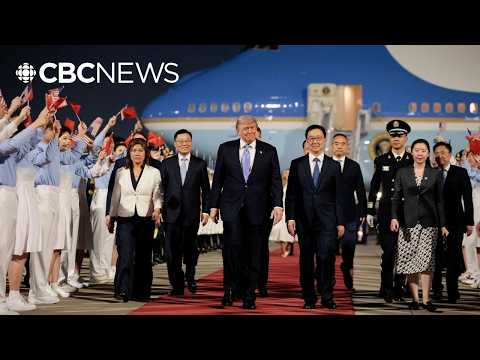

[Video below.] President Donald Trump landed in Beijing on Wednesday for a major summit with Chinese President Xi Jinping, with the war in Iran, trade tensions and American arms sales to Taiwan expected to be at the center of the talks.
The main portion of the visit is scheduled for Thursday, when Trump and Xi are set to hold bilateral discussions, tour the Temple of Heaven, where Chinese emperors once prayed for strong harvests, and attend a formal state banquet.
China welcomed Trump with an elaborate arrival ceremony, including a red carpet rolled out after Air Force One touched down in the Chinese capital.
Greeting the president were Chinese Vice President Han Zheng; Xie Feng, China’s ambassador to Washington; Ma Zhaoxu, executive vice minister of foreign affairs; and David Perdue, the U.S. ambassador to Beijing.
The ceremony featured a military honor guard, a military band and about 300 Chinese young people waving Chinese and American flags while chanting, “Welcome, welcome! Warm welcome!” as Trump walked toward his waiting limousine.
The youth greeters wore white and robin’s egg blue outfits that matched the colors of the presidential aircraft.
“We’re the two superpowers,” Trump told reporters as he departed the White House on Tuesday for the long flight to Beijing. “We’re the strongest nation on Earth in terms of military. China’s considered second.”
Trump has sought to project strength, but the trip comes at a sensitive point in his presidency, with his domestic standing hurt by the U.S.-Israeli war with Iran and inflation that has climbed as a result of the conflict.
The Republican president is looking for a diplomatic and economic success, with hopes of securing Chinese agreements to purchase more American soybeans, beef and aircraft. He said trade would be discussed “more than anything else.”
The Trump administration is also seeking to begin the creation of a Board of Trade with China, aimed at managing disputes between the two countries. Such a body could help keep last year’s trade war from reigniting after Trump’s tariff increases and China’s response through its control of rare earth minerals. The standoff resulted in a one-year truce last October.
Still, Trump’s visit comes as Iran remains a major issue in Washington. The war has effectively shut down the Strait of Hormuz, leaving oil and natural gas tankers stranded and pushing energy prices to levels that threaten to damage global economic growth.
Trump said Xi does not need to help bring the conflict to an end, even though Iranian Foreign Minister Abbas Araghchi was in Beijing last week.
“We have a lot of things to discuss. I wouldn’t say Iran is one of them, to be honest with you, because we have Iran very much under control,” Trump told reporters Tuesday.
Taiwan is also expected to be a central point of discussion, as Beijing has objected to U.S. plans to sell weapons to the self-governing island, which China claims as part of its territory.
Trump said Monday that he planned to discuss with Xi an $11 billion arms package for Taiwan that his administration approved in December but has not yet begun delivering. It is the largest weapons package ever authorized for Taiwan.
At the same time, Trump has shown more uncertainty about Taiwan than some previous U.S. leaders, raising questions about whether he may be willing to reduce American support for the island democracy.
Taiwan’s importance has also grown because it is the world’s leading chipmaker and central to artificial intelligence development. The United States has imported more goods from Taiwan than from China so far this year, while Trump has used Biden-era programs and his own agreements to push for more semiconductor manufacturing in America.
Ahead of Trump’s arrival, the Chinese Communist Party’s People’s Daily published a sharply worded editorial declaring that Taiwan is “the first red line that cannot be crossed in China-U.S. relations” and “the biggest point of risk” between the two countries.
Trump was already presenting the trip as a success before leaving the White House. He spoke about Xi’s expected return visit to the United States later this year and complained that the White House ballroom now under construction would not be finished in time to properly host the Chinese leader.
“We’re going to have a great relationship for many, many decades to come,” Trump said of the U.S. and China.
Trump traveled to Beijing aboard Air Force One with a group that included senior aides, family members and leading business figures, among them Nvidia CEO Jensen Huang and Tesla and SpaceX chief Elon Musk. During the flight, Trump posted on social media that his “first request” to Xi would be for China to expand opportunities for American companies operating there.
“I will be asking President Xi, a Leader of extraordinary distinction, to ‘open up’ China so that these brilliant people can work their magic, and help bring the People’s Republic to an even higher level!” Trump wrote.
Despite Trump’s public confidence, China is approaching the summit from “a much stronger place,” said Scott Kennedy, a senior adviser on Chinese business and economics at the Center for Strategic and International Studies in Washington.
Beijing’s goals include easing technology restrictions on access to computer chips and finding ways to lower tariffs.
“But even if they don’t get much on any of those things, as long as there’s not a blow-up in the meeting and President Trump doesn’t go away and look to re-escalate, China basically comes out stronger,” Kennedy said.
U.S. Treasury Secretary Scott Bessent and Chinese Vice Premier He Lifeng met Wednesday at Incheon International Airport, west of Seoul, to discuss economic and trade matters, according to China’s state-run Xinhua News Agency.
Trump is also expected to bring up the possibility of a nuclear arms agreement among the United States, China and Russia that would limit each country’s arsenal, according to a senior Trump administration official who briefed reporters before the trip. The official spoke on condition of anonymity under rules set by the White House.
China has previously shown little interest in joining such an agreement. Pentagon estimates say Beijing has more than 600 operational nuclear warheads, far fewer than the United States and Russia, which are each believed to have more than 5,000 nuclear warheads.
The last nuclear arms agreement between the United States and Russia, the New START treaty, expired in February, ending limits on the world’s two largest nuclear arsenals for the first time in more than 50 years.
As the treaty neared its expiration, Trump turned down Russia’s call to extend the bilateral agreement for another year and instead called for “a new, improved, and modernized” agreement that includes China.
The Pentagon estimates that China will have more than 1,000 operational nuclear warheads by 2030.
{Matzav.com}