

New York (VINNEWS/Rabbi Yair Hoffman)
It has been 59 years. Picture standing there in 1967. The heart pounds as history unfolds. After two thousand years of exile, of tears, of prayers whispered in foreign lands, Har HaBayis – the Temple Mount returned to Jewish hands.
In those moments of divine intervention, miracles unfolded across Yerushalayim. The Mirrer Yeshiva experienced one of them. A bomb crashed through the ceiling of the beis medrash — and did not explode.
Rav Chaim Shmuelevitz zt”l delivered a shmuess in the Mirrer Yeshiva in June of 1967, just days after the war ended. He cited the pasuk in Az Yashir: “Then the chieftains of Edom were startled; as for the powerful men of Moav, trembling seized them.” Rav Chaim asked: what chiddush is the pasuk revealing? Is it not obvious that open miracles produce trembling?
His answer cut deep. It is precisely the nature of people not to change themselves even after seeing open miracles. “This explains,” said Rav Chaim, “why people around us now are not changing after seeing the open miracles of the Six Day War.”
The Mir bomb was one of many.
Pilots returning from sorties over Egypt were stunned at their own success rates — 150 percent, 200 percent, beyond anything their training predicted. The Jordanians, unaware that the Egyptian codes had been changed the previous day, sent battlefield communications to Cairo that never arrived in time. Soldiers who liberated the Old City refused to enter through Shaar HaAshpa, the Dung Gate; they went in through Shaar HaArayot, the Lions’ Gate, the same gate through which the Sanhedrin once exited to the Mount of Olives.
But the greatest miracle was the return of the Kosel itself. For nineteen years it had been forbidden to us — its stones yearning for our touch as we yearned to press our foreheads against them.
The Place Itself
The Kosel is the last physical remnant of the retaining wall built by Herod around the Har HaBayis. It is not the Mikdash. It is not the Kodesh HaKodashim. It is the outer wall of the platform — and yet the Midrash (Shir HaShirim Rabbah 2:9) teaches that the Shechinah has never departed from the Western Wall. The Alshich explains this continuous presence as Hashem’s tangible promise of our eventual return.
The Emek HaMelech writes that the prayers pressed against these stones by the tzaddikim of Yerushalayim sustain the world. Every crevice has absorbed centuries of supplication.
Kriyah: The Halachic Picture
The halachos of Kriyah upon seeing Yerushalayim and the Kosel deserve careful attention, particularly on Yom Yerushalayim when Jewish sovereignty over the city is precisely what is celebrated.
The basic halacha is recorded in Shulchan Aruch (Orach Chaim 561). One who sees the cities of Yehudah in their destruction recites “Arei kodshecha hayu midbar” and tears [as in rips- not tears as in cries]. One who sees Yerushalayim in its destruction recites “Beis kodsheinu v’sifarteinu” and tears again. One who sees the place of the Mikdash tears once more — and this tear is the more serious tear made near the heart, which may never be fully mended.
The question that hovers over Yom Yerushalayim is whether Kriyah still applies today. The Bach (OC 561) holds that when Jews have sovereignty over Yerushalayim, the city is no longer considered “in its destruction” for purposes of Kriyah. The Taz disagrees sharply [with his father-in-law the Bach], arguing that without the Beis HaMikdash, the city remains in churban regardless of who holds political control.
The Chasam Sofer (Yoreh Deah 759) ruled that Kriyah remains obligatory. The Minchas Shlomo (1:73:10) of Rav Shlomo Zalman Auerbach zt”l addressed this directly in our era: even though Yerushalayim is under Jewish government, non-Jewish places of worship and burial sit upon the Har HaBayis itself, and we are powerless to remove them. The city is not yet redeemed. Kriyah stands.
The Chazon Ish would tear Kriyah even upon seeing the Kosel through a window or from a distance. The Mishnah Berurah (561:4) adds that on the day one first sees Yerushalayim in its current state, one should abstain from meat and wine.
Practically speaking, one tears upon seeing Yerushalayim (the populated city) if it has been thirty days since the last visit, and again — near the heart, irreparably — upon seeing the place of the Mikdash. The Kosel itself, according to most poskim, is treated as the Makom HaMikdash for this purpose.
Going Up to the Kosel — Not the Har
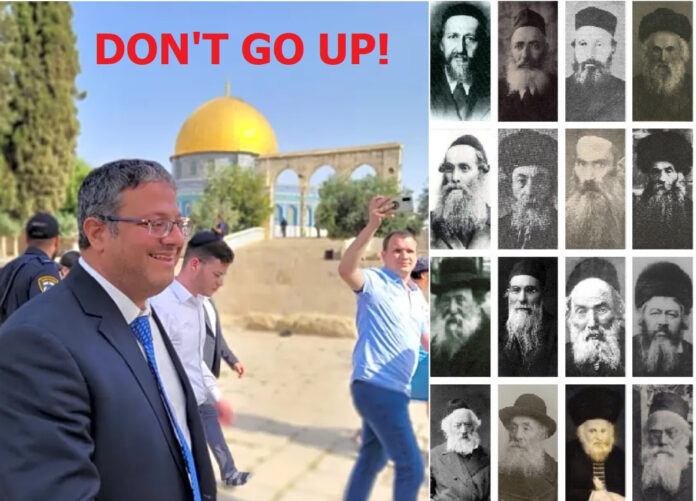
A sharp distinction must be drawn between the Kosel and the Har HaBayis itself. The Kosel plaza sits below and outside the Temple Mount platform. Halachically, it is permitted territory. The Har HaBayis above is another matter entirely.
The Rambam (Hilchos Beis HaBechirah 7:7) ruled that the kedushah of the Mikdash never lapsed — “kidshah l’sha’atah v’kidshah l’asid lavo.” Since we are all assumed to be teme’ei meis, entry to areas of the Har that require taharah is forbidden. The Rabbanut HaRashit issued a public proclamation immediately after the Six Day War, signed by virtually every gadol of the generation — Rav Yitzchak Nissim, Rav Isser Yehudah Unterman, Rav Shlomo Zalman Auerbach, the Steipler, Rav Moshe Feinstein — forbidding entry to any part of the Har HaBayis. The Edah HaChareidis took the same position.
The other issue is that if one does go up to Har HaBayis thinking he himself will go to the Mikveh and make sure to only walk in places where he thinks he knows that it is permitted to walk in – he is causing others to stumble terribly – it is equivalent to walking on the edge of the Grand Canyon and hoping no one follows. Each year 2 to 3 people die by falling over the cliff. Those that violate walking on Har HaBayis are thousands times more.
The Kosel plaza, by contrast, is not only permitted but, according to many, sought after. The Mishna (Keilim 1:8) and the Tzitz Eliezer (10:1:10) discuss which inner zones of the Har are forbidden even today.
The Pilgrimage Question
Is there a mitzvah to come to Yerushalayim during the Shalosh Regalim in our times? The Rambam (Hilchos Chagigah 1:1) holds that the obligation of re’iyah was tied to the korban re’iyah; without the Mikdash there is no mitzvah. The Tashbatz, the Sdei Chemed, the Chasam Sofer, and the Aruch LaNer disagree — the mitzvah of aliyah l’regel exists independently of the korban.
Rav Yosef Shalom Elyashiv zt”l acted on the second position. He walked to the Kosel every regel. When age made the walk difficult, he went during the seven days following Yom Tov, when the kedushah of the chag still hangs over Yerushalayim.
Davening at the Wall
Rav Chaim Kanievsky zt”l ruled — based on Brachos 30a and Shulchan Aruch OC 94 — that one davening at the Kosel should not face the stones themselves but should angle slightly toward the place of the Kodesh HaKodashim. The stones are not the destination. They are the gateway.
Sovereignty and Responsibility
The Greek soreg inscription discovered in 1871 by Charles Clermont-Ganneau — and now displayed in the Istanbul Archaeology Museum, with a fragment at the Israel Museum — warned non-Jews not to pass the latticework barrier into the inner Temple courts on pain of death. The very stones of the Mount testify to the kedushah of what we have inherited.
That kedushah obligates us. Sovereignty without sanctity is hollow. Walking to the Kosel, davening at its stones, weeping into its crevices — this is the unbroken chain reaching back to David HaMelech, to Shlomo, to the kohanim who served in the Beis HaMikdash. Every tefillah pressed into these stones is a thread in the tapestry of geulah.
The author can be reached at [email protected]