

 Matzav
Chief Rabbi Rav Kalman Ber Issues Special Yom Yerushalayim Letter: “We Were Zocheh to What the Vilna Gaon Was Not”
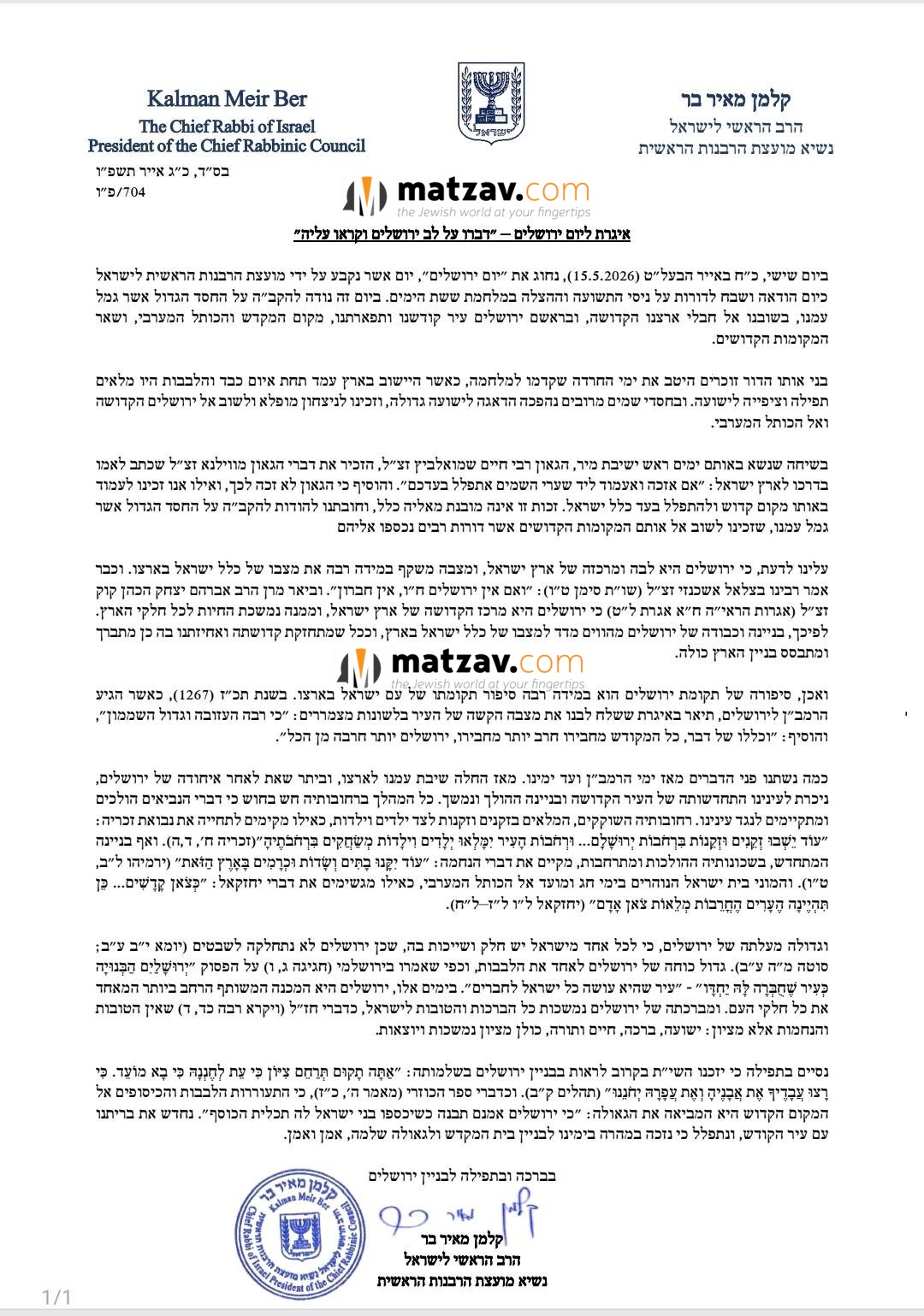
Israel’s Chief Rabbi, Rav Kalman Meir Ber, published a special letter ahead of Yom Yerushalayim focusing on the spiritual significance of the day, the return to the Kosel and Yerushalayim following the Six-Day War, and the unfolding fulfillment of the nevuos of redemption in our times.
In the letter, Rav Ber presents Yom Yerushalayim through an emunah– and Torah-based perspective, describing it as a day established by the Chief Rabbinate as a permanent day of hoda’ah for the miracles and salvations of the Six-Day War.
At the beginning of the letter, the Chief Rabbi writes that Yom Yerushalayim is “a day established by the Council of the Chief Rabbinate of Israel as a day of thanksgiving and praise for generations for the miracles of salvation and deliverance during the Six-Day War. On this day we thank Hakadosh Boruch Hu for the great kindness He bestowed upon us in our return to the regions of our holy land, foremost among them Yerushalayim, our holy and glorious city, the place of the Bais Hamikdosh and the Kosel Hama’aravi, and the other holy sites.”
He continues by recalling the fear and uncertainty that gripped the country in the days leading up to the war.
“Those of that generation remember well the days of anxiety that preceded the war, when the settlement in the Land stood under grave threat and hearts were filled with prayer and anticipation for salvation. And with abundant Heavenly mercy, the fear was transformed into great salvation, and we merited a wondrous victory and to return to holy Yerushalayim and to the Kosel Hama’aravi,” he writes.
Rav Ber then quotes remarks delivered during that period by Mir Rosh Yeshiva Rav Chaim Shmulevitz zt”l, who cited the famous words of the Vilna Gaon in a letter written to his mother while traveling toward Eretz Yisroel.
“In a talk delivered in those days by the Mir Rosh Yeshiva, the gaon Rav Chaim Shmulevitz zt”l, he mentioned the words of the Vilna Gaon zt”l, who wrote to his mother on his way to Eretz Yisrael: ‘If I merit to stand near the gates of Heaven, I will pray on your behalf.’ And he added that the Gaon did not merit this, whereas we merited to stand in that holy place and pray on behalf of Klal Yisroel. This merit is by no means self-understood, and it is our obligation to thank Hakadosh Boruch Hu for the great kindness He bestowed upon us, that we merited to return to those holy places for which so many generations yearned.”
The Chief Rabbi stresses that Yerushalayim is the heart and center of Eretz Yisroel, and that the condition of the city reflects the condition of Klal Yisroel as a whole.
He cites Rav Betzalel Ashkenazi, who wrote, “And if there is no Yerushalayim, Heaven forbid, there is no Chevron,” and brings the explanation of Rav Avrohom Yitzchok Hakohen Kook zt”l that Yerushalayim is the center of the kedusha of Eretz Yisroel, from which spiritual vitality spreads throughout the land.
Rav Ber writes that the rebuilding of Yerushalayim is, in many ways, the story of the rebirth of the Jewish people in their land. He references the famous letter of the Ramban describing the devastation he found upon arriving in Yerushalayim in the year 1267.
“In the year 1267, when the Ramban arrived in Yerushalayim, he described in a letter sent to his son the city’s terrible condition in chilling language: ‘For the abandonment is great and the desolation immense,’ and added: ‘In general, whatever is holier than another place is more destroyed than another place, and Jerusalem is more destroyed than all.’”
Turning to the present era, Rav Ber describes today’s Yerushalayim as a visible fulfillment of the nevuos of consolation and redemption.
“How greatly things have changed from the days of the Ramban until our own times. Since our nation began returning to its land, and especially after the reunification of Yerushalayim, the renewal and ongoing rebuilding of the holy city are clearly visible before our eyes. Anyone who walks through its streets can tangibly sense that the words of the prophets are being fulfilled before our eyes.”
He points to the bustling streets of Yerushalayim, filled with elderly residents and children playing, as a living realization of the nevuah of Zechariah.
“Its bustling streets, filled with elderly men and women alongside boys and girls, seem to bring to life the prophecy of Zechariah: ‘Old men and old women shall yet sit in the streets of Jerusalem… and the streets of the city shall be filled with boys and girls playing in its streets’ (Zechariah 8:4-5).”
He also points to the city’s ongoing expansion and rebuilding as the fulfillment of Yirmiyahu’s prophecy that “houses and fields and vineyards shall yet be bought in this land,” as well as Yechezkel’s vision of the once-desolate cities once again filled with masses of Jews streaming to the Kosel.
Rav Ber further emphasizes that Yerushalayim belongs to every Jew equally, noting the teaching of Chazal that the city was never divided among the shevatim.
He writes, “Great is the power of Yerushalayim to unite hearts,” quoting the Yerushalmi’s explanation of the posuk “Yerushalayim built as a city joined together” as “a city that makes all Israel into companions.”
According to Rav Ber, Yerushalayim today serves as the broadest common denominator uniting all parts of Klal Yisroel, while all brachos and goodness flow to the Jewish people through the kedusha of the city.
Concluding his message, the Chief Rabbi offers a heartfelt tefillah for the complete rebuilding of Yerushalayim and the coming of the Geulah Sheleimah.
“Let us conclude with a prayer that the Almighty will soon merit us to see Jerusalem rebuilt in its completeness: ‘You shall arise and have mercy upon Zion, for it is time to favor her, for the appointed time has come. For Your servants cherish her stones and favor her dust’ (Tehillim 102). And in the words of the Kuzari, that the awakening of hearts and yearning for the holy place is what brings redemption: ‘For Jerusalem will indeed be rebuilt when the Jewish people long for her with the ultimate longing.’ Let us renew our covenant with the Holy City and pray that we merit speedily in our days the rebuilding of the Bais Hamikdosh and complete redemption, amen v’amen,” the chief rabbi concludes in his letter.
{Matzav.com}