
 Vos Iz Neias
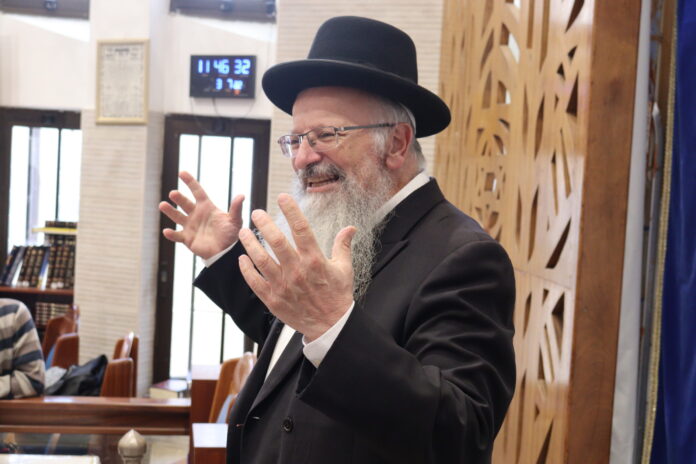
An Open Letter to HaRav Shmuel Eliyahu shlita Regarding His Call for a Synagogue on the Temple Mount
New York (VINNEWS/Rabbi Yair Hoffman) It was with great interest that this author read the recent remarks of HaRav Shmuel Eliyahu shlita, Chief Rabbi of Tzfas and member of the Mo’etzes HaRabbanus HaRashis, calling upon the Prime Minister and government ministers to advance the establishment of a beis knesses on Har HaBayis. The yearning expressed in those remarks — that after two millennia of galus the time has come to reassert a Jewish presence on the holiest place on earth — is a yearning that beats in the heart of every ma’amin.
It is precisely because the matter is so weighty, however, that the proposal must be examined with care. With the utmost respect for HaRav Eliyahu shlita and for the memory of his father, the late Rishon LeTzion HaRav Mordechai Eliyahu zt”l, it is respectfully submitted that the call to establish a beis knesses on Har HaBayis at this time is both unwise and halachically problematic. Two considerations support that conclusion.
The First Consideration: Lifnei Iver Under All Three Approaches
In the sugyos that deal with Lifnei Iver there is a well-known apparent contradiction. The Gemara in Nedarim 62a relates that Rav Ashi had an avah, a forest, which he sold to an avodah zarah fire-temple, and when asked about Lifnei Iver he responded that most of the wood would be used for ordinary heating rather than for avodah zarah. The Ran explains that this is permitted because of the principle of tliya — that whenever it is possible to assume a permitted purpose, even where that possibility is statistically or factually dubious, we do so. The Ran’s view is cited by the TaZ in Yoreh Deah 151, and the Chasam Sofer in his teshuvah (YD #9) develops the concept at length.
On the other hand, the Gemara in Bava Metzia 75b indicates that it is a violation of Lifnei Iver to lend money without witnesses, and a similar indication appears in Bava Metzia 5b — suggesting that wherever a strong likelihood of violation exists, Lifnei Iver applies.
Three approaches have been advanced to resolve the contradiction: That of the Tosfos Anshei Shaim, that of the Tzitz Eliezer,
and that of lbc”l Rav Dovid Feinstein zt”l.
The first, the approach of the Hagahos Tosfos Anshei Shem in Mishnayos Shevi’is 5:7 and of the TaZ in YD 151, is that whenever there is a greater probability of violation than of non-violation, we do not assume a permitted purpose and Lifnei Iver applies. This is also the approach taken by HaRav Yitzchak Zilberstein shlita.
The second approach, found in the Tzitz Eliezer (vol. IV, 5:3), is that the Talmudic cases that forbid where the violation is more likely are speaking of a rabbinic Lifnei Iver only.
The third approach is that of HaRav Dovid Feinstein zt”l, recorded in this author’s sefer on Lifnei Iver, “Misguiding the Perplexed,” p. 97: that wherever the action being performed will directly lead to a violation on the part of the recipient, and without it the recipient would not have had the desire or opportunity to transgress, Lifnei Iver applies — and this is also offered as a possibility by the Tzitz Eliezer.
Under each of these three approaches, the establishment of a beis knesses on Har HaBayis would constitute a biblical violation of Lifnei Iver.
HaRav Eliyahu shlita invokes the pesak of his father, HaRav Mordechai Eliyahu zt”l, who ruled that a beis knesses may be established in areas permitted for ascent according to halacha. With deep reverence for that pesak, the difficulty is not with the halachic siting of the structure itself but with its inevitable consequences. A beis knesses on Har HaBayis, by its very nature as a destination of national and religious significance, would draw enormous numbers of Jews — including the overwhelming majority who lack the halachic training, the proper preparation of tevilah, and the precise knowledge of the boundaries necessary to confine themselves to the permitted areas. The kares-bearing prohibitions of entering the makom haMikdash and the azaros b’tumah — the gravest prohibitions in this entire parashah — would not be a remote possibility but a statistical near-certainty.
Under the approach of the Hagahos Tosfos Anshei Shem and the TaZ, where the question is whether violation is more likely than non-violation, the answer here is unmistakable: the probability of widespread violation by the masses who would come is overwhelming.
Under the approach of HaRav Dovid Feinstein zt”l, the connection is even more direct — the very existence of a beis knesses on the Har is precisely what would draw Jews to a place where, absent that beis knesses, the vast majority would never venture. Even under the most lenient of the three approaches, which classifies certain cases of doubt as rabbinic, this is not a case of doubt; this is a case of foreseeable and predictable mass violation.
It must also be said that the pesak of HaRav Mordechai Eliyahu zt”l, permitting a beis knesses in halachically permitted areas, was issued as a theoretical halachic determination about siting. It is a separate question — and one that the call before us does not adequately address — whether the practical establishment of such a beis knesses today, given who would come, in what state of preparation, and to what areas they would inevitably wander, passes the test of Lifnei Iver under any of the three approaches above. It does not.
The Second Consideration: Pikuach Nefesh and the Value of Jewish Life
Independent of the Lifnei Iver analysis stands a second, equally weighty consideration: the foreseeable cost in Jewish lives.
The history of the past several decades has made it tragically clear that even the most modest changes to the status quo on Har HaBayis — a visit by a public figure, an expanded hour of access, a rumor of altered arrangements — have repeatedly served as the trigger for waves of violence in which Jews have been murdered, rachmana litzlan. The establishment of an actual beis knesses on the Har would not be a modest change. It would be perceived throughout the Muslim world as a transformation of the most volatile site in the Middle East, and the security implications, by the consistent assessment of every relevant Israeli professional body, would include mass casualties — in Yerushalayim, throughout Eretz Yisrael, and very likely against Jewish communities abroad.
The Torah’s directives on this point are numerous and explicit. The verse in Parashas Ki Seitzei discussing hashavas aveidah is extended by the Gemara in Sanhedrin 73a to the obligation to save another’s life — v’hasheivoso lo. There is the negative mitzvah of lo sa’amod al dam rei’echa, not standing idly by your brother’s blood (Vayikra 19:16, Shulchan Aruch C.M. 426:1). The She’iltos, based on the Gemara in Bava Metzia, derives from v’chai achicha imach a full obligation to save others, which the Netziv rules applies even where some personal risk is involved. The Ramban in Toras HaAdam understands v’ahavta l’rei’acha kamocha as a directive to save our peers from danger. And overarching all of these is the mitzvas asei of v’nishmartem me’od l’nafshoseichem — the fundamental Torah obligation to guard Jewish life.
We must also make sure that we not allow misinformation, wishful thinking, or political pressure to shape decisions on which Jewish lives depend. When a proposed action carries with it the predictable consequence of Jewish blood being spilled — not as a remote contingency but as the considered assessment of those charged with protecting the tzibbur — these mitzvos do not stand silent. Chamira sakanta me’isura. Jewish life is precious beyond measure, and a kehillah that yearns for the Beis HaMikdash must yearn for it in a way that does not, chas v’shalom, hasten the death of Jews.
Concluding Thoughts
None of the above diminishes the longing for the binyan Beis HaMikdash that animates the words of HaRav Eliyahu shlita. That longing is the longing of Klal Yisrael, and it is the longing of every one of us who davens three times a day for its restoration. The question is whether the proposed step would bring that day closer or push it further away — and whether, in the interim, it would draw thousands into kares-bearing violations and cost Jewish lives.
For the reasons set forth above, the call to establish a beis knesses on Har HaBayis at this time is both unwise as a matter of hashkafah and policy, and halachically problematic under each of the recognized approaches to Lifnei Iver. The Beis HaMikdash will be rebuilt. May we be zocheh to see it bimheirah b’yameinu. Until then, the path forward must honor both the kedushah of the makom and the kedushah of every Jewish neshamah.
The author can be reached at [email protected]