
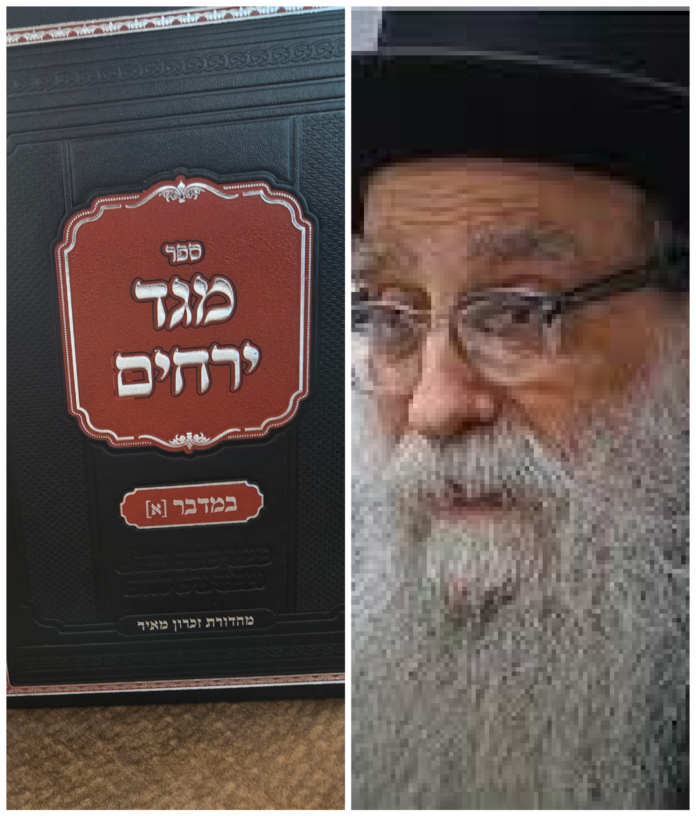

LAKEWOOD (VINNEWS/Rabbi Yair Hoffman) When his Seforim on the Yamim Tovim came out they shook the Torah world, and now the very first Chailek of Rav Yeruchem Olshin’s shiurim on Torah are now out in a beautiful volume called, “Meged Yerachim.” The first volume is only on BaMidbar Nasoh and Bahaaloscha. Perusing its pages, the Torah world will have a similar reaction. It has 30 Simanim on Sugyas in Chumash and 71 maamarim on Mussar and MAchshava. Both sections together total 630 pages.
What follows is a brief overview of the sugyos’ contents based on its tochain mefurat. Note that this is just of BaMidbar
Siman 1. why Hashem waited a full month before counting Bnei Yisrael.
- Why were Bnei Yisrael counted on the first of Iyar instead of the first of Nisan, when the Shechinah first came to dwell among them?
- The Shechinah arrived on the first of Nisan, but it only became permanently settled thirty days later, on the first of Iyar.
- Two separate ideas about the Shechinah resting — one is the Shechinah resting “in the Mishkan,” and the other is the Shechinah resting “upon the Jewish people” themselves.
- A puzzling contradiction in Rashi (Maseches Beitzah) about when the Shechinah left Har Sinai — was it on the first of Nisan or the twentieth of Iyar?
- Rashi seems unsure about the exact date the Shechinah departed from Sinai.
- A closer look at Rashi’s uncertainty regarding when the Shechinah moved from Har Sinai to rest upon the Jewish people.
- The counting took place on the first of Iyar, before the Shechinah came to rest upon them on the twentieth of Iyar.
Siman 2: Who Goes Out to War? The Age Requirement of Twenty
Why soldiers must be at least twenty years old, and whether this applies to every type of war.
- Rashi’s statement that a person does not go out to war until age twenty.
- Rashi’s proof: the Torah writes “all who go out to the army” instead of “all who go out as soldiers.”
- Does the age requirement of twenty apply only to a milchemes mitzvah (obligatory war), or also to a milchemes reshus (optional war)?
- What is the basis for saying that the age of twenty applies only to a milchemes mitzvah and not to a milchemes reshus?
- The age of twenty represents true adulthood — the point at which a person is ready to carry responsibility for the community.
Siman 3: “Bnei Naftali” — A Different Phrasing
Why did the Torah uses a slightly different phrase when counting the tribe of Naftali?
- For every other shevet (tribe), the Torah writes “Livnei” (to the sons of), but for Naftali it writes only “Bnei Naftali” (the sons of Naftali). Why the change?
- Within Shevet Naftali, there were more daughters than sons.
- The Pnei Yefos (Haflaah) explains that it was not necessary to count Bnei Naftali in the usual way because the total was already known.
- The Chasam Sofer’s view: Bnei Naftali were counted even though the number was already known.
- The Pnei Yefos’s explanation does not fit with the opinion of the Ramban.
- Even according to the Ramban, the earlier point still holds — but according to the Netziv (quoting the Arizal), the general total works differently.
Siman 4: Why Shevet Levi Was Counted Separately
This Siman explains why the Leviim were not counted together with the rest of Klal Yisrael.
- Two reasons why Shevet Levi was not counted along with the other shevatim.
- Why Rashi did not give the reason that the Leviim were left out because they did not go to war.
- Why Rashi did not give the reason that the Leviim were left out because they did not receive a portion in Eretz Yisrael.
- The reasons Rashi did give make sense because Rashi understood the counting itself as coming from Hashem’s deep love for the Jewish people (mitoch chibasan).
Siman 5: Counting Shevet Levi Without Shekalim — The Danger of Counting Jews
The unique way the Leviim were counted and the danger of counting Jews directly.
- Why were the Leviim not counted using shekalim (coins) like the rest of the Jewish people, or at least like most of them?
- The danger of plague that comes from a direct count.
- The sugya seems to suggest that the prohibition only applies when counting all of Klal Yisrael — but counting a portion of the nation might be permitted.
- The Gemara did not actually prove that counting even a portion of Klal Yisrael is forbidden, because perhaps the rule there referred to the whole nation.
- A closer reading of the sugya does show that even counting a portion of Klal Yisrael is forbidden.
- If so, the question becomes: how was Moshe Rabbeinu allowed to count Shevet Levi?
- The Chasam Sofer holds that counting a portion of Klal Yisrael is forbidden — so why was there no danger of plague here?
- Since this counting was also done through the Shechinah itself, there was no prohibition, because the goal was to know the full total.
Siman 6: The Leviim Camped Around the Mishkan — Guarding the Mikdash
The mitzvah of guarding the Mishkan and Beis HaMikdash.
- The commentators ask why the encampment of the Leviim around the Mishkan was so important. There are two separate laws involved: guarding the Mikdash, and the placement of Machaneh Leviyah.
- A deeper look at the two laws regarding the Leviim’s encampment.
- The Rambam and Ramban appear to disagree with the approach of the Gra”z (the Baal HaTanya).
- The Rambam’s view, backed by other Rishonim: the guarding of the Mikdash is for the honor of the Mikdash.
- The Rambam also holds that guarding is meant to prevent a zar (a non-kohen) from entering.
- A difficulty on the Rambam: the pesukim themselves seem to say the purpose of guarding is specifically to keep out a zar.
- The resolution — there are actually two reasons for the mitzvah of guarding: the honor of the Mikdash, and preventing a zar from entering.
- In the Mishneh Torah, the Rambam does not mention guarding against zarim, because in the Beis HaMikdash the gates were already closed.
- The repetition in the pesukim corresponds to the two reasons for guarding — the honor of the Mishkan and keeping out a zar.
Siman 7: Teaching Torah to Students Is Like Raising Your Own Children
This Siman explores the relationship between a rebbi and his talmid.
- Anyone who teaches the son of his friend Torah — the pasuk considers it as if he had given birth to him himself.
- A rebbi is obligated to teach his students just as he would teach his own sons, because they are truly considered his sons.
- The Pachad Yitzchak’s view: the idea that “students are called sons” only applies to a talmid muvhak — a primary, outstanding student.
- Even a student who is not a talmid muvhak is still considered like a son.
- In Torah learning, the relationship does not fully reach the level of “sons of Hashem” — rather, it is “as if he had given birth to him.”
- Rashi did not need to bring a separate proof for the term “sons,” because it is already learned from the pasuk: “And these are the toldos of Aharon and Moshe.”
Siman 8: The Work of Bnei Kehas Is Called “Melachah,” Not “Avodah” — and the Aron Carried Its Carriers
This Siman looks at the unusual wording the Torah uses for the work of Bnei Kehas, and the famous concept that the Aron miraculously carried those who carried it.
- The work of Bnei Kehas is called “melachah,” while the work of Bnei Gershon and Bnei Merari is called “avodah.”
- Bnei Kehas carried on their shoulders (called “melachah”), while Gershon and Merari used wagons (called “avodah”).
- The reason the term “melachah” is used for Bnei Kehas is connected to the famous teaching that the Aron carried its bearers.
- If the Aron carried its own bearers, why is the term “melachah” (work) used at all for Bnei Kehas?
- The Aron carrying its bearers means it lightened the load — not that it removed it completely.
- The Aron only began to carry its bearers after they themselves first began to carry it.
Siman 9: “From Thirty Years and Above” — When a Ben Levi May Begin Avodah at Age 13
An apparent contradiction about the age at which a Levi may serve in the Mishkan.
- The Rambam writes that a ben Levi is fit for avodah once he reaches the age of bar mitzvah, even before age thirty.
- The Kesef Mishneh answers that a Levi under thirty is not given avodah on a regular basis — he is only allowed to serve occasionally (derech mikreh).
And what follows is from the very last Maamar on parshas Bahaaloscha:
How great is the middah (character trait) of “nosei b’ol im chaveiro” (sharing in the burden of one’s fellow) — that through it, the shotrim (officers/foremen) in Mitzrayim merited to be appointed among the seventy zekeinim (elders) and to receive upon themselves the resting of the Shechinah literally from Moshe Rabbeinu. And also Moshe Rabbeinu himself merited, through this very middah, to be the leader of Klal Yisrael, and through it as well [he merited] that the Shechinah rested upon him from HaKadosh Baruch Hu.
But they rose to an even more elevated level through this middah — they merited causing the Shechinah to rest upon them from Moshe Rabbeinu himself. For this middah teaches us more than anything else the great value of acquiring Torah and its wisdom, because through it a person is able to distance himself from the falsehood of “self-love,” which is one of the forty-eight ways through which Torah is acquired. And through it a person merits to bring himself close, and to draw near, to the truth of “Toras Emes” (the Torah of truth) — to attain Torah and to grow in it to such a degree as to be [counted] among the Sanhedrin.
And this is a matter that pertains to every single individual in his life — both in matters between a person and his fellow, and in matters between a person and the members of his own family. For a person, by his very nature, is by instinct a lover of himself. And the middah of “nosei b’ol im chaveiro” is in essence the nullification of self-love and the entering into the troubles and difficulties of one’s fellow — to be all given over to the other, to give one’s eyes and heart to feeling distress over one’s friend, as if his own pain and difficulty were his fellow’s troubles and difficulties.
[This is] just as Moshe Rabbeinu, alav hashalom, did when he went out to his brothers “and saw their burdens” — that he gave his eyes and his heart to ponder and to feel the pain and distress of his fellows, to be in distress over them and to share with them in their burden. And it is incumbent upon us to walk in the ways of our forefathers and to attach ourselves to their middos. Through this we will merit to distance ourselves from falsehood and to draw close to the truth, to reach the elevated level of acquiring the Torah and attaining its wisdom — which is “Toras Emes” — just as the shotrim in Mitzrayim merited, who suffered blows and torments for the sake of their fellow Jews, and at the end were lifted up to an elevated [station] and exalted standing, regarding which Hashem commanded Moshe:
“Gather to Me seventy men from the elders of Yisrael, whom you know to be the elders of the people and its officers… and I will take from the spirit that is upon you and place it upon them, and they shall bear with you the burden of the people.”
The author can be reached at [email protected]