
 Vos Iz Neias
Senior Jerusalem Rabbi Says Claims of Blanket Temple Mount Ban Are “Mistaken”
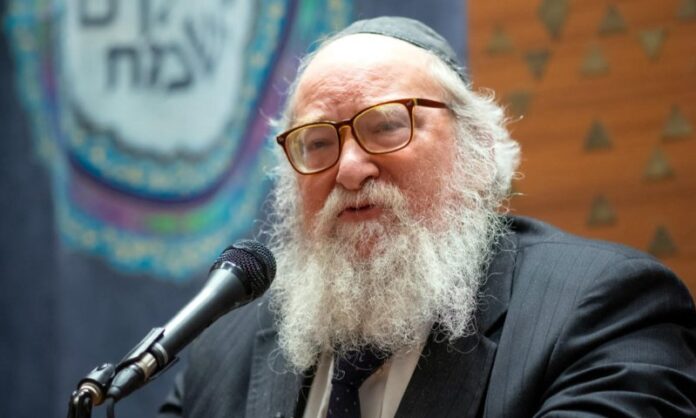
JERUSALEM (VINnews) — Rabbi Yitzchak Breitowitz, an American-born Israeli rabbi and internationally known lecturer at Ohr Somayach in Jerusalem, said during a recent lecture that Jewish law permits entry to certain areas of the Temple Mount under specific conditions, comments that have reignited debate within the Orthodox Jewish community over Jewish visits to the contested holy site.
Breitowitz, who serves as the rabbi of Kehillas Ohr Somayach in Jerusalem, is widely regarded as a leading authority on Jewish law and ethics. Known for his broad scholarship and ability to explain complex religious and legal topics, he has lectured extensively in both the United States and Israel on medical, business and family ethics, and has written numerous articles on commercial law, bankruptcy, medical ethics and halacha.
During the lecture, Breitowitz said he personally does not ascend the Temple Mount because of his own religious stringency, but suggested that some commonly repeated prohibitions regarding Jewish entry to the area may be overstated.
“I still do not go up to the Temple Mount because I am machmir,” Breitowitz said. “But in truth, perhaps this is not the correct stringency.”
The Temple Mount, known to Muslims as the Haram al-Sharif, is the holiest site in Judaism and the third-holiest in Islam. The site is administered by the Islamic Waqf under a long-standing status quo arrangement, while Israeli police maintain overall security control.
Breitowitz said Jewish tradition and halachic scholarship make it possible to identify areas where Jews may enter after proper ritual immersion in a mikveh and while avoiding sections believed to have contained the holiest parts of the ancient Temples.
“There is a large area where entry is definitely permitted,” he said. “Anyone who is ritually impure from contact with the dead may enter the Temple Mount. However, other forms of impurity … are forbidden.”
At the same time, he stressed that he does not actively encourage Jews to visit the site because of concerns they could inadvertently enter prohibited areas or fail to follow required ritual preparations.
“But it should be emphasized that the claim that someone is ‘liable to karet’ simply for entering the Temple Mount area outside the holiest zones is mistaken,” he said, referring to a severe spiritual punishment described in Jewish law.
Breitowitz also said conditions surrounding Jewish prayer on the Temple Mount have changed significantly in recent years.
“In the past, the police prohibited prayer on the Temple Mount,” he said. “But today the situation is very different, and people even fully prostrate themselves there with arms and legs outstretched.”
His comments were welcomed by Rabbi Shimshon Elboim, head of the Temple Mount Administration, an advocacy group that promotes increased Jewish visitation and prayer rights at the site.
“Every additional rabbi who encourages ascent to the Temple Mount brings closer the return of the Jewish people to the Temple Mount,” Elboim said.
The issue remains one of the most sensitive religious and political disputes in Israel. Many leading ultra-Orthodox rabbis continue to forbid visits to the Temple Mount altogether, citing concerns over ritual purity laws and uncertainty surrounding the precise location of the biblical Holy of Holies. Others argue that carefully supervised visits are permissible under Jewish law.