
 JBizNews
Google Launches Gemini Spark Agent in Direct Strike at OpenAI and Anthropic
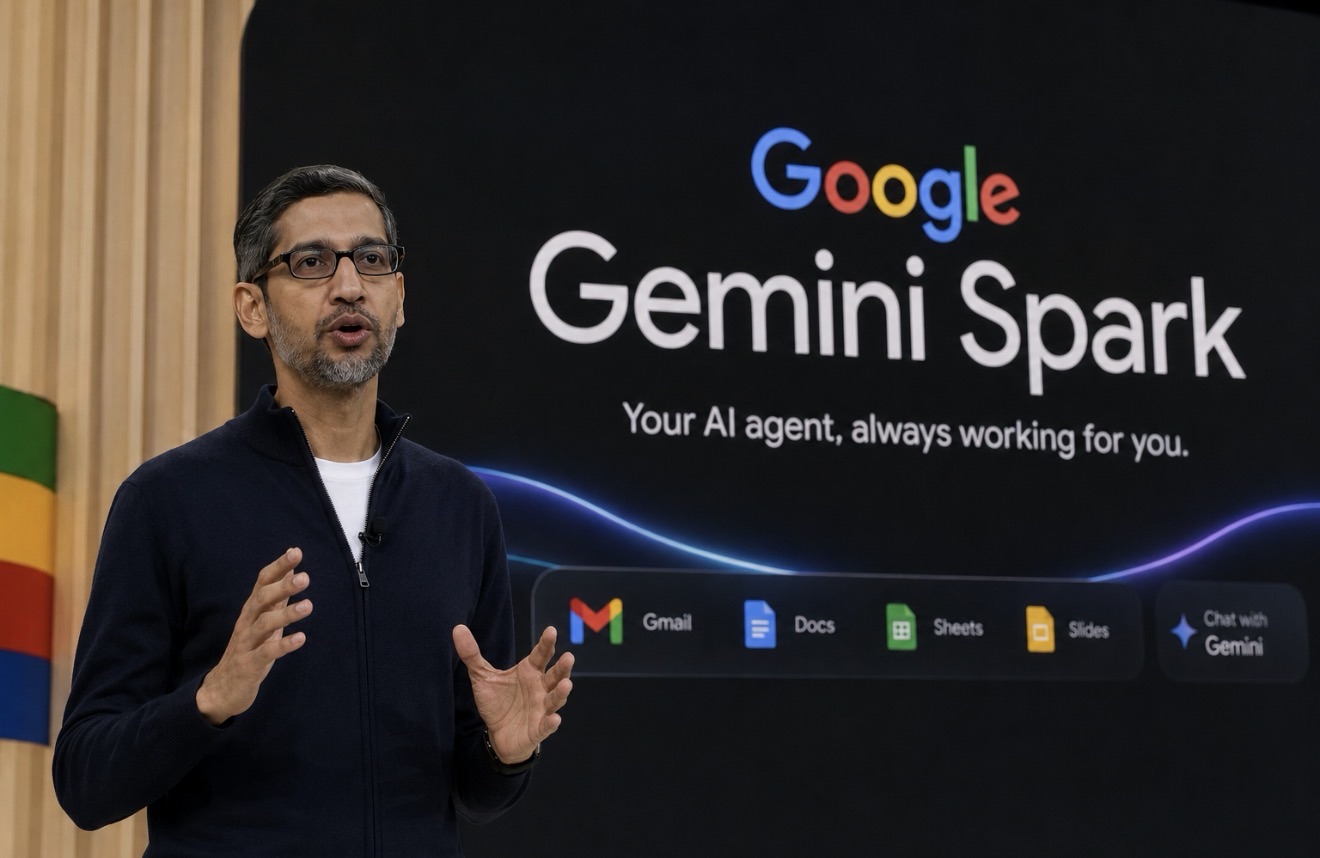
Alphabet Chief Executive Sundar Pichai unveiled Gemini Spark on Tuesday, a new always-on personal AI agent designed to autonomously draft emails, manage inboxes, compile documents and eventually complete purchases on a user’s behalf, marking Google’s clearest attempt yet to dominate the fast-emerging “agentic AI” market now being contested by OpenAI, Anthropic, Microsoft, and Apple.
The launch, announced during Google I/O in Mountain View, California, positions Gemini Spark as far more than a chatbot. Unlike traditional assistants that respond only when prompted, Spark operates continuously in the background on dedicated Google Cloud virtual machines, allowing it to continue performing tasks even after a user closes a laptop or locks a phone. The product will initially roll out next week to subscribers of Google AI Ultra, Alphabet’s new $100-per-month premium tier, before expanding into a wider U.S. beta.
“We’re super focused on bringing that frontier capability of agents safely and securely to consumers so that they work for everyone,” Pichai told reporters during a pre-briefing ahead of the keynote, framing the product as a digital assistant capable of acting independently under user direction rather than simply answering questions.
The unveiling immediately escalated Silicon Valley’s AI arms race, shifting competition away from chat interfaces and toward autonomous software agents that can execute workflows across apps, documents, and enterprise systems. Spark integrates directly with Gmail, Google Docs, Sheets, Slides, and the broader Workspace ecosystem while also connecting to third-party services through the emerging Model Context Protocol standard. Launch partners include Canva, Instacart, and OpenTable.
During the live demonstration, Josh Woodward, vice president of the Gemini App and AI Studio at Google Labs, showed Spark pulling information from emails and documents to automatically draft management updates and monitor customer-service inquiries for small businesses. The system runs on Google’s newly introduced Gemini 3.5 Flash model paired with the company’s “Antigravity” agentic framework, which coordinates multiple AI agents simultaneously.
Koray Kavukcuoglu, chief technology officer of Google DeepMind and Google’s chief AI architect, said the company’s newest model was specifically optimized for autonomous workflows. “3.5 Flash is especially good when deploying multiple agents simultaneously and completing long-running tasks,” Kavukcuoglu said, adding that Google had internally tested AI agents capable of building a functioning operating system from scratch.
Underneath the product reveal sits a major economic and infrastructure strategy.
Google claims Gemini 3.5 Flash outperforms its previous flagship Gemini 3.1 Pro model across most benchmarks while operating roughly four times faster than comparable frontier systems in token output speed. Google executives said an optimized Antigravity configuration can run up to 12 times faster in certain enterprise environments, potentially allowing customers to sharply reduce AI infrastructure costs.
Pichai told reporters that enterprise clients processing roughly one trillion AI tokens per day on Google Cloud could theoretically save more than $1 billion annually by shifting workloads toward a combination of Flash and the larger Gemini 3.5 Pro model, which is scheduled for broader release next month.
Internal demand growth inside Google itself has become staggering. According to executives, Google’s systems were processing roughly half a trillion tokens daily in March. That figure has now surpassed three trillion daily tokens and continues doubling every several weeks as AI adoption accelerates across products and enterprise workloads.
The launch arrives during an increasingly aggressive battle among major AI labs to dominate the emerging market for digital agents that can act independently across software ecosystems.
Anthropic recently introduced Claude Cowork, a desktop AI agent capable of operating directly on a user’s machine. OpenAI has been expanding browser-based ChatGPT agent functionality. Microsoft continues embedding AI agents across Office 365 and Windows. Meanwhile, Apple is expected to unveil a significantly upgraded Siri during next month’s WWDC conference, positioning the assistant as a cross-application agent capable of carrying out complex tasks autonomously.
Ironically, Google itself is expected to help power Apple’s upgraded Siri through a multi-year agreement reportedly valued near $1 billion annually, further underscoring how intertwined the AI infrastructure race has become even among fierce competitors.
Google’s competitive advantage may ultimately come from the enormous amount of user context already stored across its ecosystem. Unlike newer entrants, Gemini Spark can access years of emails, documents, calendars, spreadsheets, and browsing behavior already sitting inside Google accounts.
That deep integration is central to Google’s strategy.
“Your inbox is effectively a memory system competitors don’t have,” one developer attending the event remarked after the keynote, echoing a broader industry belief that long-term user context may become the defining moat in the AI-agent race.
The AI rollout also intersects with a parallel strategic shift underway inside Alphabet’s hardware business.
Earlier this month, Pichai disclosed during Alphabet’s first-quarter earnings call that Google will begin selling its custom Tensor Processing Unit chips directly to enterprise customers for deployment inside their own data centers — a sharp break from Google’s previous cloud-only hardware model.
“As TPU demand grows from AI labs, capital markets firms, and high-performance computing applications, we’ll begin delivering TPUs directly to select customers,” Pichai told investors.
The move represents one of the first credible long-term challenges to Nvidia’s dominance of AI accelerator hardware. Nvidia currently controls the overwhelming majority of the global AI-chip market and carries a market capitalization approaching $5 trillion.
Google has already signed large-scale TPU agreements with Anthropic, while reports indicate the company is negotiating additional multibillion-dollar chip arrangements with Meta Platforms and other hyperscale buyers.
The broader financial backdrop has given Alphabet room to aggressively pursue the AI expansion.
Google Cloud generated more than $20 billion in first-quarter 2026 revenue, up 63% year over year, while cloud operating income tripled to $6.6 billion. Alphabet also disclosed a backlog of roughly $460 billion in future contracted cloud business, nearly doubling from the prior quarter.
At the same time, Alphabet raised its projected 2026 capital expenditures to between $180 billion and $190 billion as the company races to build enough infrastructure to support growing AI demand.
Investors remain divided on whether the spending surge will ultimately generate meaningful profits. Alphabet shares have climbed roughly 23% year-to-date as investors embraced Google’s accelerating AI position, though the stock fell modestly following Tuesday’s keynote as Wall Street weighed the enormous infrastructure costs required to scale agentic systems globally.
For now, Pichai is making a much broader strategic bet than simply launching another chatbot. Google is positioning itself as the only major AI player controlling the entire vertical stack simultaneously — the AI model, the chips, the cloud infrastructure, the productivity suite, and the consumer interface.
Whether consumers ultimately pay $100 per month for a persistent AI agent embedded across their digital lives may determine whether Gemini Spark becomes one of the most important software launches of the decade — or another costly experiment in Silicon Valley’s increasingly expensive AI arms race.
— JBizNews Desk
© JBizNews.com. All rights reserved. This article is original reporting by JBizNews Desk. Unauthorized reproduction or redistribution is strictly prohibited.