
 JBizNews
Stocks Bounce Off Three-Day Slide as Target Pops, Yields Hit 16-Month High, Nvidia Looms
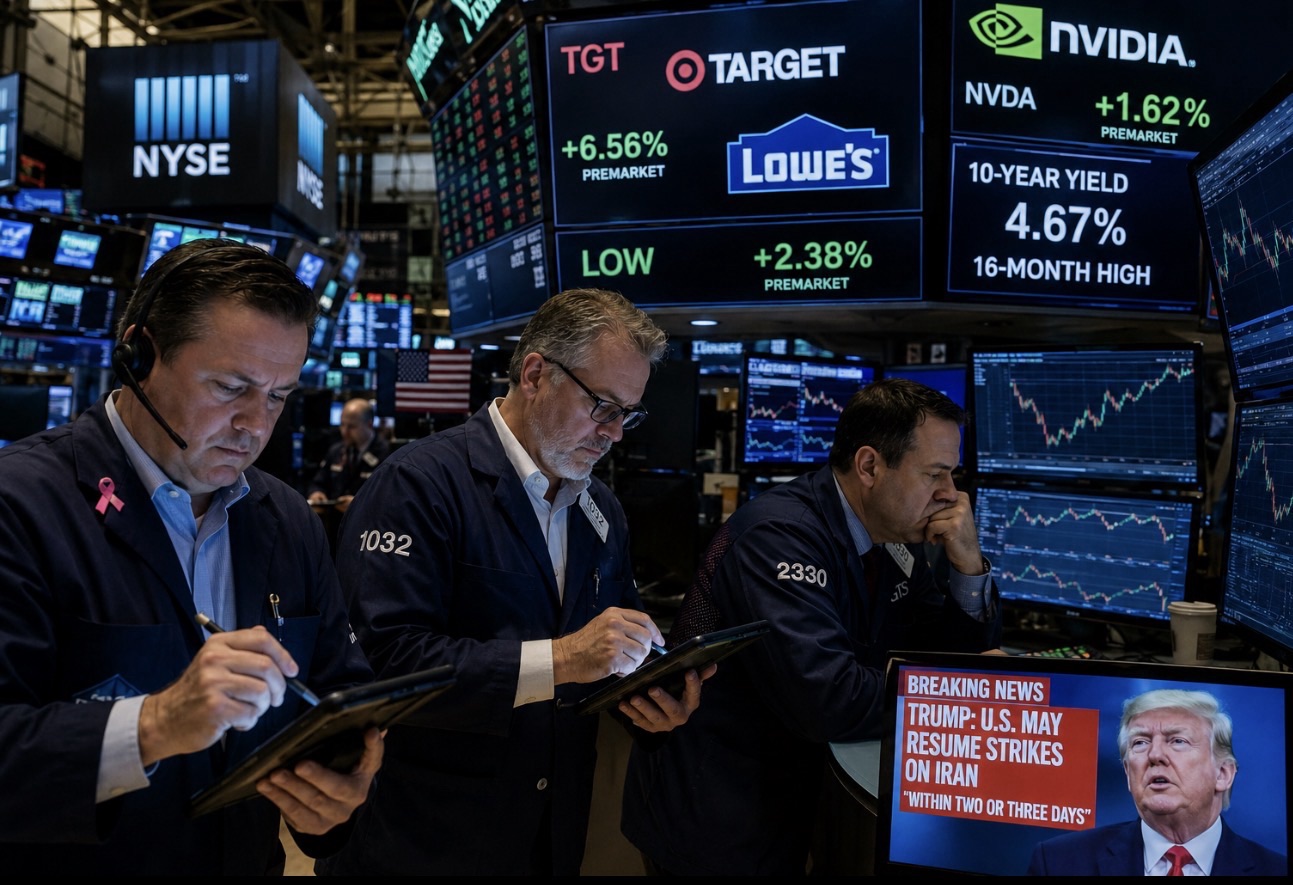
U.S. stocks pointed to a higher open Wednesday after three straight losing sessions, with Target Corp. surging on a blowout first quarter, Lowe’s Cos. ahead of the bell and the entire market positioned for Nvidia Corp.’s post-close earnings — even as the 10-year Treasury yield climbed to a 16-month high and President Donald Trump warned that the United States may resume strikes on Iran within “two or three days” if Tehran rejects Washington’s peace terms.
S&P 500 futures rose 0.3% before the opening bell, while Nasdaq futures advanced modestly as investors attempted to stabilize markets rattled by surging bond yields, rising oil prices and fears the Federal Reserve could eventually return to rate hikes if inflation accelerates further.
The biggest premarket mover was Target.
The Minneapolis-based retailer reported first-quarter results that sharply exceeded Wall Street expectations and raised full-year guidance, marking the company’s strongest quarter in more than a year and signaling that American consumers are still spending despite high interest rates and inflation pressure.
Net sales rose 6.7% to $25.4 billion, driven by 5.6% comparable sales growth and a 4.4% increase in customer traffic. Digital sales climbed nearly 9%, fueled by rapid growth in same-day delivery and advertising revenue. Adjusted earnings per share came in at $1.71, well ahead of analyst expectations.
Management also raised its 2026 forecast, now expecting annual sales growth around 4% and stronger operating margins.
Shares surged in premarket trading as investors interpreted the results as evidence that consumer demand remains more resilient than feared.
Lowe’s, the home improvement giant, was scheduled to report before the open, with analysts expecting earnings of $2.96 per share on revenue of roughly $22.9 billion. Retailer TJX Cos., parent company of T.J. Maxx and Marshalls, was also due to release earnings before the bell.
The semiconductor sector rebounded after a bruising three-session selloff tied to rising bond yields and profit-taking across artificial intelligence stocks.
Intel climbed more than 4% in premarket trading, while Advanced Micro Devices rose over 2% after Citi raised its price target on the stock. Micron Technology also moved higher as investors positioned ahead of Nvidia’s highly anticipated earnings report after the closing bell.
Nvidia remains the single most important stock in the market right now.
The AI chipmaker has become the world’s most valuable company and is widely viewed as the primary barometer for artificial intelligence spending globally. Traders expect the earnings report to determine whether the AI-driven rally that powered markets for much of the past year still has momentum — or whether valuations have become stretched.
The stakes are unusually high because Nvidia’s results now influence not only semiconductor stocks, but the broader Nasdaq, cloud computing firms, data center operators and even power utilities tied to AI infrastructure growth.
Cybersecurity stocks came under pressure despite solid earnings from Palo Alto Networks.
The company beat expectations and raised full-year guidance, but shares still fell nearly 4% after hours as investors focused on softer gross margins. The weakness spilled into peers including CrowdStrike and Zscaler.
Homebuilders, meanwhile, received a boost from strong results at Toll Brothers.
The luxury-home builder reported earnings and revenue well above analyst forecasts, benefiting from resilient high-income buyers despite elevated mortgage rates. Shares rose more than 5% in extended trading after the release.
But beneath the earnings optimism, the bond market continues to dominate investor psychology.
The 10-year Treasury yield hovered near 4.67% Wednesday morning, the highest level in roughly 16 months, as markets increasingly price in the possibility that inflation could remain elevated well into 2027 because of the Iran war and sustained energy-price shocks.
Oil prices remain elevated as the Strait of Hormuz — one of the world’s most critical shipping lanes — continues operating under severe disruption amid the ongoing conflict with Iran.
Trump intensified concerns Tuesday when he warned the United States could resume military strikes within days if Tehran rejects Washington’s terms.
The prolonged instability has pushed gasoline prices higher, increased freight and shipping costs globally and forced investors to reassess assumptions that the Federal Reserve would eventually move toward lower interest rates.
Markets now see meaningful odds of another Fed rate hike by late 2026 or early 2027.
Investors will closely analyze Wednesday afternoon’s release of the Federal Reserve’s latest meeting minutes for any indication policymakers are becoming more concerned about persistent inflation driven by energy and geopolitical instability.
Treasury Secretary Scott Bessent, speaking from G7 finance meetings in Paris, added further pressure by urging allies to strengthen sanctions on Iran while coordinating policies around critical minerals and trade protections against China.
Bessent warned European officials that excess Chinese industrial exports could damage Western manufacturing sectors if coordinated protections are not implemented.
Among other notable market movers, UnitedHealth Group fell after an HSBC downgrade, while Wolfspeed plunged on reports the semiconductor materials company may face bankruptcy risk within weeks. Chinese electric-vehicle maker Xpeng rose more than 5% after posting a smaller-than-expected quarterly loss and stronger delivery guidance.
The remainder of the week remains packed with market-moving catalysts.
In addition to Nvidia, companies including Intuit, Williams-Sonoma, Walmart, Deere, Ross Stores, Zoom, and Deckers Outdoor are scheduled to report earnings over the next two sessions. Investors will also watch Friday’s University of Michigan consumer sentiment reading for additional clues about household spending and inflation expectations.
For consumers, however, the market story increasingly comes down to something simpler than earnings or AI valuations.
Higher Treasury yields mean more expensive mortgages, car loans and credit cards. Higher oil prices mean more expensive gasoline, airfare and shipping costs.
And as long as the Iran conflict keeps pressure on global energy markets, those costs are likely to remain elevated regardless of whether stocks bounce for a day or continue sliding.
— JBizNews Desk
© JBizNews.com. All rights reserved. This article is original reporting by JBizNews Desk. Unauthorized reproduction or redistribution is strictly prohibited.