
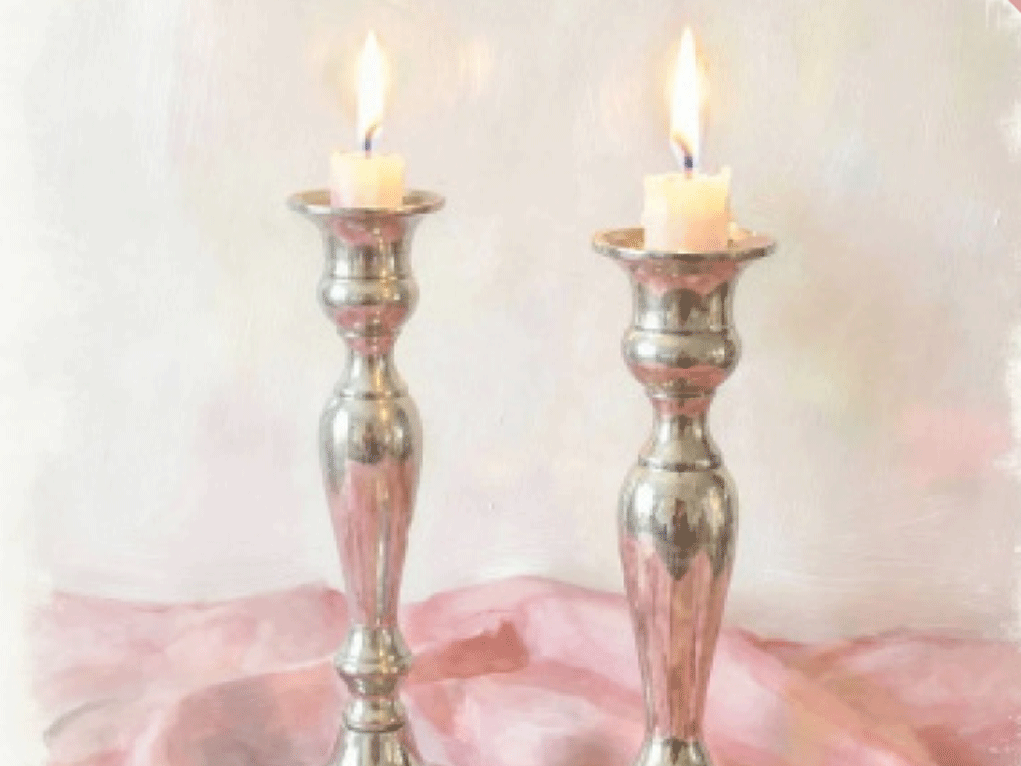

Last Shabbos, the Shabbos before Shavuos, is always Parshas Bamidbar. It is known by some as Shabbos Derech Eretz. The Mishnah in Avos teaches us that derech eretz kodmah laTorah, that proper conduct precedes Torah, and so before we can receive the Torah on Shavuos, we pause for a Shabbos of mentchlichkeit, of refinement, of derech eretz.
But for many Americans, it had a different name. President Trump named it Shabbos 250 in honor of the United States semiquincentennial. I guess that our president, who has no qualms about vilifying his opponents and is not known for his genteel civility, chose another name for the Shabbos. But that is fine.
After all, as part of his Jewish American Heritage Month proclamation, he designated this past Shabbos a “National Sabbath” as part of his vision to “Rededicate 250” in honor of the 250th anniversary of American Independence.
And honestly? Credit where credit is due. This is a president who, whatever else one wants to say about him, has shown a genuine warmth toward the Jewish people, one that we have not always enjoyed from the Oval Office. He moved the embassy to Yerushalayim when every predecessor balked. He pardoned Sholom Mordechai Rubashkin. And has surrounded himself with Jewish advisors who keep Shabbos, daven three times a day, and don’t think twice about leaving the West Wing early on a Friday afternoon. So when the man asks his Jewish citizens to honor the Shabbos, the appropriate first response is not cynicism.
I am not exactly sure what Shabbos has to do with the 250th anniversary of American independence. The president advocating for shemiras Shabbos is quite a curious notion, but, in fact, many Yidden were kvelling. After all, no sitting president ever asked Jews to keep Shabbos. George Washington wrote a nice haskamah letter to the Touro Synagogue. President Reagan gave a drosha at Temple Hillel, where former Ambassador David Friedman’s father served as the rabbi. But “Yidden, heet Shabbos!” — words immortalized by the Munkatcher Rebbe — were not expected to be echoed by Donald Trump.
Like all things Jewish, and all things Trump, the reaction was mixed. Some were excited, others suspicious.
Truth be told, he is not the first political figure to make the pitch. Connecticut Senator Joe Lieberman, who was shomer Shabbos his entire career in Washington, wrote a book in 2011 called The Gift of Rest, an open exposition on Shabbos addressed to both Jewish and non-Jewish audiences, with across-the-board endorsements from leaders of the Mormons, the Southern Baptists, and of course prominent Jews. Even Charlie Kirk, the conservative activist killed last year, left behind a posthumous bestseller called Stop, in the Name of G-d, about the value of keeping a Shabbos. Shabbos has somehow become a crossover product. The world, it seems, has discovered or are at least becoming curious about what we have been doing in our homes and shuls since Har Sinai.
But as much as the world dabbles in this “day of rest” idea, we can’t forget that Shabbos is exclusively our and belongs to no one else. It is that special sign, the ois between the Ribono Shel Olam and Klal Yisroel alone. Not for the world. Not even for the world to experiment with. Akum sheshovas chayov misah. A nochri who keeps Shabbos in the way that we do crosses a line. It is our sign, our signature, our weekly testimony that Hashem made the world in six days and rested on the seventh, and that we, His chosen, were the ones who said na’aseh venishma when everyone else refused even to read. Even for a nishma first.
Which is exactly why, charming as the president’s gesture was, we cannot afford to outsource our Shabbos to the goodwill of the goyim. We are the guardians. The umos ha’olam may admire the institution from a respectful distance, and that is sweet, but the responsibility for protecting Shabbos belongs to us alone, and history has more than once required us to prove it.
Think of the Shabbos marches in pre-war Europe, when frum Yidden in Lithuania, even in Germany, paraded through the streets to protest the Sabbath desecration that was creeping into Jewish life. Think of the great Shabbos rallies in New York and Chicago in the early twentieth century, when our great-grandparents who had crossed an ocean and lost jobs every Monday morning for keeping the seventh day took to the streets to demand that Shabbos be honored in the home, the shul, and the workplace. Rav Yaakov Yosef Herman, of All for the Boss fame, lost positions, lost income, and lost respectability in the eyes of his neighbors all because Shabbos was non-negotiable. They didn’t have presidential proclamations. They had mesirus nefesh.
It did not come with slogans, or pomp and internet sign-ups, or half-baked commitments to make a president proud. It came with mesirus nefesh for the entire Shabbos to make the Ribono Shel Olam proud. And as gracious as the president is, let’s not forget our job.
A talmid of Rav Shlomo Freifeld once told me how he was the driver for my zaide, Rav Yaakov Kamenetzky, together with Rav Yitzchok Hutner. The driver got lost in an area of Brooklyn not friendly to bearded rabbis. As he meandered through the mean streets, Rav Hutner became nervous. “Freg a politzmahn,” he implored. “Ask a policeman.” My zaide, well versed in the streets of Neherda’ah, said, “Don’t worry. Go two blocks. Make a left. After the first light, another left. Then an immediate right, and there’s the entrance to the highway.” Rav Hutner was insistent. “Please. Ask a policeman.” So the bochur found a police car and asked. The officer took one look at the two sages in the back seat, understood the gravity of the situation, and began: “Turn around, go four blocks, and make a left. After the first light, another left. Then an immediate right and you’ll see the entrance to the Brooklyn-Queens Expressway.”
My zaide turned to his dear friend with a smile. “Nu, Reb Yitzchok. Az d’goy zugt, dos iz es besser? When the gentile tells you, are you happier?”
It is a fair question to carry into Shavuos. Yes, we were flattered by the Presidential Proclamation. Yes, we appreciate the president’s recognition. But our Shabbos was beautiful before it was a “National Sabbath,” and it will be beautiful long after the bunting from the 250th comes down, even if it is only a comparable handful of Yidden keeping Shabbos kehilchasa.
This week, as we did 3,338 years ago, we stand at Har Sinai again and once again answer na’aseh venishma before we’ve even heard the question. The other nations were offered the Torah and passed on it. We said yes before we read the fine print. The Ohr Hameir, a talmid of Rav Zev Wolf of Zhitomir, who was a talmid of the Maggid of Mezritch, explains that shemiras Shabbos is a weekly embodiment of that very na’aseh venishma. We stop creating, we surrender control, and we enter Hashem’s world before we fully understand it. Every Shabbos, we relive the moment our nation chose emunah before everything.
That may not be what the president had in mind, but it is certainly what we must have in mind.
So thank you, Mr. President. The recognition is appreciated, the warmth is felt, and the gesture is historic.
But the gift of Shabbos was never in question for the people who already knew it. We were guarding it in Hungary. We were guarding it on the Lower East Side. We were guarding it in Kelm and Slabodka and Telshe. We are guarding it now. We will not have to wait another 250 years for another National Shabbos.
For Trump, it may be Shabbos 250.
For us, it’s Shabbos 3,338.
Just Saying.