

New York (VINNEWS/Rabbi Yair Hoffman) Lo sira mi’pachad layla, mei’chetz ya’uf yomam — “You shall not fear the terror of the night, nor the arrow that flies by day” (Tehillim 91:5). The imagery that Dovid HaMelech describes has rarely felt more literal than it does today along Israel’s northern border . Soldiers and citizen alike are facing small, fast, lethal projectiles — fiber-optic-guided drones launched by Hezbollah that, rachmana litzlan have been killing our brethren.
It is a drone that cannot be jammed and something that all of Klal Yisroel should be saying Tehillim for.
The proper approach, of course, is bitachon bashem combined with hishtadlus. And that hishtadlus has created a partial solution.
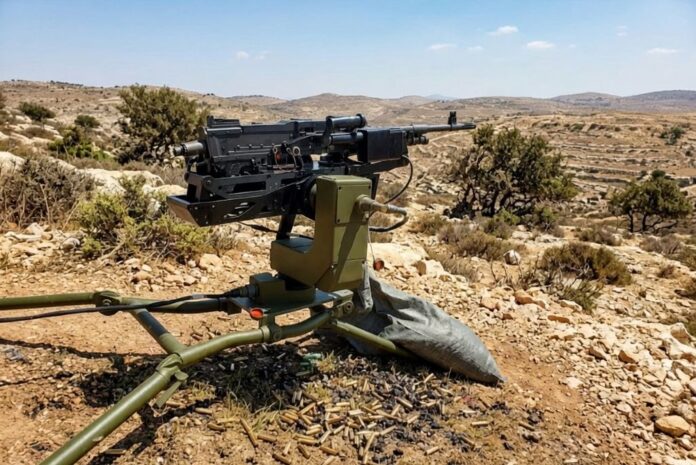
Smart Shooter, the Kibbutz Yagur-based defense technology firm, has just signed a NIS 6.7 million agreement with Israel’s Ministry of Defense to supply its SMASH Hopper lightweight remote-controlled weapon stations, with options that could expand the deal’s total value to approximately NIS 14.6 million. The system is aimed squarely at the chetz ya’uf yomam of our generation.
A Contract Born of Urgent Necessity
The agreement calls for delivery of SMASH Hopper systems, spare parts, and related services during the second half of 2026. Smart Shooter CEO Michal Mor described the deal as reflecting “the ministry’s continued confidence in the company’s technology,” adding that the system addresses “urgent” defense needs.
The timing is no coincidence. Just days before the contract was announced, IDF officer Cpt. Maoz Israel Recanati, Hy”d, was killed in a Hezbollah drone strike in southern Lebanon — the seventh Israeli military death since the nominal ceasefire that took effect on April 17, 2026.
Despite the formal cessation of hostilities, Hezbollah has continued to harass IDF positions and Israeli border communities with a weapon that has proven dismayingly difficult to counter.
The Fiber-Optic Threat
Fiber-optic drones — small first-person-view (FPV) quadcopters tethered to their operators by a hair-thin glass fiber cable — emerged as a defining weapon of the Russia-Ukraine war. Hezbollah operatives, observing this evolution carefully, have adapted the technology for use against Israel.
The menace lies in their immunity to electronic warfare. Conventional drones rely on radio frequency communication that can be jammed or spoofed. Israel, which has invested enormously in EW capabilities, has been highly effective at neutralizing radio-controlled UAVs. But a drone receiving its commands through a physical cable — a wire roughly the width of dental floss — emits no detectable signal whatsoever. Israel’s electronic shield, in effect, simply does not see it.
These drones are also remarkably cheap. According to Israeli military officials, Hezbollah produces them locally from an off-the-shelf commercial drone, a small explosive payload, and readily available transparent fiber cable — at a cost measured in hundreds of dollars per unit.
The IDF has attempted various improvised responses: concrete walls, netting strung over positions, net-launching interceptor drones, and even anti-drone barbed wire supplied to the Lebanese Armed Forces. An Israeli military official, speaking to CNN, candidly acknowledged that none of these measures is foolproof: “It’s a threat that we are still adapting to.” On April 11, the Defense Ministry’s Directorate of Defense Research and Development issued a public call for solutions — nearly two years after such systems first appeared on the Ukrainian battlefield.
What the SMASH Hopper Is
Weighing approximately 15 kilograms, the SMASH Hopper is a compact, modular, remote-controlled weapon station designed for rapid deployment on light vehicles, ground robots, fixed posts, masts, and tripods. The operator controls it from a safe distance from the threat — a critical feature when the threat is a high-explosive drone designed to hunt and kill the very soldiers attempting to shoot it down.
The system offers full day-and-night operation, automatic scanning and target detection, and a safe trigger mechanism. Mounted on a stabilized platform rather than held by a fatigued or stressed soldier, it delivers consistent precision under conditions where human marksmanship deteriorates. The SMASH family can engage drones at ranges of up to 250 meters, with recent integrations on heavy machine guns extending that range to 400 meters during NATO trials in Project VANAHEIM.
Software as the Decisive Factor
What makes Smart Shooter’s systems distinctive is not the hardware but the software. A camera and sensor feed continuous imagery into an onboard computer, which analyzes the scene in real time. When the operator identifies a target and presses a button, the system locks on and tracks — calculating, frame by frame, where the projectile must be aimed to strike a target moving erratically at considerable speed.
The operator’s job is reduced to alignment. The system displays a firing window; the trigger releases the shot only when the geometry is correct. This approach — called Lock-Track-Hit — converts a difficult skill into a task that can be performed by ordinary soldiers, even reservists with minimal training. The first round, according to Smart Shooter, hits its target.
This is precisely what the fiber-optic drone problem demands. Because these drones cannot be jammed, they must be killed kinetically. But the targets are tiny, fast, and piloted aggressively at high speed. A soldier under attack, with seconds to react, must hit a target the size of a dinner plate moving at 60 or 70 miles per hour. Without computational assistance, this is essentially impossible for any but the most exceptional marksmen.
Why the SMASH Hopper Specifically Addresses This Threat
First, the system does not depend on electronic detection. Because fiber-optic drones emit no radio signal, radar- and RF-based detection systems struggle against them. The SMASH Hopper acquires targets optically — exactly the modality that fiber-optic drones cannot evade. When integrated with detection radars such as the DRS RADA RPS-42, an end-to-end sensor-to-shooter solution is produced.
Second, the remote-control architecture removes the soldier from the kill zone. Fiber-optic drones are designed to hunt specifically the soldiers attempting to engage them. A SMASH Hopper mounted on a fixed post or light vehicle — with its operator controlling it from a protected position — denies the drone its target. From a halachic perspective, the principle of u’shmartem me’od l’nafshoseichem is served in a particularly direct way by technology that places machinery, rather than men, in the line of fire.
Third, the system’s software-driven nature allows it to be updated as the threat evolves. The same approach has allowed SMASH systems to evolve from their original mission — countering Hamas balloons and kites along the Gaza fence — to engaging the much more demanding targets of today.
Global Validation
The Israeli Defense Ministry’s vote of confidence comes against substantial international validation. Last week, the U.S. Army awarded Smart Shooter a $10.7 million contract for SMASH 3000SA rifle-mounted fire-control systems. The United Kingdom’s Ministry of Defence has placed orders worth roughly 4.6 million pounds. Germany, NATO member states, and other allied nations have deployed Smart Shooter technology. The company maintains subsidiaries in the United States, Germany, and Australia.
A Sober Assessment
No single system will solve Israel’s drone problem. The fiber-optic threat will require a layered response — improved detection, physical barriers, intelligence operations against Hezbollah’s drone infrastructure, and kinetic interceptors at multiple ranges.
The SMASH Hopper occupies one critical layer — the close-in, last-line, point-defense layer where a drone has evaded all other countermeasures and is seconds from impact. In that role, it offers what Israel’s soldiers have urgently needed: a tool that does not require them to expose themselves to acquire a small, fast, maneuvering target with a rifle alone.
For Cpt. Recanati, Hy”d, and the six soldiers who fell before him during this latest chapter of the Lebanon conflict, this technology has come too late. The hope and prayer is that for the next soldier whose position is found by a Hezbollah drone, the SMASH Hopper will already be in place, scanning the sky.
As Dovid HaMelech declared: Baruch Hashem tzuri ha’melamed yadai la’krav, etzbe’osai la’milchama — “Blessed is Hashem, my Rock, who trains my hands for battle, my fingers for war” (Tehillim 144:1). In our dor, that training increasingly takes a digital form. The SMASH Hopper is one of the latest expressions of an old principle: that Klal Yisrael must combine bitachon in Hashem with the most capable tools its hands can wield.
The author can be reached at [email protected]