
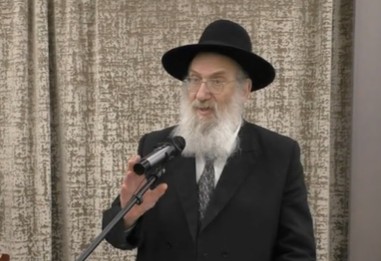

NEW YORK (VINNEWS/Rabbi Yair Hoffman) What follows is a fascinating and inspiring new understanding of Naomi based on a shiur given by Rav Uren Reich shlita. This shiur was delivered the same day that the Rosh yeshiva served as the sandek for this author’s einekel. The pasuk at the beginning of Megillas Rus describes this wealthy, successful lady, Naomi.
How’s everything going for her? And then she leaves with her husband to stay in Moav, and one tragedy after another befalls her, and she comes back bereft of everything that she had before. “Vayehi k’voanah Beis Lechem” — as they come back and they come into Beis Lechem, and everybody’s assembled there, “vateihom kol ha’ir” — everybody was talking about it. “Vatomarna ha’zos Naomi?” Is this the lady that we once knew? Naomi — she’s unrecognizable. “Vatomer aleihen, al tikrena li Naomi.” Don’t call me Naomi.
The word Naomi is from ne’imus — sweet. “Kerena li Mara” — call me bitter. “Ki heimar Shakai li me’od” — Hashem has given me much bitterness. “Ani mele’ah halachti, v’reikam heshivani Hashem; lamah tikrena li Naomi, v’Hashem anah vi, v’Shakai heira li.”
We look at these words, and they sound like the bitter ranting of a woman who’s fallen on hard times — negative and upset.
She, so to speak, spits at those who call her Naomi. Why are you calling me Naomi? I’m not Naomi. I’m now a woman who’s living a bitter life. Things have turned very bad for me.
But it may have meant something completely different.
And I’d like to share a story about my great-grandfather, Rav Shlomo Zalman Pines. Rav Shlomo Zalman Pines lived in Minsk. He was truly “Toraso v’zulaso b’mokom echad.” He was a fabulously wealthy person, part of his family, and he learned yomam va’laylah. And gedolei Yisroel stayed in his house — Rav Zalman Sender, Rav Chaim Brisker. He spent his Shabbosos with Rav Meir Simcha, and he spoke about it till the end of his life — different chiddushim that he discussed with Rav Meir Simcha.
And the wealth in the house was so fabulous that his wife used to tell the grandchildren stories about the maidservants they had, and the gold — they didn’t have silver, they had gold.
They had all kinds of cutlery. And every year, as a very wealthy man, he used to go with his wife to Switzerland for a vacation, and he left his two children behind with a babysitter — this was their minhag b’kviyus.
And one year — I think it was 1914 — for reasons that no one knows, he took both children with him that year. And they were in Switzerland, and on the way out, they realized they were missing certain papers.
They went back to the stantzia to get the papers, and they missed the boat that day, and therefore they decided to go back to Russia the next day. Which was Hashgachah Pratis — they got a telegram: “The Bolsheviks have taken over. There’s a revolution. A lot of unrest. Don’t come back right now. Wait until you know what’s me’ulad yom.”
Shortly afterwards, he got another telegram, or maybe a letter: “They’ve taken over completely. The Russian Revolution — and the scapegoat for everything is the wealthy people. They’ve taken over everything that you have. If you walk into Russia, you’ll be killed immediately. Stay where you are.”
And he realized that it was a gezeiras Hashem that he has to stay in Switzerland.
He had kim’at no money with him at all. He had what he brought with him for the vacation. And he had some very nice leichter, and he had a little bit of a part in the house that he was in in Switzerland.
He was doomed to be a poor man for the rest of his life. “Litvish atam tarchem,” omar, “dar raglov, v’al ma she’amar Baruch Atah Hashem Elokeinu Melech ha’olam — dayeinu emes.”
From then, for the next 30 years until the end of his life — more than 30 years — he never spoke a word about his previous riches. He lived as a very poor man, and he was marbitz Torah yomam va’laylah, sha’arim, sha’arim.
Yeduah — he said on himself, he said to my uncle Reb Dov, he learned Bava Kamma over 100 times b’iyun. He wrote on kol chelkei ha’Torah, atem chochmas Halacha.
But the point that I’m bringing out of it is “mefulag harayim.” Here he’d lived one track as a wealthy person, a baal gedulah, a person who was machnis kedushah l’Yisroel, b’haflagah — and in a moment, so to speak, his life was nehefach, and he was mekabel b’tzidduk hadin, b’ahavah, and never spoke about it.
His wife used to speak to the children about it, but he never said another word.
And what’s the omek of that? What’s the depth of that?
He put that life behind him. He realized that Hashem gives a person a tafkid. His tafkid until now was to live the life of a wealthy person — with tzidkus, with Torah, with avodas Hashem. And now he had a different goral. And he didn’t want to hear about what was before. It’s not relevant. Why be nostalgic about times that used to be and feel that I’m missing something? I’m in a new world, and a new tekufah.
Naomi lived a life of sweetness for a long time. And when she came back, people were comparing the lady they were watching to the lady she used to be. And from the name of a person, they said, comes the tafkid: “Ha’zos Naomi?” Is this the lady that we knew, that was Naomi? “Vatomer aleihen” — and she said to them: I don’t view myself anymore as Naomi. That was my previous life. “Al tikrena li Naomi.” Don’t give me the title Naomi. Naomi is the lady I used to be. “Kerena li Mara, ki heimar Shakai li me’od.”
Now Hakadosh Baruch Hu has given me the trial, the tribulation, of having a bitter life — and seeing if I can endure it with the right kabbalah b’ahavah. “Ani mele’ah halachti, v’reikam heshivani Hashem” — middas harachamim. Now Hakadosh Baruch Hu has decided to give me a different role. “Lamah tikrena li Naomi?” Why talk about the Naomi that used to be? It’s irrelevant. “V’Hashem anah vi, v’Shakai heira li.”
And the truth is, as we all know, Naomi’s gedulah begins now.
Now, through Rus, Naomi has a connection — as we see at the end of the Megillah, she becomes the one who is the forerunner of Malchus Beis Dovid and Malchus Melech HaMashiach.
So a person who feels deprived because there was something great that he had — whatever it may be — that was taken from him: this is the avodas Hashem. “B’chol me’odecha” — Chazal zogn, “b’chol middah u’middah she’hu moded lecha, hevei modeh lo me’od me’od.” A person has to accept what Hakadosh Baruch Hu gives him. It’s a very, very difficult challenge.
I remember my father, alav ha’shalom — he was a very active person, he was a sociable person, he liked people. And when he became sick, and he was in an old age home, at the beginning he couldn’t deal with the transformation of his life. He spoke to me about it; we spoke. Hakadosh Baruch Hu gives a different tafkid, and he took that discussion and he said it over to many people: “I’ve been mekabel — now I have a different life. Now I have to take care of Mommy, I have to take care of Mommy, and I have to live a slower life, and it takes me half an hour till I walk next door to Minchah. That’s my life. I’m going to be mekabel b’ahavah.”
This is the way we all have to live in avodas Hashem. U’bizchus ha’kabbalos ha’tovos shelanu nizkeh l’mashiach.
The transcriber can be reached at [email protected]