
 Matzav
San Diego Mosque Shooting Revives Scrutiny Over 9/11 Ties, Imam’s Pro‑Hamas Sermons
Monday’s deadly shooting at the Islamic Center of San Diego, which claimed the lives of three men, has once again placed the mosque under intense public scrutiny due to both its historical connections to two September 11 hijackers and more recent outrage over inflammatory anti-Israel remarks made by its imam and members of his family.
Federal and local authorities are treating the attack as a hate crime after investigators said two teenage suspects — Caleb Liam Vazquez, 18, and Cain Lee Clark, 17 — allegedly opened fire inside the mosque before later being discovered dead in a nearby vehicle from what officials believe were self-inflicted gunshot wounds. Law enforcement sources said investigators uncovered Nazi paraphernalia, extremist manifestos, and antisemitic writings tied to the suspects, who authorities described as adherents of neo-Nazi ideology.
As investigators worked to piece together the motive behind the attack, attention also shifted back to the controversial history of the Islamic Center of San Diego, including longstanding questions surrounding individuals connected to the mosque and the September 11 terror attacks, as well as criticism directed at Imam Taha Hassane over comments defending what he described as Palestinian “resistance.”
The mosque first became the subject of national attention after it was revealed that two of the September 11 hijackers, Nawaf al-Hazmi and Khalid al-Mihdhar, attended services there while residing in San Diego. The 9/11 Commission later examined allegations that people affiliated with the mosque community assisted the pair with housing and logistical support after they arrived in California. Subsequent reports alleged that associates connected to the mosque also helped the hijackers obtain identification documents, buy a vehicle, and gain access to financial resources. The commission, however, did not determine that mosque officials or congregants knowingly participated in the terrorist conspiracy.
Separate reports further alleged that members of the mosque community organized a welcoming event for the hijackers shortly after their arrival in San Diego in 2000.
In more recent years, controversy surrounding the mosque centered largely on Hassane, who has served as imam there since 2004. Following Hamas’s October 7, 2023 massacre in Israel — in which approximately 1,200 people were murdered and more than 250 were kidnapped in the deadliest attack against Jews since the Holocaust — Hassane faced backlash for comments widely viewed as justifying the violence.
“This did not start last week or on October 7th,” Hassane said in a video posted to social media days after the attack. “This is the result of brutal Zionist occupation and genocide.”
Hassane later promoted the sermon on Instagram, writing: “Resistance is justified when people are under occupation and don’t let them change that narrative.”
His rhetoric intensified in the weeks that followed. During an October 20 sermon delivered less than two weeks after the Hamas massacre, Hassane again defended what he repeatedly referred to as “resistance.”
“When people are occupied, then the resistance is justified,” Hassane said. “We cannot accuse somebody who is fighting for his life to be a terrorist. The terrorist is the one who started the occupation, not the one who is defending himself.”
The criticism surrounding Hassane did not end after the immediate aftermath of October 7. In subsequent months, his public statements and activism continued attracting attention over his harsh anti-Israel rhetoric and support for radical anti-Israel campaigns.
In January 2024, Hassane accused Israel of enforcing “apartheid.” Not long afterward, he posted online: “Zionism is Islamophobia!”
Several months later, in May 2024, Hassane publicly backed anti-Israel protest encampments at the University of California, San Diego. He appeared alongside demonstrators and urged university officials to “boycott and divest from Israel.”
Members of Hassane’s family also became embroiled in controversy over anti-Israel activism and inflammatory social media activity.
According to watchdog organization Canary Mission, Hassane’s daughter, Selma Hassane, “promoted incitement, spread hatred of Israel, engaged in anti-Israel activism and is a supporter of the Boycott, Divestment, Sanctions (BDS) movement.”
Canary Mission documented years of activism tied to Selma Hassane, including involvement with the controversial campus organization Students for Justice in Palestine, participation in anti-Israel demonstrations, and organizing efforts in support of Palestinian causes.
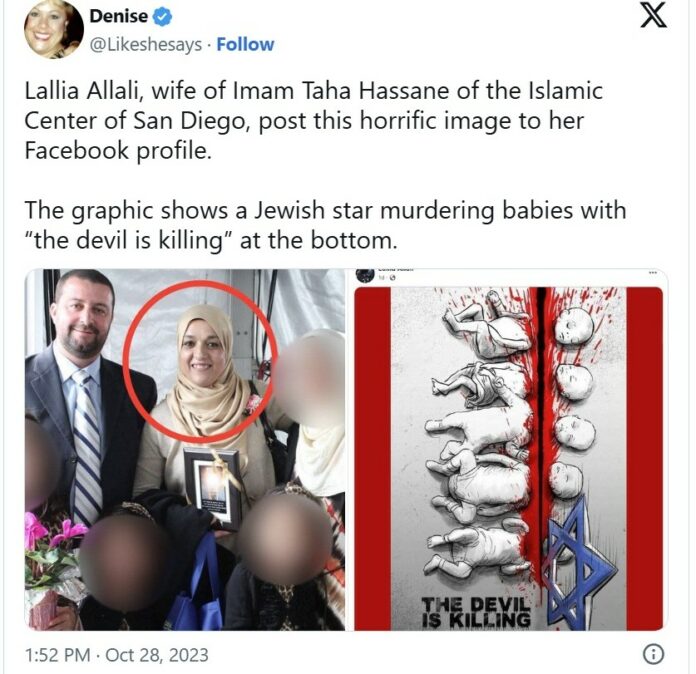
Meanwhile, Hassane’s wife, Lallia Allali, drew widespread condemnation after reposting an image weeks following the October 7 attacks that depicted a Star of David decapitating five babies alongside the phrase: “The devil is killing.”
The fallout from the post quickly spread into her professional life. At the time, Allali served on the San Diego Union-Tribune Community Advisory Board as an emeritus member and regularly contributed commentary focused on interfaith understanding and “Islamophobia.” She also taught at the University of San Diego and authored academic work addressing anti-Muslim bias.
The San Diego Union-Tribune later denounced the image as “a graphic and deplorable antisemitic image,” adding that after verifying the repost, “we accepted her resignation and removed her from the list of board members and contributors on our website.”
The University of San Diego also announced that Allali would no longer teach at the institution, stating: “While individuals have the right to express their views on their personal accounts, they do not reflect the views of USD leadership nor any official position of the university.”
Rabbi Abraham Cooper, associate dean and global social action director of the Simon Wiesenthal Center, strongly condemned the repost at the time, calling it a contemporary “blood libel” and labeling the imagery “despicable and deplorable.”
Residents living near the mosque also told the New York Post that relations between the Islamic Center and surrounding neighborhoods became increasingly strained after the October 7 attacks, particularly due to concerns involving a nearby Hebrew-language charter school.
“Hassane was supposed to bridge all the communities, but quickly became a hostile figure,” local journalist and parent Stella Escobedo told the outlet.
{Matzav.com}