
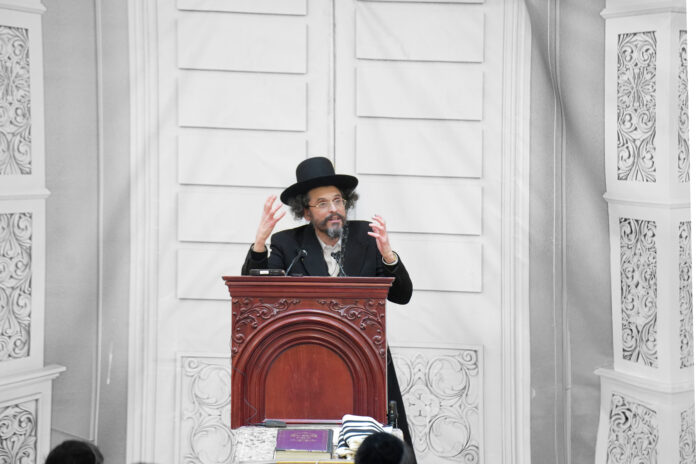

One of the reasons why I wanted to speak to Rav Chaim Mordechai Ausband, the rosh yeshivah of Yeshivas Ateres Shlomo in Rishon LeZion in Eretz Yisrael, was not only because of who he is but because I was interested in hearing about his father and what it was like growing up in his home.
Rav Chaim Mordechai lives on the top floor of a Bnei Brak apartment building not far from Kiryat Ponevezh, where he spent years immersed in Torah. When he opens the door, his tall, slender frame hardly obscures my view into the apartment. He has a small beard and large, bushy peiyos.
“Please come in and sit down,” he says immediately. Rav Chaim Mordechai is always in a hurry, perpetually drawn back to his favorite place in the world: in front of his Gemara.
I begin by asking him for some recollections of his father.
“I would say that the most prominent thing about him was the way he conducted himself at home,” he begins. “I never once saw my father sitting on a couch. He never spoke devarim beteilim, not in the house and not anywhere else. This made an extraordinary impression on all of us. The hanhagah inside the home was simply a continuation of what it was outside. There was no ‘home version.’ There are many people who are renowned for great things, but at home their hanhagah is different. By my father, it was the opposite. The world was out there; we were in here,” he says, pointing to the sefarim in his dining room where we are seated.
It is this mehalech that led his father to enroll Rav Chaim Mordechai in the mesivta of the Telshe Yeshiva when he was only seven years old. His classmates were 13—almost double his age. From there, he went on to Telshe Chicago, where he learned under Rav Chaim Levin, zt”l, before returning to Telshe Cleveland for two formative years under Rav Mordechai Gifter, zt”l. He then made his way to Ponevezh, where he learned under Rav Elazar Menachem Man Shach, zt”l, absorbing not only his shiurim but his derech and becoming one of his talmidim muvhakim.
It was in Ponevezh that he also found his shidduch. He married the daughter of Rav Gavriel Knopfler, the rosh yeshivah of Shaarei Torah in Manchester, England, where I myself learned for four years as a young bachur. Rav Knopfler is also a talmid of Ponevezh.
Rav Chaim Mordechai chose to remain in Ponevezh in Eretz Yisrael, where he spent many years immersed in Torah. His reputation quickly grew as one of the great masmidim and lamdanim in the yeshivah, and he was sought after as a maggid shiur in many places. For a number of years he served as rosh yeshivah at Yeshivas Kiryat Melech under Rav Shlomo Kanievsky, where his shiurim and shmuessen were legendary. He later joined Yeshivas Ateres Shlomo as its rosh yeshivah, where he has acquired a large and devoted group of talmidim.
As I am speaking to him, I am struck by a thought. The classic way of being taught Torah is the way we received it at Har Sinai: through direct transmission—word by word, halachah by halachah, from rebbi to talmid and from mouth to ear. This is the way Torah is transmitted in yeshivos, rebbeim teaching the younger grades and delivering shiurim and older bachurim learning with a chavrusa. It is structured. You sit down, open a sefer and learn.
Then there is Torah that is absorbed by osmosis, not so much received as breathed in year after year until it becomes the very fabric of a Yid’s inner life. Some may call this chinuch; others might call it growing up in a Torahdike home. Either way, what it produces is something no amount of formal instruction can fully replicate: a person for whom Torah is not merely a studied subject but part of every aspect of life.
Rav Chaim Mordechai is a product of both approaches, and much of his father’s hanhagah, he explains, had a specific source: Kelm. “He learned in Kelm under Rav Shach, who was himself a talmid of Kelm,” he tells me.
The Kelm derech was about the cultivation of mentchlichkeit in its most exacting form: every gesture considered, every word weighed and every middah refined to reflect a single inner ideal. The Kelmer mussar of Rav Simcha Zissel Ziv taught that a person’s true ruchniyusdike level reveals itself not in moments of dramatic challenge but in the texture of ordinary, everyday life.
Rav Chaim Mordechai speaks very energetically and excitedly, gesticulating animatedly with his hands. He offers an illustration of his father’s extraordinary level of ruchniyus.
“When my father was a young man, my mother once served him a meal. He gave no indication that anything was out of place; he simply sat there quietly until she finally realized that she had forgotten to give him a fork. He wouldn’t eat without a fork, so he said nothing, because in Kelm one doesn’t draw attention to what is missing. One doesn’t inconvenience the host. One doesn’t say ‘I need.’ One absorbs the discomfort quietly and moves on.
“Even when I was growing up, these seemed like strange hanhagos,” Rav Ausband says with a smile. “It wasn’t until I was much older that I understood that it was strange for the hamon am, regular Yidden. My father’s hanhagos were ones that people describe as belonging to truly great people.”
Nowhere were these exalted hanhagos more evident than in Rav Eizik Ausband’s relationship with food, or rather his studied indifference to it.
“He didn’t talk about food,” Rav Ausband says simply, “and he connected this directly to the Chofetz Chaim. He would quote him, ‘Let’s just get through the eating. Let’s be done with it and move on to what matters.’”
There was another story about the Chofetz Chaim that he would often tell, which makes the point even clearer.
“They once gave the Chofetz Chaim a bowl of kasha, and someone at the table began commenting on the food. Is it good? Is it tasty? The moment the conversation turned to the food itself, the Chofetz Chaim put down his spoon and stopped eating. The message required no elaboration. A Yid eats because the body requires it to live. The moment eating becomes a pleasure to be savored and discussed, it is no longer a benefit to the body. It was something essential but had now been trivialized.”
The Ausband seudos resembled those of the Chofetz Chaim.
“There might have been the occasional exception,” Rav Chaim Mordechai reflects, “but as a general rule the Shabbos seudah in our home was kulo kodesh. It bore no resemblance to an ordinary weekday meal that most people are accustomed to.”
The structure was unvarying.
“My father would return home from yeshivah after Minchah and Maariv, take his place at the table and eat. My mother, a”h, would look at him and ask, ‘Nu, vos iz der vort fun haynt—So what is today’s dvar Torah?’ That was the conversation. There was no schmoozing or devarim beteilim.”
And it wasn’t only during meals that Rav Eizik refrained from small talk.
To read more, subscribe to Ami

