
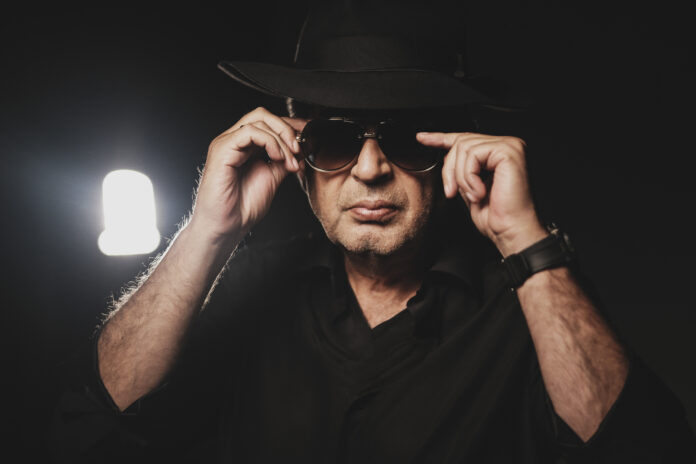

Following the collapse of the Soviet Union, Dr. Shyfrin emerged as one of the leading industrial entrepreneurs in Eastern Europe. He cofounded Midland Group, an international industrial and investment company with operations spanning steel production, shipping, real estate, agriculture and technology. Under his leadership, the company became a major force in the global steel and commodities sectors, with partnerships and investments extending across Europe, North America and Asia. Throughout his business career, he became known for combining scientific thinking with strategic long-term vision in highly complex international markets.
Despite his considerable commercial success, Dr. Shyfrin experienced a profound personal and existential crisis in 2002 at the age of 42. Confronted by questions with regard to mortality, meaning and human purpose, he found that neither business achievement nor science could adequately answer these queries that increasingly defined his inner life: Why are we here? What is consciousness? What happens after death? Is there an underlying order to existence?
During this pivotal period, Dr. Shyfrin sought guidance from Rabbi Yaakov Dov Bleich, the chief rabbi of Ukraine, who encouraged him to undertake teshuvah. What began as a personal search evolved into decades of intensive study of Torah, Talmud, Jewish philosophy and Kabbalah. Approaching these subjects through the disciplined lens of a scientist, he became especially interested in the relationship between ancient mystical thought and modern developments in quantum physics, information theory, thermodynamics and consciousness studies.
These explorations culminated in his book From Infinity to Man, which proposes a synthesis between Kabbalistic concepts and contemporary scientific thought. In the book, Dr. Shyfrin advances the idea that information rather than matter alone may constitute the fundamental structure of reality, drawing parallels between Jewish mystical teachings and modern theories in physics. The work attracted international attention for its ambitious interdisciplinary approach and positioned him as a distinctive voice in contemporary discussions about science and spirituality. He later expanded these ideas into what he calls the “Kabbalah of Information,” an evolving philosophical framework he explored in subsequent writings and lectures.
In parallel with his intellectual work, Dr. Shyfrin has remained deeply involved in philanthropy and Jewish communal life, supporting educational, humanitarian and cultural initiatives all over the world, particularly in Ukraine. He has also contributed essays and Torah commentaries to leading Jewish publications and educational platforms.
In recent years, Dr. Shyfrin has expanded his creative pursuits into music through his project Shyfrin Alliance, blending blues, jazz and rock with philosophical and spiritual themes. His music reflects many of the existential and mystical ideas explored in his writings, creating what he describes as another language for expressing questions of time, soul, longing and transcendence.
Known for his rare ability to bridge science and spirituality, commerce and contemplation, Dr. Eduard Shyfrin occupies a singular place among contemporary thinkers, equally at home discussing metallurgy, quantum theory, Torah or music. A few weeks ago, I had the privilege of speaking with him about the remarkable journey that has taken him from the industrial upheavals of post-Soviet Eastern Europe to the worlds of Jewish mysticism, philosophy and artistic expression.
You are a man who is interested in so many things. How do you see all of that coming together in your personality?
That’s life, Rabbi. Life has many faces.
Does it have many faces, or is it one face with many features?
You could put it that way as well. We shouldn’t limit ourselves. If we think we can do something important, we should allow ourselves that possibility instead of restricting it.
You seem to be on a continuous journey, constantly exploring and looking for different experiences.
Exactly. I was once told by my rabbis that if you do something against your will but do it anyway, you receive the greatest reward. I jokingly replied that in that case, I wouldn’t receive any reward for my work, because I genuinely enjoy studying and learning. I’m not doing it against my will.
You’re doing what you like to do.
Not always. There are times when I have to do something that’s a duty. But when you can do what you like and be happy with the results of your labor—I’m quoting Koheles—it’s a great gift from G-d.
As a man of many facets, what is your ultimate like?
Intellectual cognition.
Sometimes a person’s occupation and life story aren’t one and the same. But it seems that your life mission and intellectual interests align. They seem to be very interconnected, with your biography influencing your thought processes.
You’re absolutely right. In my view, the ideal state is one of holism, when the whole is greater than the sum of its parts. It’s very difficult to reach, but we should strive toward it. You’re also right that all of my activities are interconnected; they flow into each other, forward and backward. I’m driven by a desire to understand this world, to understand G-d, and to understand whatever I can.
Life is a journey for everyone, but for you it seems to be one in the geographical sense as well. I understand that you’re currently in Monaco, although your life began in a different culture and place.
Absolutely. I was born in Soviet Ukraine.
At what age did you discover your need to discover?
It’s a long story. My late parents, of blessed memory, were people of the book. As long as I can remember, our small apartment was filled with volumes. I started reading very early. We were a family that valued language, and that orientation was deeply ingrained in me, shaped first and foremost by my parents.
What kinds of interests did they have?
They were both metallurgical engineers. Later on, my father became a professor and earned a doctorate in science. He was more analytically inclined. My mother, by contrast, adored books and knowledge, and she collected several thousand volumes. In our home, the book was the queen of the apartment.
I assume it was a very small apartment.
Yes. I was born in a one-room apartment with six people living there.
Did you have any exposure to religious books?
Absolutely not. This was the Soviet Union, and my father was a member of the Communist Party. I was also a member of the party for six years. Religion was strictly forbidden. I didn’t know anything about the Torah or the synagogue. However, I did know that I was Jewish.
To read more, subscribe to Ami

