
 JBizNews
Congo Ebola Crisis Hits Pharma, Mining and Travel Sectors as Outbreak Engulfs Hospitals
By JBizNews Desk
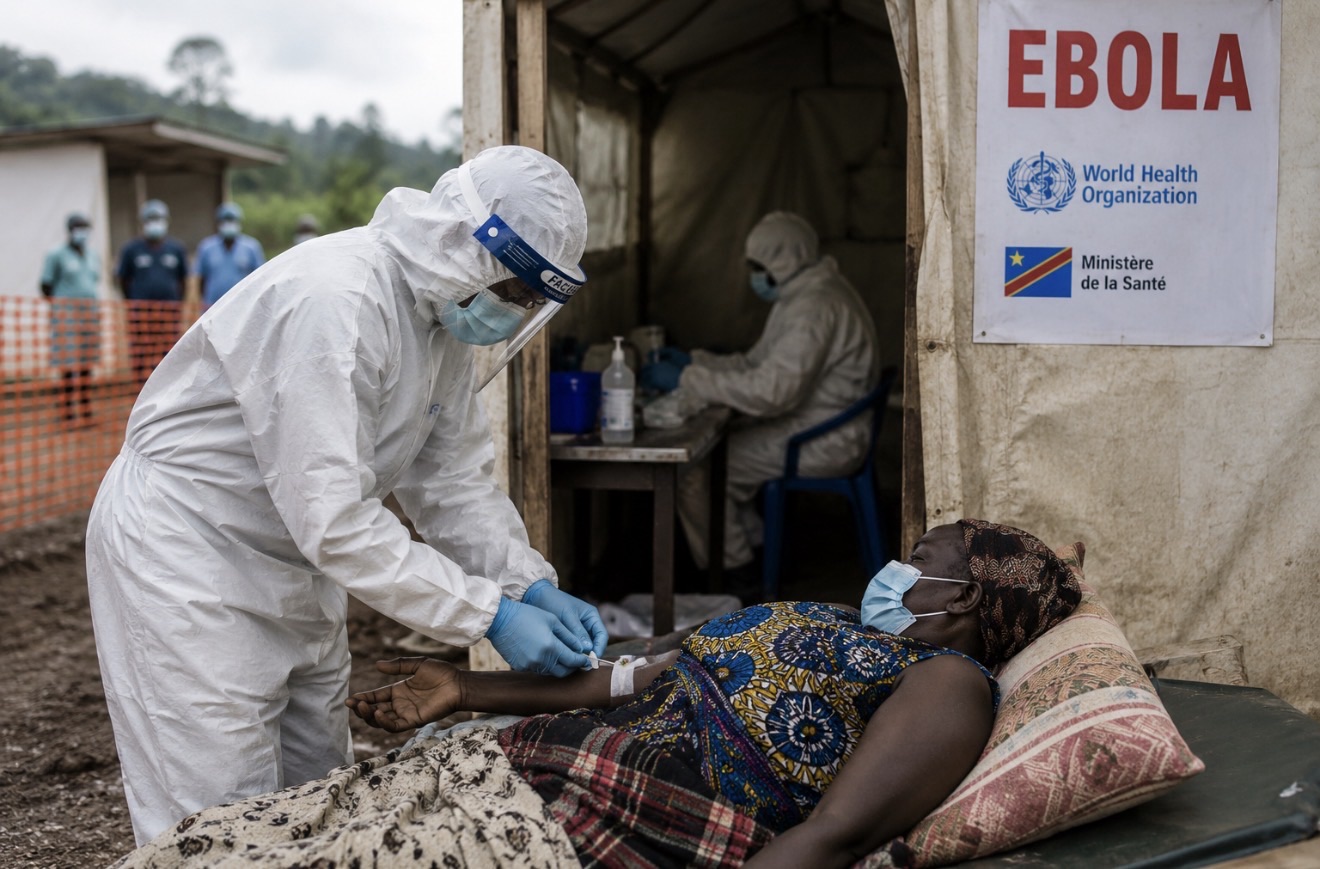
Bunia, Democratic Republic of the Congo — May 24, 2026 — Hospitals across eastern Congo are “fighting with no tools at all,” according to Dr. Jean Kaseya, Director-General of the Africa Centres for Disease Control and Prevention, as a fast-moving outbreak of Bundibugyo ebolavirus spreads across one of Africa’s most strategically important mining corridors and begins rippling through the pharmaceutical, aviation, insurance and global commodities sectors.
The Democratic Republic of the Congo’s Ministry of Public Health, working alongside the World Health Organization and Africa CDC, has confirmed 968 suspected cases and 216 deaths across Ituri, North Kivu and South Kivu provinces, while neighboring Uganda has reported five imported cases in Kampala, the country’s capital and commercial hub.
The outbreak has already triggered emergency travel measures, intensified supply-chain monitoring and reignited fears of a broader regional disruption across Central Africa.
On May 18, the U.S. Centers for Disease Control and Prevention and the Department of Homeland Security imposed enhanced travel screening and routing restrictions for travelers recently transiting the DRC, Uganda or South Sudan. American citizens and permanent residents leaving affected areas are now being funneled through designated U.S. airports in Virginia, Texas and Georgia for additional screening procedures.
The measures are complicating operations for international carriers including Delta Air Lines, United Airlines, Air France-KLM and Brussels Airlines, the latter long serving as one of the primary Western aviation links into Kinshasa.
The outbreak is also colliding with a growing funding crisis inside global public health systems.
The WHO and Africa CDC have jointly requested more than $314 million in emergency funding for containment, treatment and surveillance operations, including roughly $54 million earmarked for neighboring high-risk countries such as Rwanda, Kenya, Tanzania, Angola, Burundi and South Sudan.
The United States has pledged approximately $50 million toward frontline response efforts, while Congo and Uganda are seeking a combined $320 million in additional support.
Kaseya warned this week that donor fatigue is rapidly becoming as dangerous as the virus itself.
International health assistance to African response systems has fallen sharply over the past five years, according to Africa CDC estimates, with several programs weakened further by recent aid reductions and shifting budget priorities across Western governments.
For pharmaceutical companies, the outbreak presents a uniquely difficult challenge: there is currently no approved vaccine or targeted therapeutic for the Bundibugyo strain now spreading across eastern Congo.
Merck & Co.’s Ervebo, the only FDA-approved Ebola vaccine, targets the Zaire strain of the virus and has not been approved for Bundibugyo. The company said existing cross-protection research remains limited and largely untested in human trials.
Regeneron Pharmaceuticals’ Inmazeb antibody treatment is also designed specifically for Zaire ebolavirus and is not approved for Bundibugyo infections.
Drugmakers including Johnson & Johnson and Bavarian Nordic are now evaluating whether experimental candidates can be accelerated into cross-strain testing, but WHO officials warned this week that any targeted vaccine rollout remains months away.
The timing is especially sensitive because the outbreak’s epicenter overlaps directly with one of the world’s most important critical-minerals regions.
Ituri Province sits near major gold, cobalt and coltan transport corridors central to global electric-vehicle and battery supply chains. The Democratic Republic of the Congo produces more than 70% of the world’s cobalt supply, a strategic material used by manufacturers including Tesla, Ford Motor Co., General Motors and major Chinese battery producers.
Mining companies including Glencore, CMOC Group and Barrick Mining have not yet announced operational suspensions, but previous Ebola outbreaks triggered widespread staff evacuations, travel restrictions and production disruptions throughout the region.
The WHO has already identified mining-related population movement as a major transmission risk.
The outbreak also raises concerns for regional banking, trade and logistics infrastructure.
Kampala, where imported cases have now been confirmed, serves as a key financial and transportation hub for East African institutions including Equity Group Holdings, KCB Group and Standard Bank. Kenya and Tanzania have intensified airport health screening procedures at Nairobi’s Jomo Kenyatta International Airport and Dar es Salaam’s Julius Nyerere International Airport.
Meanwhile, major insurers and reinsurers including Allianz, AXA and Marsh McLennan are reportedly reviewing pandemic-related exposure across African travel, trade-credit and logistics policies.
The broader market fear is not simply the current outbreak itself.
It is the possibility that the outbreak escapes containment and evolves into a larger regional emergency similar to the 2014–2016 West African Ebola crisis, which caused an estimated $53 billion in economic losses across Guinea, Liberia and Sierra Leone while severely disrupting mining operations and international investment flows.
Several warning signs are already intensifying concern among health officials and multinational operators.
The outbreak reportedly went undetected for nearly four weeks, healthcare workers have already died treating infected patients at Mongbwalu General Referral Hospital, and ongoing armed conflict across eastern Congo continues restricting medical access and surveillance operations.
With no approved Bundibugyo-specific treatment available and hospitals already overwhelmed, executives across pharmaceuticals, mining, aviation and global logistics are increasingly treating the outbreak not just as a humanitarian crisis but as a growing commercial and supply-chain risk.
The next major turning point may ultimately come down to funding speed.
If the WHO–Africa CDC emergency appeal is funded quickly, the outbreak may remain primarily a logistics and containment challenge.
If donor fatigue prevails, the crisis risks spreading deeper into regional trade routes, aviation corridors and critical-minerals supply chains already strained by geopolitical instability and global commodity competition.
JBizNews Desk
© 2026 JBizNews. All Rights Reserved. Reproduction or distribution without written permission is prohibited.