
 JBizNews
Merck-Kelun Lung Cancer Drug Cut Risk Of Tumor Progression By 65%, ASCO Data Show
By JBizNews Desk
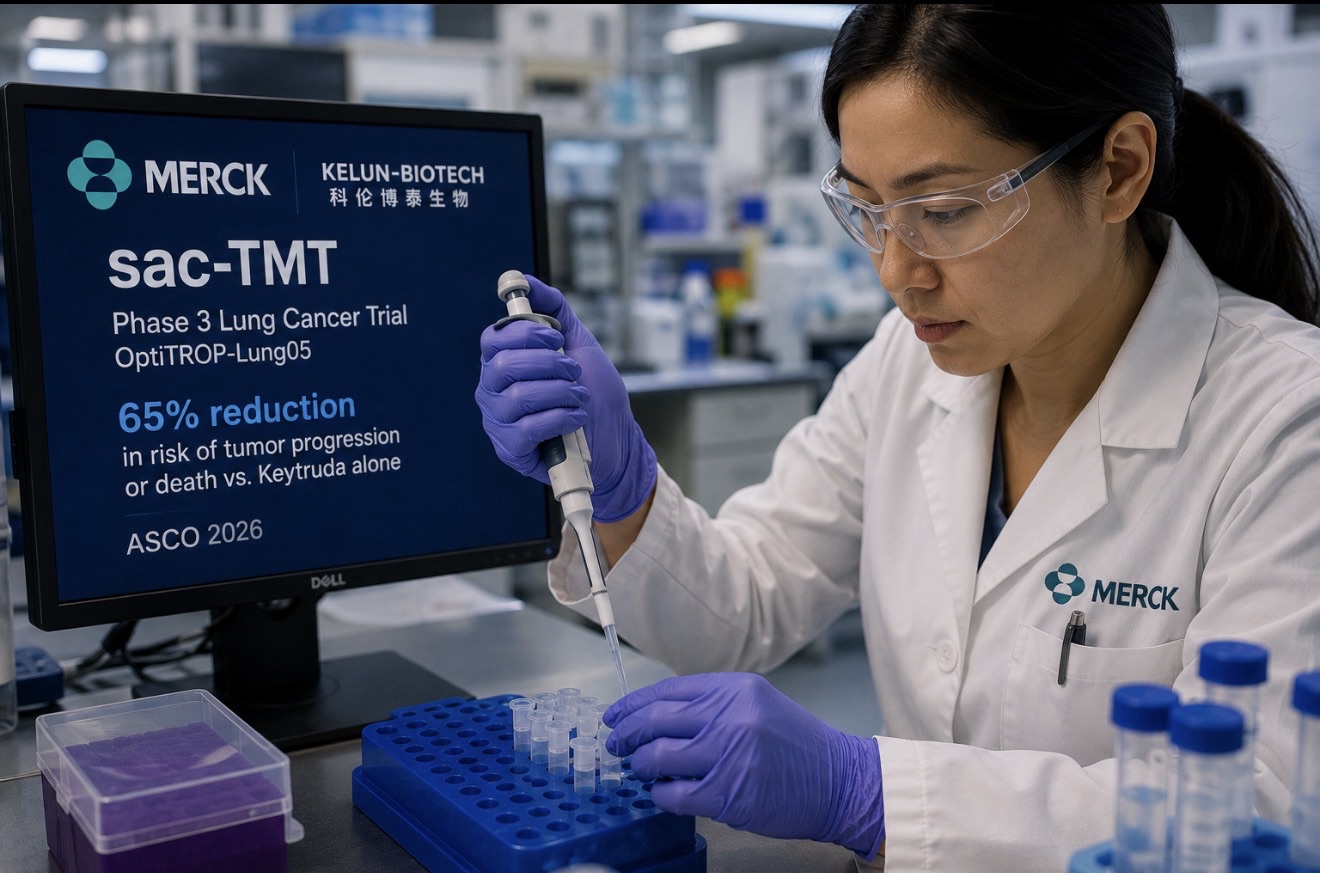
NEW YORK, May 24, 2026 — A new cancer therapy being developed by Merck & Co. and China’s Sichuan Kelun-Biotech has produced one of the strongest oncology trial results of the year, cutting the risk of tumor progression or death by as much as 65% in a late-stage lung cancer study ahead of the annual American Society of Clinical Oncology conference.
The drug, known as sac-TMT, belongs to one of the fastest-growing and most closely watched categories in cancer medicine: antibody-drug conjugates, or ADCs. These therapies are designed to function like precision-guided weapons against tumors — using antibodies to identify cancer cells before delivering targeted chemotherapy payloads directly into them while limiting damage to surrounding healthy tissue.
The latest results come from a Phase 3 trial known as OptiTROP-Lung05, where researchers tested sac-TMT in combination with Keytruda, Merck’s blockbuster immunotherapy drug, against Keytruda alone in patients with advanced non-small-cell lung cancer.
According to data scheduled for presentation at the ASCO annual meeting in Chicago beginning May 29, the combination achieved what researchers described as a statistically significant and clinically meaningful improvement in progression-free survival, meaning patients lived substantially longer without their cancer worsening.
The results add to a growing string of major wins for sac-TMT across multiple tumor types.
In a separate late-stage breast cancer study last year, the drug reduced the risk of progression or death by roughly 65% compared with conventional chemotherapy. Another lung cancer study showed the therapy lowered the risk of death by approximately 40% in heavily pretreated patients whose disease had stopped responding to prior therapies.
The consistency across different cancers and treatment settings is one of the reasons sac-TMT is increasingly viewed as one of the most important pipeline assets inside Merck’s future oncology strategy.
The drug targets a protein called TROP2, which appears on the surface of many common solid tumors, including lung, breast, ovarian, and several gastrointestinal cancers. Because the target exists across multiple cancer types, successful TROP2 therapies potentially represent multibillion-dollar franchises capable of treating millions of patients globally.
For Merck, the timing is critical.
The company’s dominant cancer medicine, Keytruda, generates more than $25 billion annually but faces major patent expirations beginning later this decade. Investors and analysts have spent years asking how Merck intends to replace that revenue stream once generic competition emerges.
Sac-TMT is rapidly becoming one of the clearest answers.
Merck is currently running at least five global Phase 3 lung cancer trials involving the drug, alongside additional studies in breast, ovarian, and other solid tumors. The company originally secured worldwide rights outside greater China through a massive licensing agreement signed with Kelun-Biotech in 2022 worth roughly $1.4 billion upfront and potentially up to $9 billion in milestone payments.
At the time, some investors questioned whether the deal was overly aggressive.
The latest ASCO data is making the transaction look increasingly strategic.
The lung cancer findings may also represent a broader scientific milestone beyond Merck itself.
According to researchers involved in the study, OptiTROP-Lung05 is believed to be the first successful Phase 3 trial showing that combining an antibody-drug conjugate with an immune checkpoint inhibitor improves first-line lung cancer outcomes versus immunotherapy alone.
That matters because pharmaceutical companies worldwide have been racing to determine whether ADCs can work synergistically with immune therapies like Keytruda, Opdivo, and Tecentriq.
If successful, the combination approach could fundamentally reshape standard treatment regimens across several major cancers.
There are important limitations investors and physicians are watching closely.
The OptiTROP-Lung05 study was conducted entirely in China and compared sac-TMT plus Keytruda against Keytruda alone. In the United States, frontline lung cancer treatment more commonly includes Keytruda combined with chemotherapy rather than as a standalone therapy.
As a result, the trial itself is unlikely to directly support U.S. regulatory approval.
Instead, analysts are focused on ongoing multinational studies testing sac-TMT against the broader global standard of care. Those results, expected over the next 18 to 24 months, will likely determine whether the therapy becomes a worldwide commercial breakthrough.
Even so, regulatory momentum is already building.
Kelun-Biotech has filed for approval in China, where regulators have accepted the application for review, while the U.S. Food and Drug Administration has already granted sac-TMT breakthrough therapy designation for certain lung cancer settings, potentially accelerating future review timelines.
The implications extend beyond one company or one drug.
Antibody-drug conjugates were once viewed as a niche technology area plagued by toxicity problems and repeated late-stage clinical failures. That perception changed dramatically after the success of AstraZeneca and Daiichi Sankyo’s Enhertu, which transformed treatment expectations in breast cancer.
Now nearly every major pharmaceutical company is racing to establish leadership in ADCs.
Pfizer, Roche, AstraZeneca, Gilead Sciences, and Merck have collectively committed tens of billions of dollars toward acquisitions, licensing deals, and research partnerships tied to the category.
For patients, the stakes are far more personal than market share.
Lung cancer remains the deadliest form of cancer globally, causing approximately 1.8 million deaths annually worldwide. Survival rates remain stubbornly low despite years of advances in immunotherapy and targeted medicine.
A treatment capable of significantly delaying tumor progression — particularly in earlier lines of therapy — represents the kind of advance oncologists believe could gradually shift long-term survival curves over time.
For Merck investors, the central question is becoming increasingly straightforward.
The company no longer simply needs to defend Keytruda.
It needs to prove it can build the next generation of oncology leadership before Keytruda’s patent clock expires.
And based on the latest data emerging ahead of ASCO, sac-TMT is beginning to look like one of the company’s strongest candidates to do exactly that.
JBizNews Desk
© 2026 JBizNews. All Rights Reserved. Reproduction or distribution without written permission is prohibited.