
 Vos Iz Neias
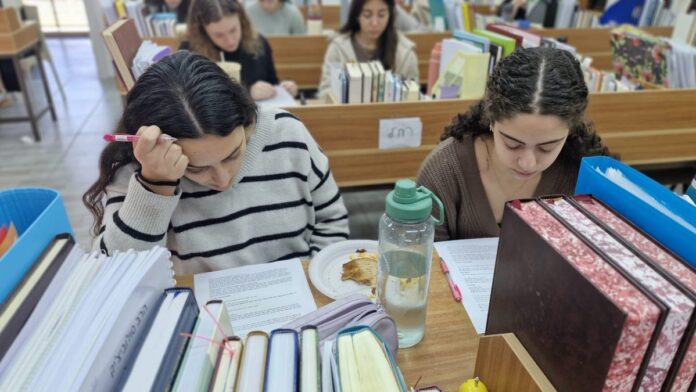
Girls Flocking To Midrashot For Year Of Full-Time Study Before IDF Or National Service
JERUSALEM (VINnews) — Ten years ago, the path of a religious girl at the end of ulpana (religious high school for girls) was clear: a year or two of national service (or military service if you were a bit rebellious), then a degree (probably in teaching), and later marriage. Only a few, the “very religious girls of the class,” would deviate from this track into a full year in a midrasha (religious women’s Torah study program).
Over the years, however, midrashot have managed to carve out their own place in the life path. Whether before national or military service, or afterward, girls from the religious sector are increasingly flocking to a year dedicated entirely to Torah study. On the occasion of Shavuot, the article asks: how did the world of midrashot become a trend that is sweeping everyone?
Tzipi Abeta, an 12th-grade teacher at Ulpanat Segula, describes very high percentages of students choosing to go to a midrasha. “I see that it is on the minds of the vast majority of girls,” she told the Kipah website, attributing the trend also to the school’s guiding approach, which holds an annual “midrasha conference” with representatives from various institutions. “This is something that didn’t exist in previous years,” she admits, “it’s a broad and very important trend.”
When asked to estimate the numbers, she guesses: “If eight years ago maybe 10% of the girls went to a midrasha, today it’s around 30% or more.” Abeta mainly knows about students who go directly after ulpana, but also hears about many who choose the path after national service. The school itself is also in the process of opening a midrasha in two tracks, one for students from France and one regular track.
When asked what caused the trend, she says: “Today the language of midrashot is very present in ulpanot. There is a midrasha in almost every school for girls who stay in the afternoon to study Torah.” She adds: “In recent years there it has become an accepted idea that there should be spiritual strengthening before going to the army, whether in a hesder yeshiva, preparatory program, or yeshiva. Girls used to go to national service or the army as they were. Today girls are already part of a very high-level academic world, so it is only natural they will also connect to Torah and faith at a high level.”
When asked whether this is part of a broader religious strengthening trend, she does not commit fully: “It’s not necessarily about being more religious. It’s a simple desire of the soul. I’ve seen girls who seemed distant and didn’t always pray, and they were thirsty for this encounter with Torah.”
Rabbanit Naama Frenkel, head of the midrasha in Lod (a branch of Midreshet Lindenbaum), sees the growth firsthand. She founded the midrasha nine years ago together with Rabbi Udi Abramovitz. In the first year, 22 students studied there. For next year, 57 girls have already registered. “Our midrasha is before service, and its growth is strongly connected to the fact that more girls are enlisting in the army,” she says, and adds: “But even girls who go to national service are looking to build their spiritual world.”
She says there is now much greater awareness of the importance of Torah study for women. “Today girls invest a lot in music, gymnastics, dance, and many other things, and there is an understanding that you also need to invest in the most important thing in our lives—our spiritual existence.” She also notes a significant increase in short introductory visits, where high school seniors experience the midrasha for a few days.
Regarding admissions, she explains: “There are admission requirements, but you won’t find dry criteria published on the website. We look for girls who love learning. We know the phenomenon of girls who struggled in high school but suddenly flourish in the midrasha and study all day, we know how to identify that. The conditions are that the girl is ready for a full day of study, able to function within a group, and that her worldview fits the midrasha.”
A student, Ayelet Yudin, a first-year national service volunteer, says it was clear to her she wanted to go to a midrasha before her service. She studied last year at Midreshet “Tachlit” in Akko, and says it was “the most accurate and best decision of my life.” She debated between military and national service but ultimately felt she needed a year of exploration first.
She says she is far from alone. In her opinion, at least 50% of girls in her class went to a midrasha. She links this to the rising rate of religious girls enlisting in the army: “Many girls who enlist go to a midrasha first.”
Like boys’ yeshivas, midrashot are also divided into different styles—different approaches, learning methods, and atmospheres. For Yudin, enthusiasm was most important: “That the girls genuinely love the place, that the staff is good, and that the learning is interesting.”
She believes there is a kind of positive social pressure to go to a midrasha: “Yes. It has become much more popular. There is some social pressure, but mainly an understanding that it is a meaningful year, time to reset your personality, gather tools, and organize your inner world.”
When asked about the challenge of sitting and studying Torah all day, she replies: “True. But there is something very flexible in midrashot, with varied classes. If a lesson doesn’t interest you, you can learn with a partner or do something else. There are no exams, the learning is very different. In a way, it becomes addictive, you don’t notice you’ve been studying all day.”