
 JBizNews
Abu Dhabi, Qatar Quietly Slip More Tankers Through Hormuz as Gulf Producers Defy De Facto Blockade
JBizNews — May 25, 2026
Abu Dhabi National Oil Co. is quietly ferrying oil and gas cargoes out of the Persian Gulf using its own fleet, threading vessels past both the Iranian navy and U.S. warships to reach energy-starved buyers, according to vessel-tracking data and people with direct knowledge of the operations cited Sunday by Bloomberg. The state producer, known as Adnoc, has leaned on “dark transits” — sailing the Strait of Hormuz with transponders switched off — to emerge as the most successful exporter operating out of the Middle East nearly three months into the U.S.-Iran war that has paralyzed the world’s most important oil chokepoint.
The disclosure marks a turning point in a conflict that has frozen roughly a fifth of global liquefied natural gas supply and a sizable share of seaborne crude since late February. According to IMF PortWatch data, only two vessels transited Hormuz on May 17, the latest published day, against a pre-crisis baseline of roughly 95 per day — leaving the waterway functionally closed even as Tehran signals a conditional reopening tied to stalled peace talks with Washington.
Adnoc’s edge, traders and shipping executives say, lies in fleet control. While most Gulf producers and Western commodity houses lease tonnage and are hemmed in by owners’ risk appetite, Adnoc has been moving cargoes on vessels controlled by Navig8, majority owned by its shipping and logistics arm, and by joint-venture partner Wanhua Chemical Group. The shipments span crude, clean petroleum products and gas carriers. After clearing Hormuz, vessels typically transfer cargo to client tankers in safer waters or sail directly to India’s west coast before returning to the Gulf for fresh loadings — a short-haul rotation that maximizes proximity to the strait. Adnoc’s Upper Zakum crude loads at Zirku Island, while naphtha and LPG move from the Ruwais mega-refinery.
“With the UAE leaving OPEC and finding ways to send ships through Hormuz in the dark, Adnoc has been willing to take more risks in order to get their oil out,” said Matt Wright, senior freight analyst at Kpler. The UAE officially exited the Organization of the Petroleum Exporting Countries on May 1, freeing Adnoc from production discipline at precisely the moment its storage was filling up and its independent commercial posture was hardening.
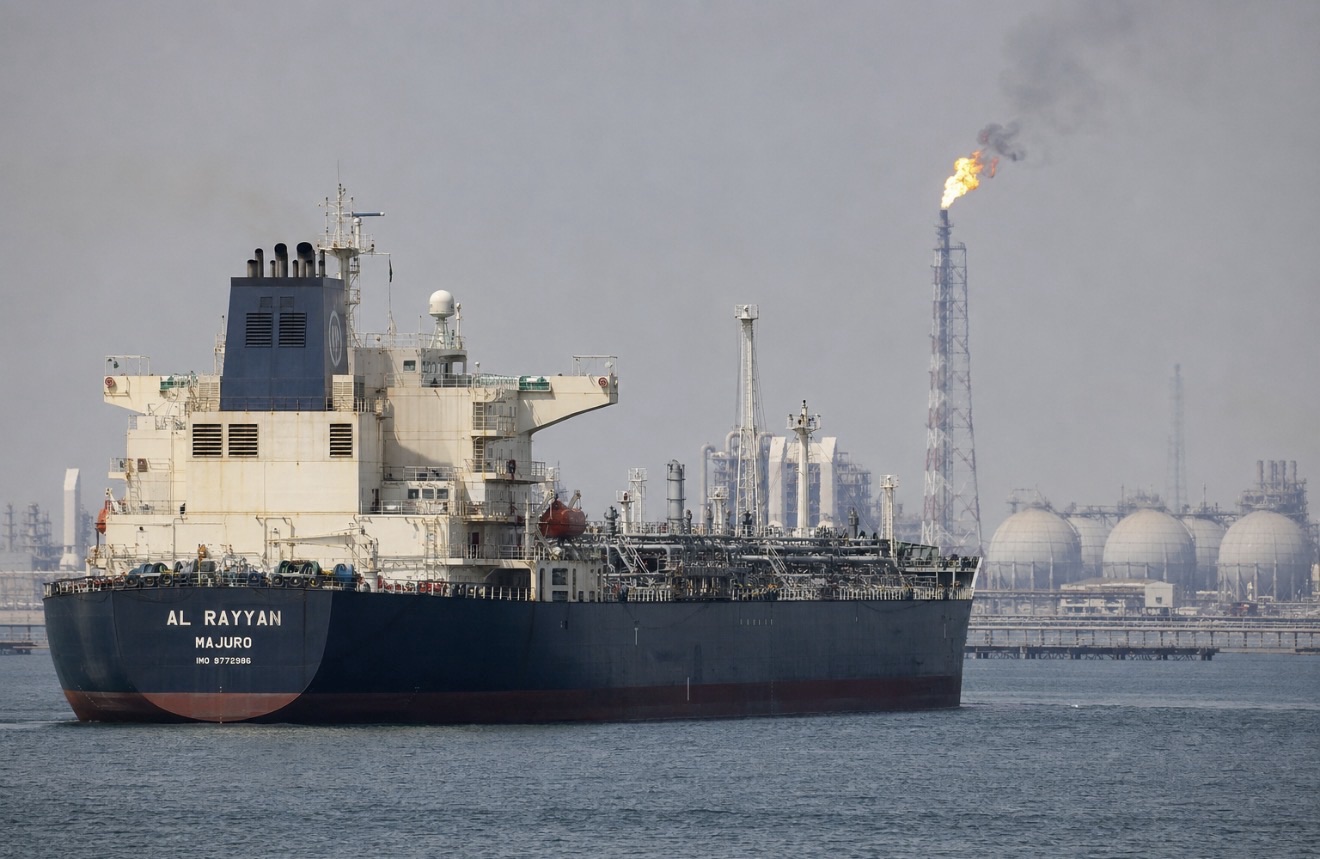
Qatar, the world’s third-largest LNG supplier, is now following a similar playbook. The Al Rayyan LNG carrier was spotted north of Muscat, Oman, on Monday after clearing Hormuz en route to top customer China, ship-tracking data reviewed by Bloomberg show. The vessel had stopped broadcasting its signal around May 22 while idling near QatarEnergy’s Ras Laffan export plant. A second Qatari tanker loaded in late March also transited the strait between Sunday and Monday. The covert runs follow the May 10 transit of the Al Kharaitiyat, Qatar’s first successful LNG shipment through Hormuz since the war began. QatarEnergy had previously declared force majeure on contracted deliveries after Iranian strikes forced Ras Laffan offline in March.
Antonia Syn, gas and LNG research analyst at Rystad Energy, said the divergence between the two producers reflects strategy as much as luck. “Adnoc hasn’t declared force majeure, unlike QatarEnergy,” she said, noting that invoking the clause “formally reduces commercial pressure to attempt risky transits, and Adnoc appears determined to avoid fully conceding that gulf LNG is stranded.” The Emirati carriers currently slipping through the strait are older vessels of the same generation as sister tankers scrapped last year, Syn added — a sign Adnoc is putting its most expendable hulls on the front line.
The volumes remain a fraction of pre-war flows. Kpler and satellite-analysis firm SynMax data show Adnoc exported at least 6 million barrels of crude on four tankers from inside-Gulf terminals in April, against pre-war shipments that ran several times that level. Pre-conflict, the Persian Gulf routinely sent three LNG cargoes a day through Hormuz. Saudi Aramco has rerouted shipments entirely through the Red Sea, while Iraq and Kuwait have either halted sales or slashed prices to lure buyers willing to absorb the risk.
War-risk premiums and freight rates have surged in tandem. VLCC rates from the Gulf to China jumped 24% in a single session earlier in the conflict to $1.67 per barrel, the steepest one-day move of the year, Kpler reported. Insurers have layered additional war-risk charges on every cargo, and electronic interference around Iran’s Bandar Abbas port — flagged by the U.S.-led Joint Maritime Information Centre — has disrupted navigation systems, pushing the Baltic and International Maritime Council to advise members to avoid the Arabian Gulf entirely where possible.
For buyers in China, India, Japan and Pakistan, the dark-transit cargoes represent the thin lifeline keeping Asian LNG and crude inventories from buckling. For Adnoc, they represent something more strategic: a demonstration that an OPEC defector with its own ships, its own refineries and its own appetite for risk can keep the lights on in customer countries when its larger neighbors cannot. The longer Hormuz stays effectively shut, the more that capability looks like a structural shift in Gulf energy power.
— JBizNews Desk
© 2026 JBizNews. All Rights Reserved. Reproduction or distribution without written permission is prohibited.