
 JBizNews
Charlie Munger’s $5,000 Baby Warning Echoes Louder as U.S. Childbirth Costs Now Top $20,000 Per Family
By JBizNews Desk
NEW YORK, May 24, 2026 — The late Charlie Munger’s blunt warning about the American healthcare system is aging uncomfortably well.
The longtime Berkshire Hathaway vice chairman argued years ago that if insured families still had to pay thousands of dollars just to have a baby, then they did not really have insurance at all. Today, the numbers suggest the problem has only grown worse.
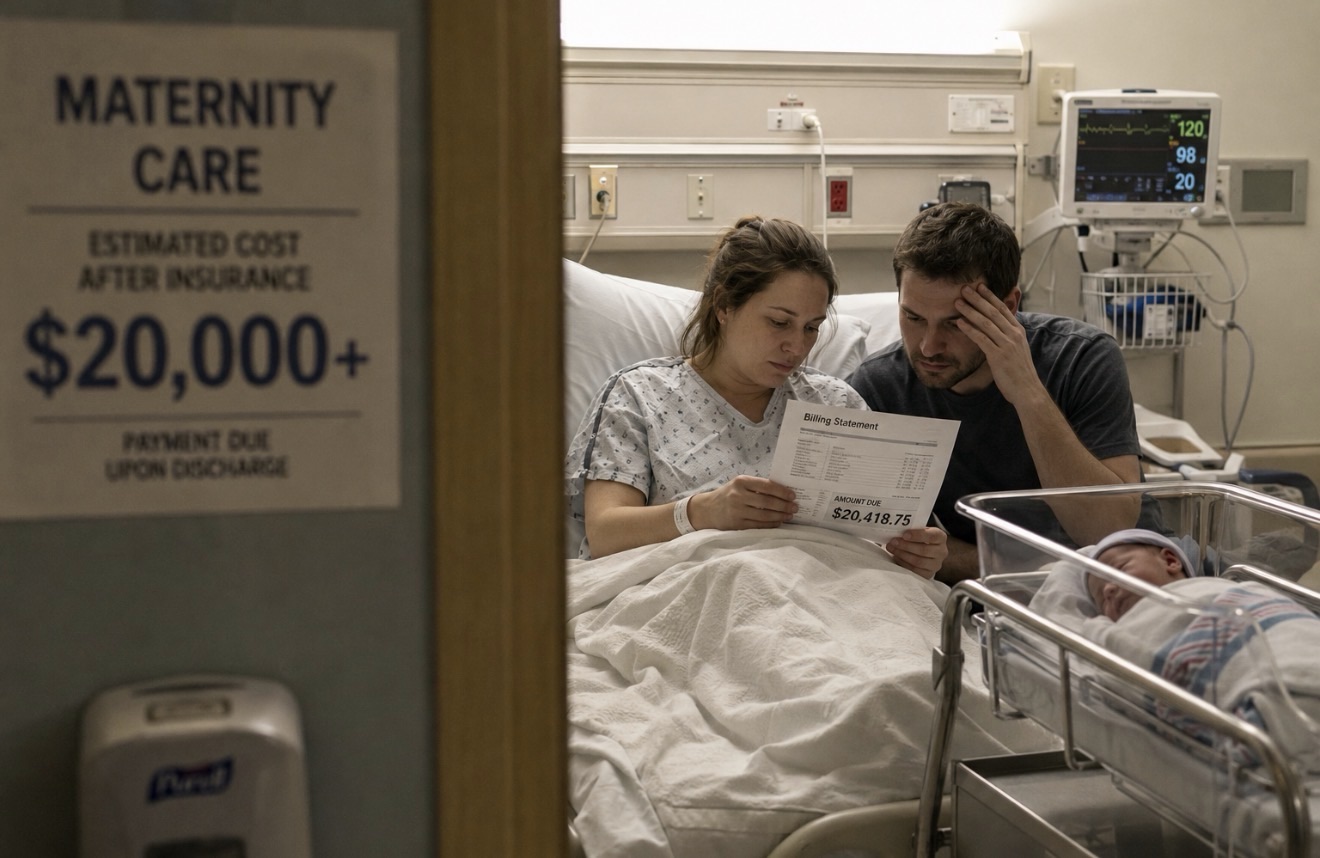
According to the Peterson-KFF Health System Tracker, using data from the Merative MarketScan Encounter Database, the average pregnancy, childbirth and postpartum care bill for women covered by employer-sponsored insurance now reaches $20,416, with families paying an average of $2,743 out of pocket even after insurance.
That does not include many of the costs that come afterward.
Newborn care adds another $5,820 in average medical spending during the baby’s first months, while cumulative healthcare costs for mother and child during the first two years now approach roughly $37,000 per family, according to KFF analysis. Families directly pay more than $4,200 of that amount themselves.
Munger saw the problem years ago.
In a widely discussed 2019 Yahoo Finance interview, Munger argued that a young couple facing a $5,000 deductible to deliver a baby effectively held an insurance product that failed its most basic purpose.
“If you have a policy with a huge deductible and you still can’t afford childbirth,” Munger said at the time, “what exactly are you insured for?”
The Berkshire executive went further, describing the broader U.S. healthcare system as something that had “grown like Topsy by accident” through decades of overlapping government intervention, private-sector inefficiency and distorted incentives.
His criticism was not ideological as much as economic.
Munger repeatedly pointed to Singapore as a model, arguing the country achieved better health outcomes at a fraction of America’s cost through mandatory medical savings accounts, universal coverage and strict cost controls. In his view, America’s healthcare system had become a hidden tax on workers, businesses and manufacturers that quietly weakened U.S. competitiveness.
The gap has only widened since then.
Federal out-of-pocket maximums under Affordable Care Act-compliant plans climbed to $9,200 for individuals and $18,400 for families in 2025. In 2026, those caps rise again to $10,600 and $21,200, according to federal guidance.
For many families, childbirth alone is enough to hit those limits.
The average allowed charge for a Cesarean-section birth now reaches roughly $28,998, compared with $15,712 for a vaginal delivery, according to Health Care Cost Institute and KFF data. About 32% of U.S. births now occur by C-section.
Many parents also get caught by timing.
Pregnancies often span two insurance-plan years, meaning families can hit deductibles and out-of-pocket maximums twice during a single pregnancy and delivery cycle.
The financial pressure arrives at exactly the moment household budgets are already under strain.
One parent often takes unpaid leave or reduced work hours while childcare, housing and basic living costs continue climbing. Industry analysts note that pregnancy remains the single most common cause of hospitalization for Americans covered by employer-sponsored insurance, making maternity costs one of the clearest stress points in the modern benefits system.
The issue has started attracting bipartisan political attention.
Lawmakers introduced legislation in 2025 that would eliminate cost-sharing for maternity care under employer-sponsored insurance plans, similar to how preventive services are currently treated under the Affordable Care Act. The proposal has not advanced, but its introduction reflected growing concern that high-deductible insurance models have shifted too much financial risk onto middle-class families.
Major corporations have spent years trying to address the problem themselves.
Companies including Walmart, JPMorgan Chase, and other large employers have experimented with direct healthcare contracting, bundled maternity-payment systems and employer-run clinics in an effort to reduce healthcare spending. So far, none have meaningfully changed the broader national cost trajectory.
U.S. healthcare spending surpassed 17% of GDP in 2024 — by far the highest level in the developed world — even as American life expectancy continues to lag behind many peer nations.
For Wall Street and corporate America, Munger’s argument still resonates because healthcare costs ripple through nearly every part of the economy.
Rising medical expenses feed directly into wage pressure, consumer spending patterns, government deficits, insurance premiums and employer labor costs. Families paying thousands of dollars out of pocket to have children are not just facing a healthcare issue — they are facing a broader affordability problem affecting everything from home purchases to retirement savings.
That was the core of Munger’s warning.
The question he posed in 2019 remains unresolved in 2026:
If insurance does not meaningfully protect families from the cost of having a child, what exactly is it protecting them from?
JBizNews Desk
© 2026 JBizNews. All Rights Reserved. Reproduction or distribution without written permission is prohibited.