
 Matzav
Report: US and Israel ‘Actively Working’ to Strip Jordan of Al-Aqsa Custodianship
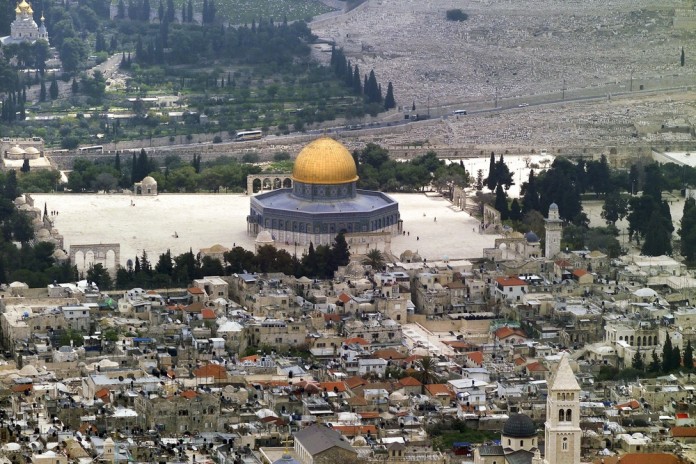
A report published by Middle East Eye claims that the United States and Israel are quietly advancing a dramatic proposal that would dismantle Jordan’s longstanding custodianship over the Al-Aqsa Mosque complex in Yerushalayim and replace it with a new governing structure more closely aligned with Israeli oversight and interests.
According to multiple American, Jordanian, Palestinian, Gulf Arab, and Western sources cited in the report, the initiative is being championed by President Donald Trump’s son-in-law Jared Kushner and U.S. Ambassador to Israel Mike Huckabee. The proposal would reportedly end the authority of the Jordanian-backed Islamic Waqf and establish a new Israeli-created administrative body that would redefine the Al-Aqsa compound as a “multi-faith centre.”
Officials familiar with the discussions told Middle East Eye that the proposed framework would permit Jews “equal access” to the site and officially authorize organized Jewish prayer there in large groups.
Under the alleged arrangement, Israel would also gain substantial influence over the appointment of imams, mosque administrators, and preachers, while additionally taking part in approving the content delivered in Friday sermons.
Two American officials told the outlet that Washington had already prepared a draft outlining its vision for the future of the compound. According to those sources, the Trump administration envisions transforming Al-Aqsa from an exclusively Muslim religious site into a tourist destination representing all three Abrahamic faiths.
A Western official and another source briefed by Jordanian authorities said one proposal under discussion would create a rotating oversight structure involving multiple Arab countries.
According to those sources, Bahrain, Egypt, Morocco, and the United Arab Emirates have already been briefed on the American initiative.
However, two Gulf Arab sources and another individual familiar with Jordanian deliberations said Saudi Arabia strongly opposes the proposal, viewing it as dangerously destabilizing.
Sources cited in the report said Israel first presented the concept to the Trump administration nearly ten years ago, but that the effort intensified after Huckabee assumed his diplomatic post last year. According to the report, Huckabee “repeatedly” urged Washington to move forward with the plan.
Huckabee, an Evangelical Christian and longtime supporter of Israel, has consistently backed Israeli settlement activity in disputed territories and has advocated for expanded Jewish rights on Har Habayis.
One source close to the Jordanian government told the outlet that “the Americans have been angry that the Jordanians cite their custodianship and raise complaints about Israeli actions at Al-Aqsa”.
The tensions have escalated in recent weeks. Earlier this month, Jordan’s parliament condemned Israeli efforts to seize Palestinian property and Islamic endowments in areas surrounding the mosque compound.
Sources interviewed by Middle East Eye said the proposal leaves unresolved questions surrounding Yerushalayim’s Christian holy sites.
Jordan’s royal family also serves as custodian of the Church of the Holy Sepulchre and the Church of the Ascension, and maintains veto power over the appointment of the Greek Orthodox Patriarch of Yerushalayim.
“This plan says nothing about the Christian sites, which raises a whole new set of concerns,” one of the sources said.
A Jordanian government official insisted that the kingdom’s position regarding Yerushalayim remains unchanged and emphasized that the Hashemite custodianship is recognized internationally through treaties and formal agreements, including the 1994 peace treaty between Israel and Jordan.
The official said Jordan continues coordinating with Palestinian, Arab, and international partners to preserve the sites’ “Arab, Islamic and Christian identity” and block attempts to alter the historical status quo.
For decades, the Al-Aqsa Mosque compound has operated under a carefully maintained arrangement preserving its standing as an exclusively Islamic holy site.
Following the Six-Day War in 1967, Israel and Jordan reached an understanding under which the Islamic Waqf would retain control over internal religious administration while Israel handled outside security responsibilities.
Although non-Muslims may visit during designated hours, Jewish prayer at the site is officially prohibited under the current arrangement.
For Jews, the area is revered as Har Habayis, the location where the two Batei Mikdash once stood — first the Beis Hamikdash built by Shlomo Hamelech and later the Second Temple destroyed by the Romans.
Jordanian and Palestinian officials reportedly believe the emerging proposal resembles the arrangement imposed at the Ibrahimi Mosque in Chevron after the 1994 massacre carried out by an Israeli settler.
Following that attack, Israel formally divided the site between Muslim and Jewish worshippers, allocating 63 percent for Jewish prayer and 37 percent for Muslims despite the location’s significance to all three major monotheistic faiths.
For Jordan’s Hashemite monarchy, control over Al-Aqsa is viewed as a central pillar of the kingdom’s legitimacy and standing in the Muslim world.
The Hashemites trace their custodianship over Yerushalayim’s holy sites back to 1924 during the British Mandate period following the collapse of the Ottoman Empire and the end of the Islamic Caliphate.
After losing control of Mecca and Medina to the Saudi royal family, the Hashemites were granted responsibility for Muslim and Christian holy sites in Yerushalayim.
Jordan’s role was later formally acknowledged in its peace treaty with Israel, which recognized Amman’s “special role” concerning Yerushalayim’s Islamic holy places.
Still, Jordanian and Palestinian leaders have long argued that Israeli governments and nationalist activist groups have steadily weakened that arrangement over time.
Repeated Israeli police operations inside the compound, growing visits by nationalist Jewish activists, and calls by Israeli ministers to allow Jewish prayer at the site have fueled accusations that Israel is gradually reshaping the status quo.
Waqf officials have also accused Israel of severely restricting maintenance and repair work at the compound while imposing increasing limitations on Muslim worshippers.
Mustafa Abu Sway, deputy chairman of the Waqf council, declined to directly address Jordan’s diminishing influence but described the Hashemite role as “a cornerstone for stability in the region”.
He added that Palestinians regard the custodianship “strategically as a lifeline” and said Jordan has consistently defended the historic arrangement at international institutions such as UNESCO.
“The Hashemite Custodianship is a cornerstone for stability in the region, undermining it is tantamount to undermining the very principles for peace”.
The Yerushalayim Governorate said it had not been officially informed about such a proposal but declared that it “reject[s] it entirely”.
Officials there warned of what they described as a “dangerous escalation” in Israeli interference with Waqf operations, including restrictions placed on guards and employees and increasing visits by Jewish activists.
Two Gulf Arab sources told the outlet that Jordan would likely seek broader regional support to counter the reported American-Israeli initiative.
Despite Jordan’s growing diplomatic ties with the UAE, the sources said Saudi Arabia would almost certainly oppose any move that weakens the Hashemite custodianship.
“Saudi Arabia fully understands that if any moves are taken against the Hashemite custodianship, then that would inflame the entire region,” one Gulf Arab source said.
Another Gulf Arab source described the custodianship as “a pillar of regional stability”, adding: “The Saudis may have disagreements with Jordan on some issues, but on Yerushalayim and Al-Aqsa they understand the consequences of dismantling the existing arrangement”.
The report also said Jordan’s Crown Prince Hussein bin Abdullah has developed increasingly close ties with Saudi Crown Prince Mohammed bin Salman in recent years, particularly after several Arab states normalized relations with Israel.
Still, the sources acknowledged uncertainty about how Saudi Arabia would react if the UAE or Bahrain publicly endorsed the proposal.
Since signing the Abraham Accords in 2020, both Bahrain and the UAE have dramatically expanded political, economic, and security cooperation with Israel despite growing outrage across the Arab world over developments in Yerushalayim and Gaza.
The UAE in particular has become Israel’s closest Arab ally, broadening ties in trade, defense, energy, and technology.
Officials cited in the report expressed concern that Emirati-backed interfaith initiatives promoting “multi-faith coexistence” could eventually be used to justify changes at Al-Aqsa.
In 2023, the UAE opened a major interfaith center housing a church, synagogue, and mosque together on one campus.
Bahrain has likewise maintained close cooperation with Israel and has defended those ties as strategically necessary in confronting Iran.
According to the report, Bahraini officials have generally refrained from publicly criticizing Israeli policy in Yerushalayim, increasing fears among Palestinian and Jordanian officials that Manama may ultimately support changes at the holy site.
“They [UAE and Bahrain] understand how explosive this issue is in the Arab and Muslim world,” one of the sources said.
“Given that they are closely aligned with Israel, they should be cautious about publicly supporting changes to the status quo,” they added.
Middle East Eye said it contacted the foreign ministries of Bahrain, Egypt, Morocco, Saudi Arabia, and the UAE but received no response before publication.
After the article appeared, an American official issued a brief denial rejecting the report outright and calling the claims that Washington was working to remove Jordan’s custodianship “totally false.”
{Matzav.com}