
 JBizNews
Trump Orders Federal Reserve to Open Payment Rails to Fintechs and Crypto Firms, Challenging Bank Monopoly
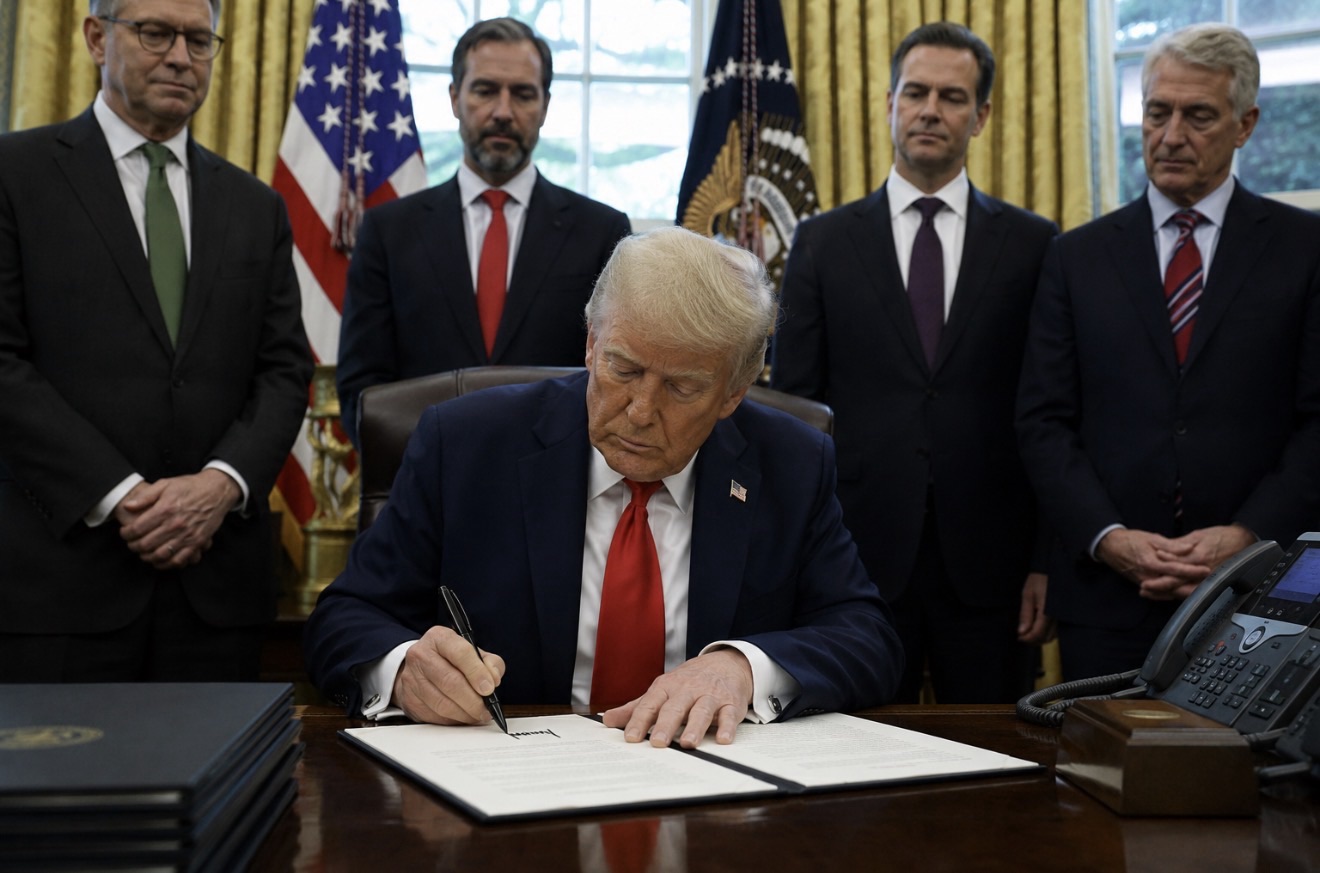
President Donald Trump signed an executive order before the Memorial Day weekend titled “Integrating Financial Technology Innovation Into Regulatory Frameworks,” directing the Federal Reserve and other federal financial regulators to review and ease rules that have long kept fintech companies and cryptocurrency firms from gaining direct access to the Federal Reserve’s payment system. According to the official White House fact sheet released the same evening, the order is intended to “streamline regulatory processes, reduce unnecessary barriers to entry, and encourage collaboration between fintech firms, federally regulated financial institutions, and Federal financial regulators.”
“The Federal Government must update regulations to allow integration of digital assets and innovative technology into traditional financial services and payment systems,” Trump said in the executive order. The directive specifically targets what the order calls “overly burdensome and fragmented regulations and supervisory practices that form barriers to entry and primarily benefit incumbent financial services firms” — language that effectively puts traditional banks directly in the administration’s crosshairs.
The executive order establishes two parallel review processes with firm deadlines. Federal financial regulators — including the Consumer Financial Protection Bureau, Commodity Futures Trading Commission, Federal Deposit Insurance Corporation, Office of the Comptroller of the Currency, National Credit Union Administration, and Securities and Exchange Commission — must conduct a review within 90 days, by August 17, 2026, to identify regulations, supervisory practices, guidance, and application procedures that “unduly impede fintech firms” from partnering with federally regulated institutions or obtaining bank charters themselves. Within 180 days, by November 15, 2026, those agencies must take concrete action based on their findings.
The order separately directs the Federal Reserve Board to complete its own review within 120 days examining whether “covered firms” — including uninsured depository institutions, fintech firms, stablecoin issuers, and cryptocurrency companies — should gain broader access to Federal Reserve payment accounts and settlement services. The Fed must also evaluate the legal pathways for expanding such access “to the extent permitted by law, subject to appropriate risk management requirements.”
At the center of the battle is something known inside the industry as a Federal Reserve master account. A master account gives a financial institution direct access to the Fedwire settlement network and the broader Federal Reserve payment system. Traditional banks use these accounts to move money instantly across the U.S. financial system. Without one, fintech and crypto firms must route transactions through partner banks, adding delays, fees, and dependence on incumbents.
For decades, those accounts have effectively been reserved for federally chartered banks. That wall has started to crack. In March 2026, the Federal Reserve Bank of Kansas City approved a limited-purpose master account for Payward, the parent company of crypto exchange Kraken, marking one of the first major openings of Federal Reserve payment access to a crypto-related entity. Trump’s order now accelerates the broader review process and forces regulators to publicly justify any future denials.
The implications for the fintech and crypto industries are enormous. Direct Federal Reserve access could dramatically reduce payment costs and settlement friction for stablecoin issuers, tokenization platforms, digital asset custodians, and instant-payment providers. Companies positioned to benefit include Circle Internet Group, issuer of the USDC stablecoin; Coinbase Global; Kraken; Anchorage Digital; Paxos; Fidelity Digital Assets; and fintech firms including Block, PayPal Holdings, Stripe, Plaid, Chime Financial, SoFi Technologies, Robinhood Markets, and Brex.
For Wall Street’s biggest banks, the order represents a direct competitive threat. JPMorgan Chase, Bank of America, Wells Fargo, Citigroup, U.S. Bancorp, and PNC Financial Services have long benefited from privileged access to the Federal Reserve’s payment rails. Lowering those barriers would force banks to compete more aggressively on fees, speed, technology, and customer experience against well-funded fintech challengers. Community and regional banks that generate revenue from correspondent banking relationships could feel even greater pressure.
For consumers, the long-term impact could be meaningful. If stablecoin issuers receive direct Federal Reserve settlement access, dollar-backed digital tokens could become faster and cheaper for online commerce, international transfers, and remittances. If fintech firms like Chime, Cash App, and SoFi gain easier access to banking infrastructure or charters, consumers could see more competitive interest rates, lower overdraft fees, and faster movement of money between accounts, brokerages, and payment apps.
The political backdrop is equally important. Trump’s administration has consistently embraced a fintech- and crypto-friendly stance since returning to office, sharply reversing what many in the industry described as the Biden administration’s “Operation Choke Point 2.0” approach toward crypto banking access. Treasury Secretary Scott Bessent and SEC Chairman Paul Atkins have both publicly supported greater fintech integration into the banking system.
Capital Alpha analyst Ian Katz wrote in a research note that “we don’t expect the order will be ignored by incoming Fed Chair Kevin Warsh,” referring to the former Federal Reserve governor widely viewed as the leading candidate to replace Jerome Powell, whose term expires on May 15, 2026.
Trump signed a second executive order the same evening directing regulators to strengthen Bank Secrecy Act enforcement against undocumented workers using unregistered payment services and peer-to-peer platforms to bypass tax reporting requirements. Together, the two orders outline a broader strategy: open the financial system to legitimate digital innovation while tightening enforcement against off-the-books financial activity.
Critics immediately raised concerns about Federal Reserve independence. Fed officials have historically resisted political pressure over master account access, arguing that opening payment rails to uninsured or lightly regulated firms creates financial stability and anti-money-laundering risks. But the administration’s hard deadlines now force regulators to publicly defend any refusal to broaden access.
The crypto industry reacted enthusiastically. Cardano ecosystem executive Bipananda Dadybayo said firms focused on tokenized treasuries, blockchain settlement systems, and digital payments could “benefit disproportionately” if the order leads to broader integration with the Federal Reserve system.
“For most of crypto’s history, the industry built systems outside traditional financial infrastructure,” Dadybayo said. “This potentially marks the beginning of a different phase — from crypto outside the system to crypto inside the rails.”
The move also ties directly into the larger global battle over digital money. As China, India, Brazil, and other BRICS countries push forward with central bank digital currencies designed partly to reduce dependence on the dollar, the Trump administration is making a different bet: that private-sector dollar stablecoins and fintech innovation can extend America’s monetary dominance into the digital age without creating a U.S. government-controlled digital currency.
The executive order does not immediately grant any fintech or crypto company new access. But it starts the clock. By August 17, regulators must report findings. By November 15, they must act. And by mid-September, the Federal Reserve must complete its own review.
For the first time in generations, the American financial system’s definition of who gets access to the core payment infrastructure — and who gets to compete with banks themselves — is formally being reconsidered.
— JBizNews Desk
© 2026 JBizNews. All Rights Reserved. Reproduction or distribution without written permission is prohibited.