
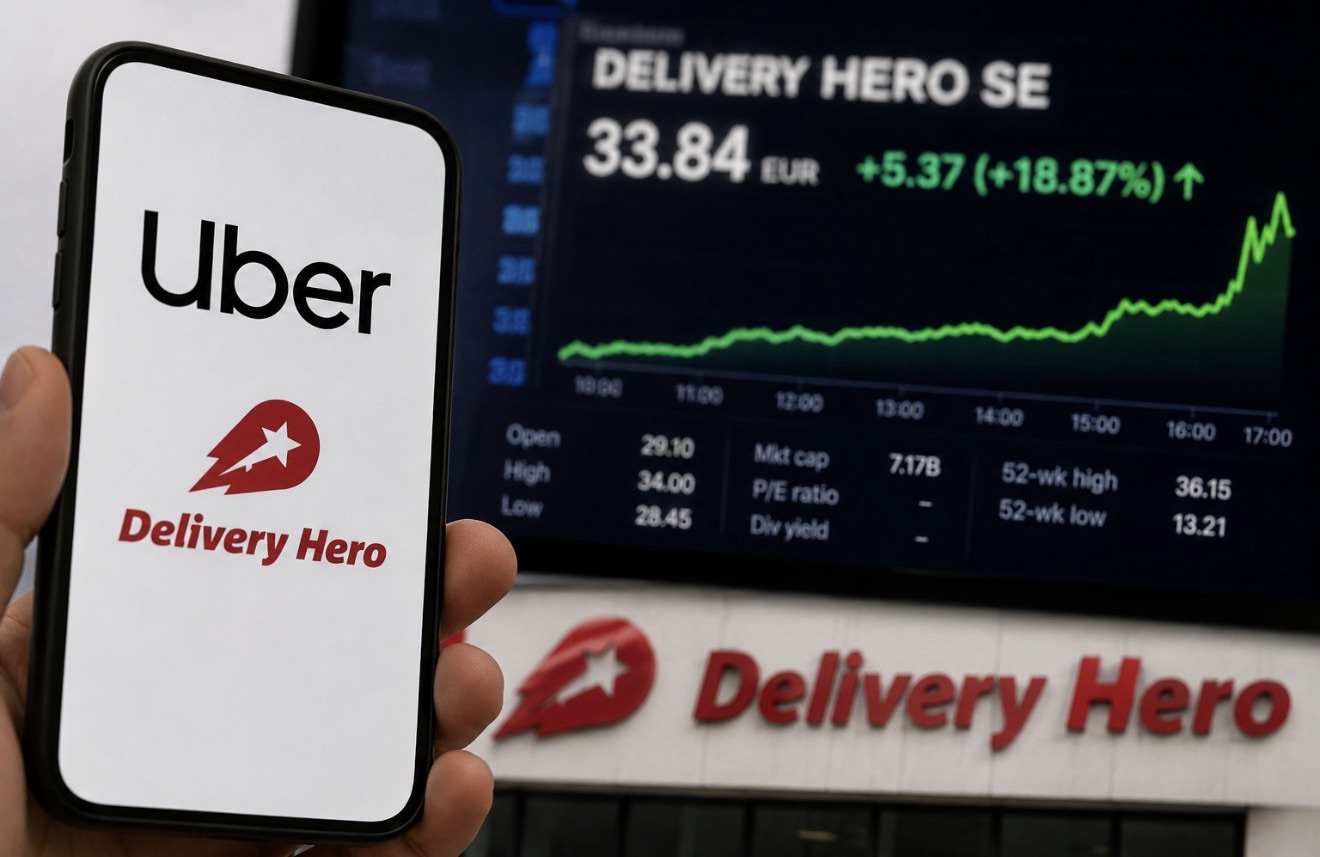

Shares of Delivery Hero SE surged Tuesday after reports emerged that Uber Technologies Inc. is exploring a potential takeover of the German food-delivery giant, a move that could reshape the global online delivery industry and trigger one of the largest consolidation deals the sector has seen since the pandemic-era boom.
Delivery Hero shares jumped sharply in Frankfurt trading following the reports, adding billions of dollars in market value as investors reacted to speculation that Uber may be positioning itself to expand deeper into Europe, the Middle East, and Asia through a large-scale acquisition.
The reports come at a pivotal moment for the global delivery sector, where slowing growth, rising labor costs, and investor pressure for profitability have intensified consolidation expectations across the industry.
Delivery Hero operates food-delivery platforms in more than 70 countries and maintains particularly strong positions across Europe, the Middle East, Latin America, and parts of Asia. The company also holds stakes in several regional delivery businesses and quick-commerce operations.
Uber, meanwhile, has spent years aggressively expanding beyond ride-sharing into food delivery, grocery delivery, freight logistics, and broader local commerce services through its Uber Eats platform.
Industry analysts say a combination between Uber and Delivery Hero would dramatically expand Uber’s international delivery footprint while strengthening its position against competitors including DoorDash, Just Eat Takeaway, Meituan, Deliveroo, and Prosus-backed food delivery businesses.
The strategic logic behind such a transaction is increasingly clear.
Global food-delivery growth has slowed materially from the explosive levels seen during the COVID-19 pandemic, forcing companies to focus more heavily on scale, logistics efficiency, and profitability rather than pure customer acquisition. Investors have increasingly pushed management teams to reduce subsidies, cut marketing costs, and improve margins after years of aggressive expansion spending.
For Uber, acquiring Delivery Hero could provide instant scale in markets where Uber Eats remains weaker or fragmented, particularly across continental Europe and emerging international markets.
The potential deal would also likely attract heavy regulatory scrutiny.
Competition authorities in the European Union, the United Kingdom, and multiple international jurisdictions have already taken a far more aggressive stance toward technology mergers and platform consolidation over the past two years. Any large-scale Uber acquisition involving major delivery-market overlaps would likely face lengthy antitrust review processes.
Investors nevertheless reacted positively to the reports, viewing consolidation as one of the clearest paths toward stronger profitability in a sector that continues struggling with thin margins and intense promotional competition.
Delivery Hero has faced mounting pressure in recent years to improve financial performance after aggressive expansion into rapid grocery delivery and quick-commerce operations weighed heavily on earnings. The company has since pulled back from several markets and shifted more aggressively toward cash-flow improvement.
Uber Chief Executive Dara Khosrowshahi has repeatedly emphasized that the company is prioritizing profitable growth and operational scale following years of investor concern over cash burn and subsidy-heavy expansion strategies.
The broader market backdrop is also fueling takeover speculation.
Technology and platform companies globally are increasingly exploring acquisitions as lower interest-rate expectations, stabilizing capital markets, and pressure to accelerate growth encourage renewed merger activity.
For Europe specifically, a potential Uber-Delivery Hero transaction would represent one of the largest technology consolidation efforts in years and could significantly reshape the competitive balance across digital commerce, logistics, and local delivery infrastructure.
Neither Uber nor Delivery Hero publicly confirmed takeover discussions Tuesday.
Still, the sharp market reaction highlights how strongly investors believe further consolidation across the global food-delivery sector has become almost inevitable.
After years of expansion fueled by cheap capital and rapid pandemic growth, the industry is increasingly entering a new phase defined by scale, efficiency, and survival.
JBizNews Desk — Europe
© 2026 JBizNews. All Rights Reserved. Reproduction or distribution without written permission is prohibited.