
 Vos Iz Neias
Degel HaTorah Meet With Eizenkot, Discuss Cooperation On Future Draft Law
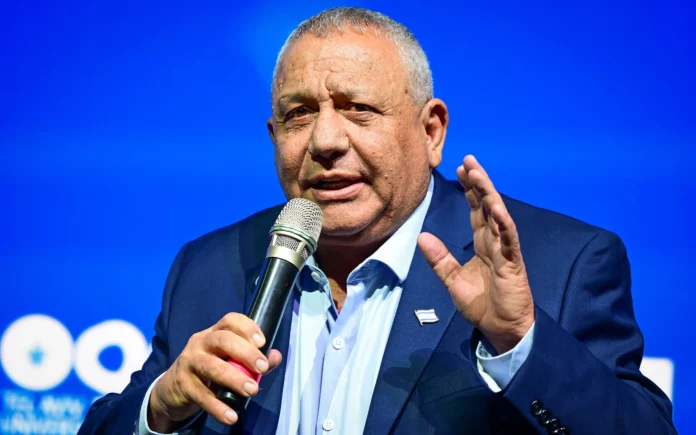
JERUSALEM (VINnews) — Rabbi Dov Landau, the president of the Council of Torah Sages of Degel HaTorah, announced two weeks ago that there was “no longer any talk about blocs,” hinting that the charedim will not automatically join the right-wing parties. Rabbi Landau has now decided to put that into practical action. After informing Prime Minister Benjamin Netanyahu that the charedim no longer intend to support a draft law, the party’s Knesset members were instructed to examine the possibility of cooperating with Gadi Eisenkot.
The goal is to explore with him the possibility of presenting an agreed-upon military draft framework in the next Knesset in exchange for political cooperation with a government headed by him, or one in which he would have significant influence over the issue of charedi enlistment. According to their assessment, such cooperation may be possible because the enlistment framework proposed by Eisenkot is considered more moderate than those of the other opposition parties and not far from the current draft law.
This represents an attempt to examine cooperation between a charedi party and one of the opposition bloc parties for the first time since 2015, when the right-wing bloc was formed and functioned without fractures or defections, including during periods when no government could be formed, leading to repeated elections, and even when the parties jointly sat in opposition during the Bennett-led government in 2021. Throughout that time, the charedi parties remained loyal to Netanyahu and did not negotiate joining any alternative coalition.
Now, however, the most stable political alignment established in Israel in recent years is facing a significant test. Even within the charedi parties, it is believed that if election results allow for the recreation of a right-wing/Haredi coalition, that would remain their first preference, provided they receive guarantees that a draft law would pass early in the next term, perhaps even before the government is sworn in as a condition for forming it.
However, if there is no decisive result or if the center-left bloc has enough seats to form a government, the charedi parties may consider abandoning the right-wing bloc and joining the new coalition in exchange for passage of a draft law.
Sources within the charedi factions explained that Netanyahu failed to recognize in time the importance of the draft law issue to the ultra-Orthodox public. Beyond all other considerations, including traditionally important issues for the Haredi community such as preserving Jewish tradition, Shabbat, and marriage according to halacha, the draft issue has become the most urgent matter on the agenda.
Contributing to this sense of urgency, they say, has been the conduct of the Attorney General and the High Court of Justice, whose actions have increasingly restricted the world of yeshiva students, creating real distress and upheaval within the charedi public. Therefore, their primary mission will be to resolve the crisis before any other political consideration.
In Degel HaTorah, they emphasize that Eisenkot, while, like the rest of the opposition, advocating for a significant increase in charedi enlistment, speaks in a more moderate tone and is far less confrontational toward the sector than others in his political camp.
Recently, Eisenkot clarified that, from his perspective, the charedi factions could be partners in a government led by him, and that he does not boycott them. This contrasts with statements made by leaders of parties such as B’Yachad (Bennett and Lapid), Yisrael Beiteinu and The Democrats, who have expressed the opposite position.